Algeria
 Egypt
 Libya
 Morocco
 Sudan
 Tunisia
 Benin
 Burkina Faso
 Cabo Verde
 Côte d'Ivoire
 Ghana
 Guinea
 Guinea-Bissau
 Liberia
 Mali
 Mauritania
 Niger
 Nigeria
 Senegal
 Sierra Leone
 The Gambia
 Togo
 Central African Republic
 Chad
 DR Congo
 Equatorial Guinea
 Gabon
 Republic of the Congo
 São Tomé and Príncipe
 Burundi
 Comoros
 Djibouti
 Eritrea
 Ethiopia
 Kenya
 Madagascar
 Malawi
 Mauritius
 Mozambique
 Rwanda
 Seychelles
 Somalia
 South Sudan
 Tanzania
 Uganda
 Angola
 Botswana
 Eswatini
 Lesotho
 Namibia
 South Africa
 Zambia
 Zimbabwe
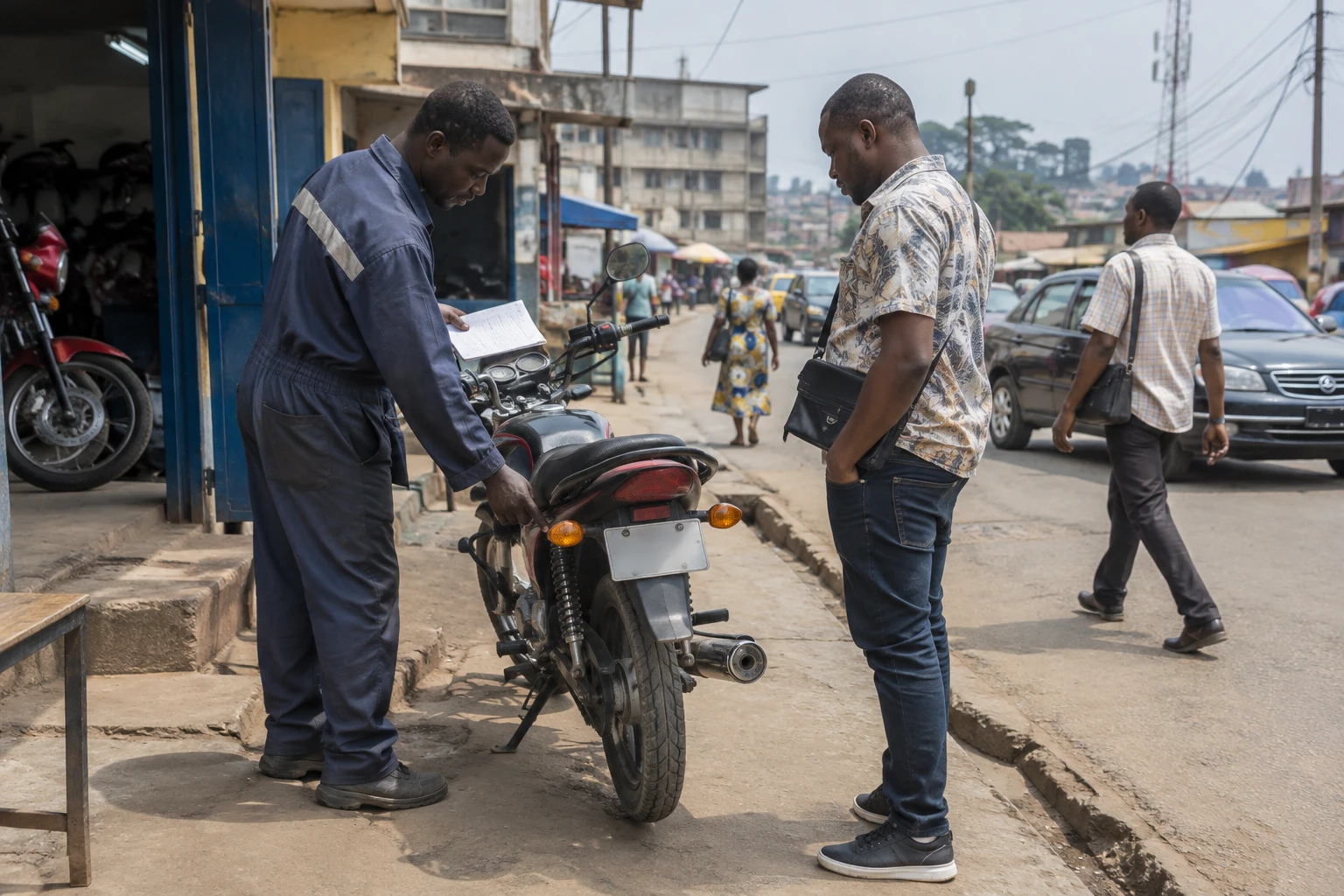
In Yaoundé, a motorbike without a number plate can become impossible to link to its owner after an offence. The Cameroonian government therefore wants to move checks further upstream: to the point of sale, before the two-wheeler even takes to the road.
Identifying bikes before their first ride
On 6 October 2023, the Minister of Territorial Administration, Paul Atanga Nji, called on sellers and importers to register motorbikes and identify buyers before delivery. He warned that shops flouting the instruction could be closed and those responsible prosecuted. The announcement was made at a meeting in Yaoundé with industry stakeholders and local authorities. These details were reported by Cameroon Tribune and Actu Cameroun.
The measure is intended to make vehicles and their owners traceable. The ministry has linked this difficulty to investigations into crimes committed using motorbikes. In Douala, the authorities seized more than 1,200 motorbikes during checks; more than 1,000 were reportedly still impounded because their owners could not be identified, according to figures reported by Cameroon Tribune. This local tally illustrates an administrative problem, but does not show that all unregistered motorbikes are used for criminal activities.
The minister also presented registration at the point of sale as a responsibility for traders. In other words, the state no longer wants to rely solely on roadside checks or on identifying riders already at work. The instruction starts with the seller and buyer, at the moment the motorbike changes hands.
Public safety and livelihoods
For people targeted in assaults, identification can make it easier to report a vehicle and help investigators. But a number plate alone cannot prevent an assault, nor does it guarantee that the person recorded as the owner is always the one riding. The practical impact will therefore depend on the quality of the records, how regularly they are updated and whether services can consult them quickly.
The rule also affects workers and traders whose incomes depend on selling or using two-wheelers every day. In the original account, a Yaoundé seller said he had seen two customers abandon their purchases after the announcement. This isolated testimony cannot measure the impact on the market, but it points to a practical question: who will handle the registration procedures and costs before the sale?
This question is particularly important for informal transport. Motorcycle taxis meet travel needs in neighbourhoods sometimes far from routes served by public transport. An identification policy can clarify responsibilities and improve vehicle tracking. Conversely, costly, slow or unevenly enforced procedures risk pushing some riders outside formal systems without improving safety.
The Ministry of Transport, administrative authorities, municipalities, sellers and unions therefore have distinct roles. In the account provided, riders’ organisations called for a database shared with municipal authorities to link motorbikes to their owners and riders. This proposal points to a central issue: a number plate identifies a vehicle, while a coherent register must make it possible to verify who is responsible for it.
A coordination challenge across Cameroon
In Yaoundé, Cameroon’s capital, as in Douala, enforcement will depend on coordination between national services and local authorities. The two cities account for a significant share of travel and motorcycle-taxi activity. However, the measure announced in Yaoundé concerns a problem that extends beyond the capital: motorbikes travel between municipalities and regions, while records and enforcement practices can vary.
The authorities have also referred to assaults attributed to motorcycle-taxi riders. These allegations must remain attributed: the profession includes workers with varied backgrounds, and the absence of a number plate is not enough to establish criminal liability. A balanced response must make investigations easier without treating all riders as criminals.
The precedent of motorbikes seized in Douala also shows the limits of a policy based mainly on raids: vehicles can remain impounded if their owners cannot be found. Identification at the point of sale is intended to prevent this impasse. But its effectiveness can only be assessed using data on registrations, checks, penalties and changes in offences, broken down by city and over time.
What needs to be measured
For Cameroonians, the challenge is twofold: reducing the anonymity of vehicles used in offences while keeping transport accessible. Implementation will need to specify the procedures, timeframes, any fees and how motorbikes already on the road will be treated. Without this information, sellers and riders risk being subject to an obligation whose requirements remain unclear.
At regional level, the issue concerns urban mobility and safety in Central Africa, where daily journeys often rely on several modes of transport, both formal and informal. Cameroon is a member of CEMAC, the Economic and Monetary Community of Central Africa; however, this announcement primarily concerns national enforcement. Its regional relevance lies above all in the questions it raises: how can data be shared, riders’ incomes protected and investigations made more effective without criminalising an entire profession?
The measure’s success will therefore not be judged solely by the number of number plates issued. It will also be necessary to establish whether the records are reliable, checks remain transparent and assaults decline without excluding road workers. This combination, more than a standalone ban on selling an unregistered motorbike, will determine the real impact of the decision in Yaoundé and across the rest of the country.