
 Algeria
 Egypt
 Libya
 Morocco
 Sudan
 Tunisia
 Benin
 Burkina Faso
 Cabo Verde
 Côte d'Ivoire
 Ghana
 Guinea
 Guinea-Bissau
 Liberia
 Mali
 Mauritania
 Niger
 Nigeria
 Senegal
 Sierra Leone
 The Gambia
 Togo
 Central African Republic
 Chad
 DR Congo
 Equatorial Guinea
 Gabon
 Republic of the Congo
 São Tomé and Príncipe
 Burundi
 Comoros
 Djibouti
 Eritrea
 Ethiopia
 Kenya
 Madagascar
 Malawi
 Mauritius
 Mozambique
 Rwanda
 Seychelles
 Somalia
 South Sudan
 Tanzania
 Uganda
 Angola
 Botswana
 Eswatini
 Lesotho
 Namibia
 South Africa
 Zambia
 Zimbabwe
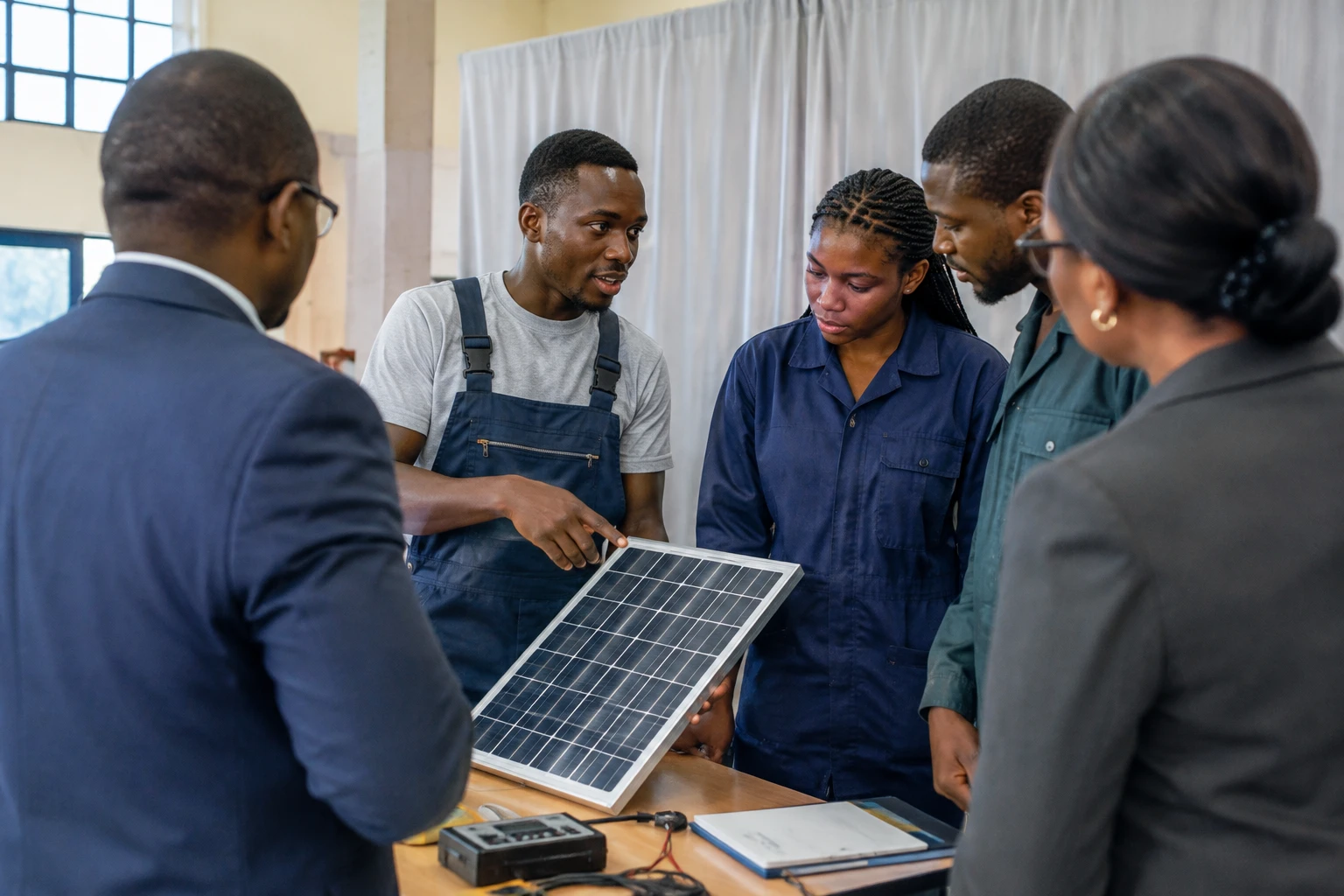
Training a solar installer, a biogas operator or a recycling specialist is not enough to guarantee a job. There must also be businesses able to hire, opportunities and decent incomes. This is the equation Cameroon is seeking to solve by developing jobs linked to the ecological transition.
A national ambition, with a deadline to clarify
In Yaoundé, the second Green Jobs Week took place from 16 to 20 October 2026. The Ministry of Employment and Vocational Training (MINEFOP) presented the Green Jobs Promotion Programme in Cameroon (PPEVC), launched to develop economic activities compatible with environmental protection.
The figure put forward is 120,000 jobs to be created or “greened” — that is, made more sustainable — notably by improving skills and professional practices. But the deadline varies across the documents consulted. The ministry officially sets a target for 2030, while reports on Green Jobs Week refer to the 2025-2029 period. This discrepancy needs to be clarified before results can be assessed. The programme framework published by MINEFOP sets the target at 2030.
The authorities identified six priority sectors: solar energy, plastic waste recycling, organic farming and cocoa, stabilised-earth construction, ecotourism and green digital technology. Eleven pilot projects are intended to support the roll-out. More than CFAF 21.15 billion has been announced for the programme, although the public information consulted here does not detail disbursements already made or their allocation by project.
Training must lead to real activities
Vocational training is the first lever being highlighted. The minister summed up the challenge as follows: “there can be no sustainable green jobs without appropriate skills”. In this context, 5,000 of the 25,000 training places announced for the ORFEV-JEUNES initiative are earmarked for green jobs, particularly in renewable energy and biogas. A report on Green Jobs Week gives these figures and reports the announcement of 2026-2027 training under the “One young person, one trade, one job” initiative.
According to the roadmap presented, 2026 and 2027 are to be used to test the pilot projects, with a target of 60,000 jobs, before a nationwide expansion planned from 2028. This timetable concentrates the first benefits in areas where projects are actually established. The effects will therefore not necessarily be the same for young people in Yaoundé or Douala, rural producers, small businesses and workers in the informal economy.
The programme will also need to define what it means by “decent work”. The number of jobs alone does not show whether they are stable, properly paid, protected against occupational risks or accessible to women and young people far from training centres. The selection of sectors and beneficiaries will affect how opportunities are distributed.
A labour market dominated by informality
Available data highlight the scale of the challenge. The Employment and Informal Sector Survey conducted in 2021 by the National Institute of Statistics (INS) estimates that 86.6% of jobs are in the informal sector. The employment rate for young people aged 15 to 34 stood at 39.3%, with a marked gap between men (47.2%) and women (31.3%). These national findings, published in 2023, show that the challenge goes beyond simply creating jobs in new sectors. The INS employment survey findings also distinguish between urban and rural areas.
Among the non-agricultural informal production units studied, only six workers in 100 were employees and 78.3% were self-employed. Of those surveyed, 2.1% had a written contract, compared with 50.2% who had a verbal contract. These figures do not describe every job in Cameroon, but they show why quality and formalisation targets matter as much as the announced total. The INS report on the informal sector sets out these working conditions.
Territorial differences are significant. The INS survey indicates that informal agricultural work accounts for a larger share in rural areas, while non-agricultural activities are more concentrated in cities. Training in solar energy or recycling will therefore deliver results only if it meets local needs, equipment is available, and young people can access finance and markets.
The test: turning announcements into tracked jobs
The PPEVC is part of the National Development Strategy 2020-2030, which aims, among other things, to transform the economy. Regionally, Cameroon is a member of CEMAC, the Central African Economic and Monetary Community. Activities linked to energy, waste, agriculture and natural resources sometimes extend beyond national borders. However, the announcements made during Green Jobs Week relate first and foremost to a Cameroonian programme; they do not in themselves amount to a common CEMAC policy.
The next step will be to verify implementation: the number of young people actually trained, their transition into jobs or viable activities, the distribution across regions and women’s access to these sectors. It will also be necessary to distinguish newly created jobs from existing jobs that have simply been reclassified. Without these indicators, the 120,000 jobs will remain a target that is difficult to compare with actual results.
The second Green Jobs Week ended on 20 October 2026. The programme opens up prospects in practical occupations, but its impact will now depend on the projects actually funded, the businesses that hire and the quality of the jobs offered. The discrepancy between the 2029 deadline reported at the event and the 2030 date published by the ministry also remains to be resolved.



