Algeria
 Egypt
 Libya
 Morocco
 Sudan
 Tunisia
 Benin
 Burkina Faso
 Cabo Verde
 Côte d'Ivoire
 Ghana
 Guinea
 Guinea-Bissau
 Liberia
 Mali
 Mauritania
 Niger
 Nigeria
 Senegal
 Sierra Leone
 The Gambia
 Togo
 Cameroon
 Central African Republic
 Chad
 DR Congo
 Equatorial Guinea
 Gabon
 Republic of the Congo
 São Tomé and Príncipe
 Comoros
 Djibouti
 Eritrea
 Ethiopia
 Kenya
 Madagascar
 Malawi
 Mauritius
 Mozambique
 Rwanda
 Seychelles
 Somalia
 South Sudan
 Tanzania
 Uganda
 Angola
 Botswana
 Eswatini
 Lesotho
 Namibia
 South Africa
 Zambia
 Zimbabwe
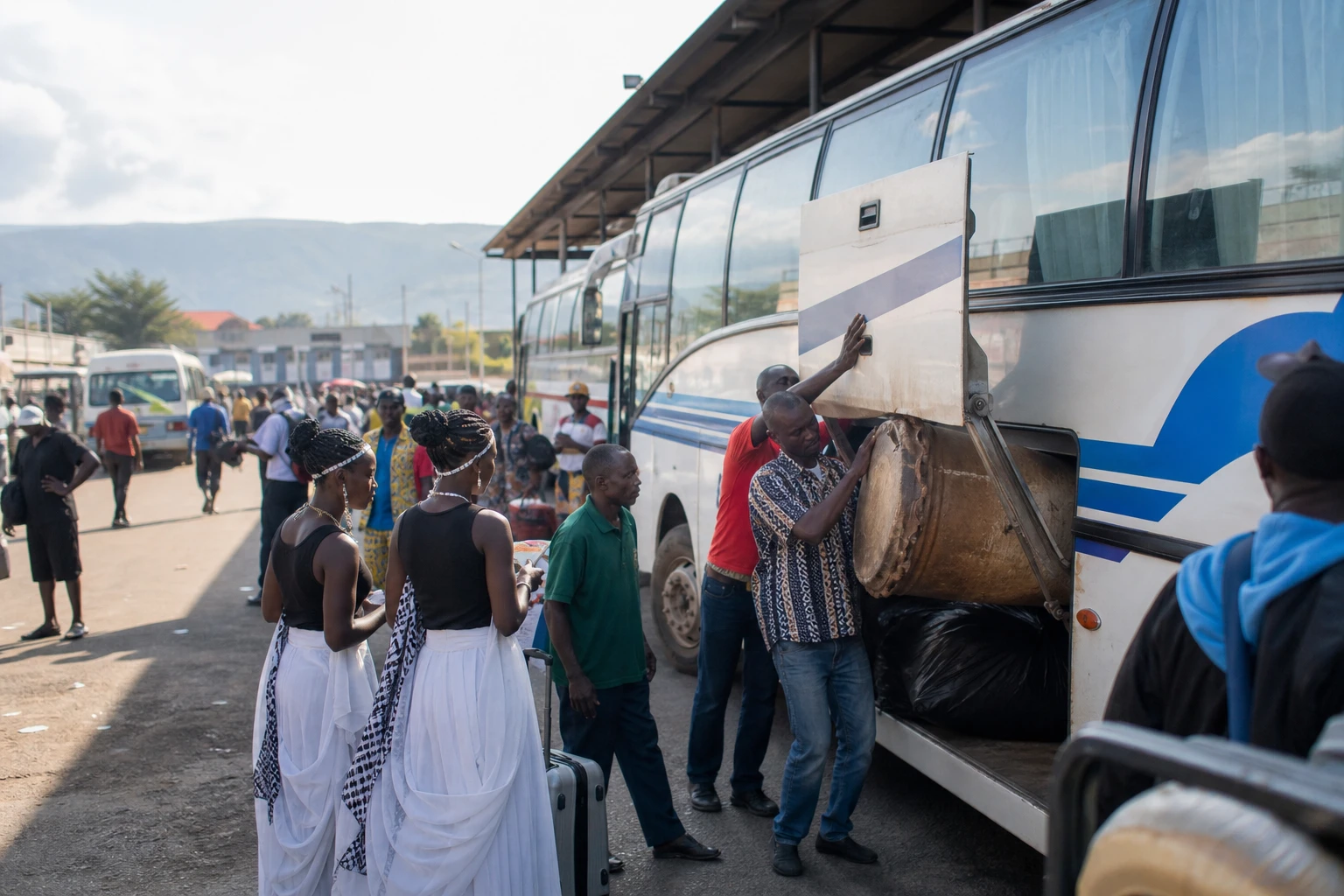
In Burundi, the drum is more than a musical instrument. It accompanies ceremonies, carries political memory and connects generations. But access to it is still governed by a rule that keeps women at a distance: since the decree of 20 October 2017, they have been barred from playing the drum in performances organised under state auspices.
A heritage bound up with the history of power
In Gitega and Bujumbura, the royal drum occupies a special place in the national imagination. Its practice brings together percussion, dance, traditional songs and heroic poetry. It therefore tells more than a musical story. It stages a particular idea of Burundi’s continuity.
This tradition developed under the former Burundian monarchy. The Karyenda, regarded as a royal drum, was associated with the authority of the mwami, the king. In this world, drums were not played at any time or by just anyone. Their manufacture, preservation and use were governed by ritual rules.
The Batimbo, custodians of knowledge relating to the drums, were responsible in particular for practising and passing on these techniques. The tradition then changed after the end of the monarchy in 1966. Performances spread across the country and abroad. Yet percussion remained largely a male preserve.
The importance of this cultural expression was recognised in 2014. The ritual dance of the royal drum of Burundi was added to UNESCO’s Representative List of the Intangible Cultural Heritage of Humanity. UNESCO describes a practice that brings together several generations and different social groups in a collective performance.
A ban turned into law
The division between male percussion and female dancing is not merely a social convention. It was written into Burundian law by decree No. 100/0196 of 20 October 2017, which governs the use of the drum at national and international levels.
Article 3 of the decree prohibits women from playing the drum. It does, however, allow women to perform female folk dances alongside the drummers.
The decree can be consulted in the archives of the Presidency of the Republic of Burundi. It did not, therefore, create the distinction between roles by itself. It gave regulatory form to a traditional concept already present in the official practice of drumming.
This distinction matters. It avoids portraying the ban as an immemorial rule, unchanged since the beginning. Academic studies of the issue indicate that, before the decree was adopted, women took part in some performances, particularly in settings involving public appearances and professional activity. The boundary between ritual drumming and public entertainment has not always been so clear.
Female symbolism, despite a male practice
The restriction is also underpinned by a particular symbolism. In traditional representations, the drum is associated with fertility and the continuity of life. Several parts of the instrument have names referring to the female body, motherhood or the umbilical cord.
This paradox fuels debate. The drum can be symbolically linked to femininity while, in practice, being reserved for men. Supporters of the rule say the distinction protects the sacred and historical character of the practice. Critics argue that it turns collective heritage into a space of exclusion.
The issue is therefore not simply the right to play an instrument. It also concerns how a society defines its custodians of heritage. When knowledge is presented as national, but access to its practice is restricted by sex, transmission becomes a political and social issue.
What the rule means for women
In official performances, women can dance, sing or take part in the stage presentation. They are nevertheless denied the central act of percussion. This difference creates a hierarchy between the roles: men produce the rhythm regarded as institutional, while women accompany it.
The restriction also affects professional prospects. A Burundian woman who wants to become a drummer faces more than a family or community custom. She encounters an administrative rule that may govern performances at national and international level.
By contrast, men who belong to drumming groups benefit from recognition linked to Burundi’s cultural diplomacy. Their performances help raise the country’s profile, particularly at international events. Heritage promotion thus creates opportunities, but they are not distributed equally.
The debate, however, rarely pits two uniform camps against each other. Some people defend the continuity of the tradition without believing that they are excluding women. Others argue that heritage can evolve without losing its identity. Between these positions, families and artists are chiefly seeking to preserve knowledge, rhythms and costumes while responding to changes in Burundian society.
A debate that extends beyond Burundi’s borders
The issue forms part of a wider discussion about intangible cultural heritage in East Africa. Burundi is a member of the East African Community, a regional organisation that also includes Kenya, Uganda, Tanzania, Rwanda, the Democratic Republic of the Congo, South Sudan and Somalia. Within this region, states are seeking to strengthen cultural exchanges as well as economic ties.
International recognition of Burundi’s drum therefore increases its reach. It protects an important tradition, but also draws attention to who is permitted to carry it forward. Safeguarding heritage means more than preserving a rhythm or ceremony. It requires documenting practices, listening to the communities concerned and making historical changes visible.
For Burundi, the challenge now is to maintain the drum’s symbolic power without freezing its history. The question of women does not call the value of this tradition into question. Rather, it reveals a central tension: how to preserve a royal legacy that has become a national emblem while the society passing it on continues to change?