Algeria
 Egypt
 Libya
 Morocco
 Sudan
 Tunisia
 Benin
 Cabo Verde
 Côte d'Ivoire
 Ghana
 Guinea
 Guinea-Bissau
 Liberia
 Mali
 Mauritania
 Niger
 Nigeria
 Senegal
 Sierra Leone
 The Gambia
 Togo
 Cameroon
 Central African Republic
 Chad
 DR Congo
 Equatorial Guinea
 Gabon
 Republic of the Congo
 São Tomé and Príncipe
 Burundi
 Comoros
 Djibouti
 Eritrea
 Ethiopia
 Kenya
 Madagascar
 Malawi
 Mauritius
 Mozambique
 Rwanda
 Seychelles
 Somalia
 South Sudan
 Tanzania
 Uganda
 Angola
 Botswana
 Eswatini
 Lesotho
 Namibia
 South Africa
 Zambia
 Zimbabwe
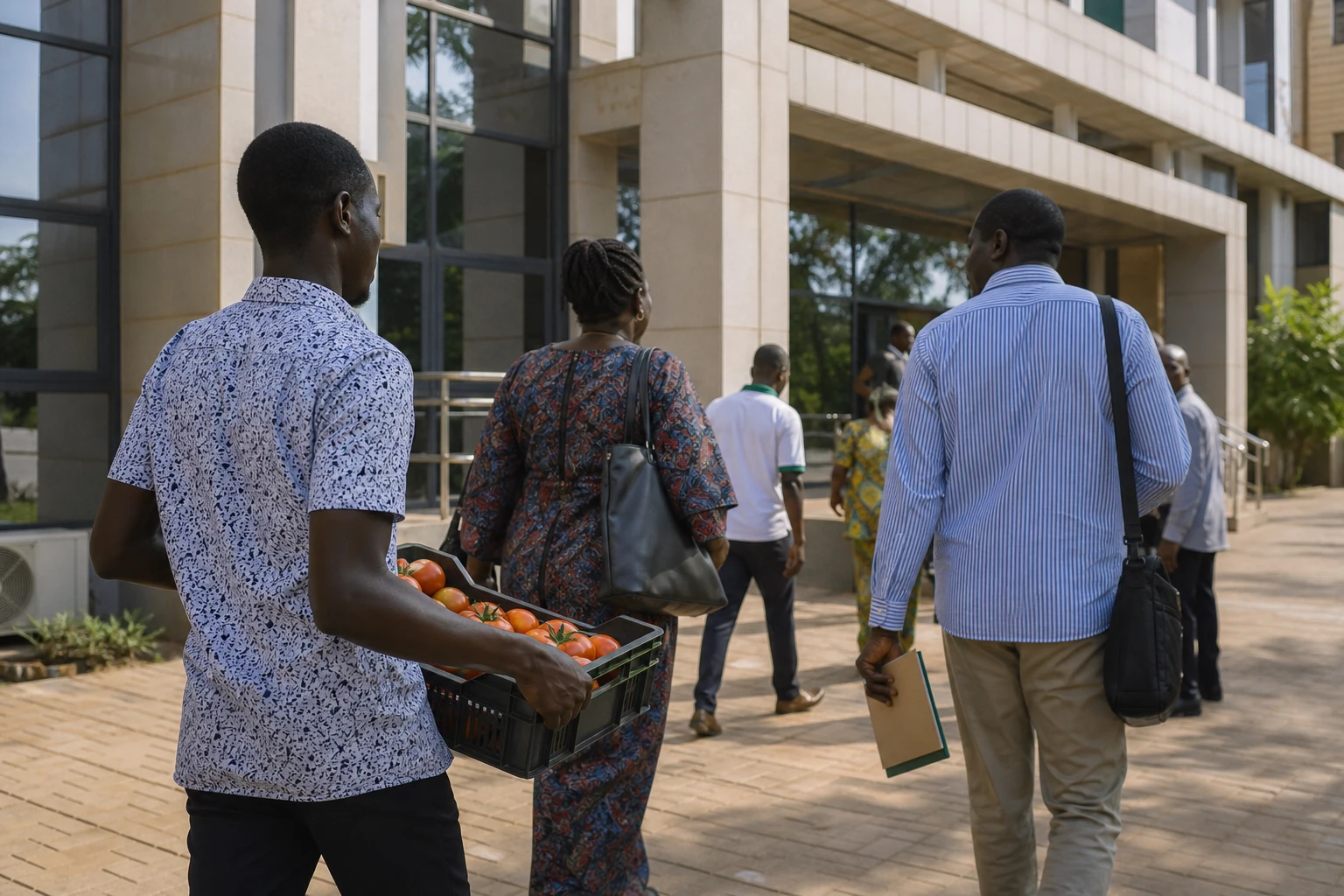
In Ouagadougou, tomatoes are no longer just a market vegetable. They have become a matter of food sovereignty, rural employment and local industry. For Burkinabè people, the real question is simple: how can fragile production be secured while supplying factories that now want to process more produce locally?
The issue is part of a broader drive to reshape Burkina Faso’s economy, as the authorities bet on local processing of agricultural products and applied research. At the West African level, the country now operates outside ECOWAS, following Burkina Faso’s withdrawal, which took effect on 29 January 2025. This has added to the importance of national policies for productive resilience and security of supply.
A strategic but still vulnerable sector
On 22 July 2026, Burkina Faso’s authorities approved a National Tomato Research Programme covering 2026–2031. The initiative was discussed with representatives of the sector’s interprofessional body, as well as agricultural extension and development services, following work that had already begun on 2 April 2026 in Ouagadougou at a scoping workshop devoted to drafting the programme.
The aim is clear: produce more, lose less and supply processors more effectively. The ministry responsible for research says it wants to improve harvest quality and yields, and make plants more resistant to disease, pests and the effects of climate change. The authorities estimate annual production at 231,764 tonnes, but say that 30% to 40% of the sector’s output is still lost as a result of the combined effects of climate change and disease and pest attacks. This range should be read as a public estimate, not as a figure consolidated by an independent statistical system.
The issue is not theoretical. Research conducted in Burkina Faso has for several years documented heavy pest pressure, particularly on market-garden crops. One academic study even reports that some insect attacks can cause very severe losses, reaching 50% to 100% in extreme cases. Other publications also highlight the role of disease and climate stress in weakening yields.
In a country where agriculture remains a major pillar of the economy and employment, the decision to underpin the tomato sector with a national research programme reflects a more structured approach to public policy. The stakes are not only agronomic. They include the stability of market gardeners’ incomes, the availability of produce in urban markets and the country’s ability to sustain a more industrialised sector.
From field to factory: the sector’s central challenge
The programme’s approval comes as Burkina Faso has already begun building an industrial base around tomatoes. In Bobo-Dioulasso, the Burkinabè Tomato Company’s factory, inaugurated on 30 November 2024, was presented as the first facility of its kind in the city. In Yako, Faso Tomate was inaugurated on 16 December 2024. The prime minister also visited SOBTO in spring 2026, a sign that the processing chain is being monitored at the highest level of government.
These investments are changing the logic of the sector. For a long time, Burkinabè tomatoes were mainly sold fresh, with production highly exposed to fluctuations and post-harvest losses. The state now also wants to secure supplies for processing plants. With this in mind, the government suspended the issuing of special permits to export fresh tomatoes on 17 March 2026. The measure was lifted on 31 March, after supplies were deemed to have improved satisfactorily and commitments had been made by stakeholders across the supply chain.
This sequence says much about the tensions within the sector. On one side, producers are seeking profitable markets, including abroad. On the other, processors need a regular flow of raw materials to keep equipment running, recoup investments and stabilise jobs. In Bobo-Dioulasso, SOBTO has already been described by the authorities as a creator of direct and seasonal jobs. Moving from fresh tomatoes to paste therefore demands a new form of collective discipline: production schedules, seed quality, pest and disease control, logistics and storage.
The National Research Programme is specifically aimed at this upstream part of the sector. In practice, it will need to help producers tackle very concrete constraints: poorly adapted varieties, vulnerability to disease, pest pressure, lower yields under water stress and post-harvest losses. Without solutions that are accessible in the field, factories can quickly find themselves underused, while growers remain exposed to unstable prices.
What Burkina Faso is testing through tomatoes
Beyond Burkina Faso, this issue reflects a broader regional trend. In West Africa, the question is no longer just how to produce. It is also about how to preserve, process and distribute. Tomatoes encapsulate this challenge: they are a high-value crop, but also highly vulnerable. When agricultural research delivers, it can reduce losses, improve rural incomes and build a stronger domestic market. When it falls short, the entire chain is at risk.
Burkina Faso is therefore taking a methodological gamble. Rather than responding only with emergency measures, the country wants to place tomatoes within a cycle of research, innovation and industrialisation. This approach is also in line with the 2026–2030 National Development Framework, which emphasises sovereignty, structural transformation and endogenous development. In other words, tomatoes are becoming a test case: can public research become a direct tool for agricultural competitiveness?
The answer will depend less on announcements than on implementation. The programme’s budget, funded projects, selected varieties and extension arrangements have not yet been detailed publicly. Yet this is where the programme’s credibility will be determined. If research reaches fields, markets and processing plants, the sector can move up a gear. Otherwise, tomatoes will remain a recurring promise instead of becoming a genuine economic engine for the people of Burkina Faso.