Algeria
 Egypt
 Libya
 Morocco
 Sudan
 Tunisia
 Benin
 Cabo Verde
 Côte d'Ivoire
 Ghana
 Guinea
 Guinea-Bissau
 Liberia
 Mali
 Mauritania
 Niger
 Nigeria
 Senegal
 Sierra Leone
 The Gambia
 Togo
 Cameroon
 Central African Republic
 Chad
 DR Congo
 Equatorial Guinea
 Gabon
 Republic of the Congo
 São Tomé and Príncipe
 Burundi
 Comoros
 Djibouti
 Eritrea
 Ethiopia
 Kenya
 Madagascar
 Malawi
 Mauritius
 Mozambique
 Rwanda
 Seychelles
 Somalia
 South Sudan
 Tanzania
 Uganda
 Angola
 Botswana
 Eswatini
 Lesotho
 Namibia
 South Africa
 Zambia
 Zimbabwe
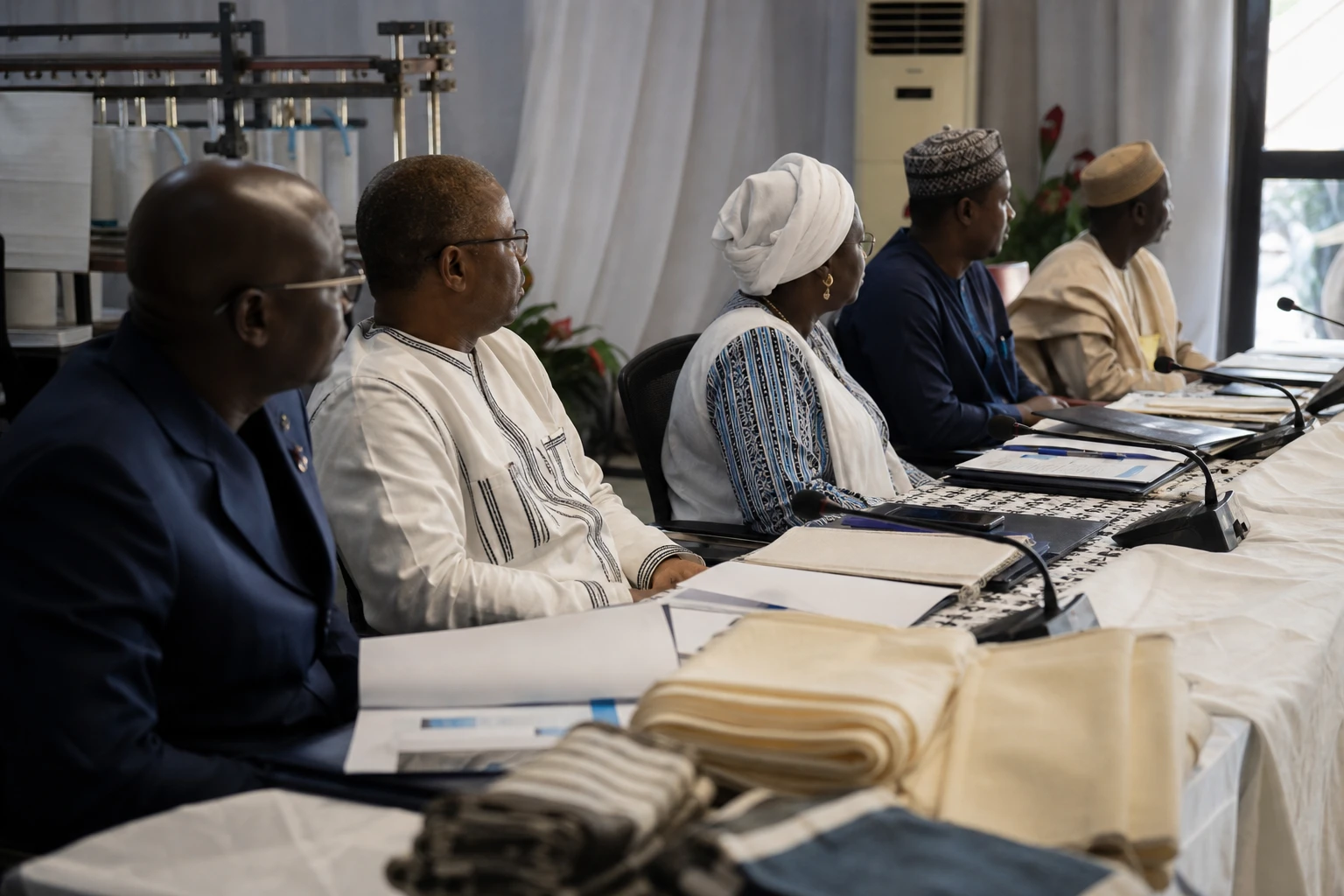
A textile factory at the heart of Burkina Faso’s industrial wager
In Bobo-Dioulasso, cotton is no longer meant simply to leave the fields. Burkina Faso now wants to take it further along the value chain, turning it into fabric, uniforms and everyday clothing. That is the purpose of the TEXFORCES-BF industrial complex, inaugurated on 9 September 2026 in Logofourousso, in the municipality of Bobo-Dioulasso, in the west of the country.
The signal is as political as it is economic. In a country that is among West Africa’s major cotton producers, the stated aim is clear: reduce dependence on imports, create jobs and keep more added value at home. The Burkinabè state is supporting this direction with a series of public decisions and industrial projects linked to textiles.
What TEXFORCES-BF means for the cotton sector
According to the authorities, TEXFORCES-BF represents an investment of 17 billion CFA francs. The complex says it will have annual capacity of up to 20 million metres of woven fabric, 5 to 6 million knitted items, up to 20 million metres of finished and dyed fabric, 4 to 6 million outfits, more than 5 million T-shirts and over one million pairs of socks. It is also expected to generate 600 direct jobs and 15,000 indirect jobs.
The factory is not limited to meeting the needs of the Defence and Security Forces and the Volunteers for the Defence of the Homeland, or VDP, civilian auxiliaries mobilised in the security effort. It is also targeting the civilian market. This dual purpose matters. It allows public-sector demand to underpin broader commercial production, thereby providing stability for the industrial facility.
The government has presented the project as a milestone in industrial sovereignty and the local processing of Burkinabè cotton. On 25 June 2026, it had already adopted a decree declaring the establishment of TEXFORCES-BF to be of urgent public utility, in order to begin the necessary land procedures. The industrial site, covering 30 hectares, is therefore part of a public decision prepared in advance, rather than a mere announcement.
The agricultural timetable points in the same direction. For the 2026-2027 cotton season, the authorities have set a target of 532,000 tonnes of conventional seed cotton and 2,250 tonnes of organic cotton. This follows an estimated 314,293 tonnes in the 2025-2026 season, after 294,507 tonnes in the previous season. In other words, the textile industry is receiving support at a time when national cotton supply is also being driven higher.
Investments seek to fill a long-standing gap
Burkina Faso is not starting from scratch. For several years, the authorities have been sending repeated signals in support of local processing. In April 2025, the government highlighted the strategic role of textiles in its industrial policy. A few months later, the Caisse des Dépôts et d’Investissements du Burkina Faso, or CDI-BF, announced a memorandum of understanding with Kenya’s Basra Textile Mills for an integrated textile plant project, valued at around $25 million.
In Bobo-Dioulasso, the National Centre for Support to the Artisanal Processing of Cotton, or CNATAC, had also been promoted as a tool to support artisans in weaving, dyeing and sewing. This link between heavy industry and artisanal processing matters. It means the sector need not be reserved for large-scale plants alone, but can also make room for the many small-scale workers in local textiles, often rooted in urban markets and local networks.
The regional context reinforces this assessment. Burkina Faso remains a major cotton exporter, but still processes too little of it at home. A World Bank report on the cotton-textile-apparel value chain notes that the intermediate stages — weaving, knitting and garment-making — have long been weak in the country. In practice, this means Burkina Faso still sells a great deal of raw material and then buys back some of the finished products it could make itself.
Fewer imports, more local added value
Foreign trade figures show the scale of the challenge. In the INSD’s 2023 statistical yearbook, Burkinabè imports of clothing and accessories stood at 48,797.9 tonnes in 2019, 41,345.3 in 2020, 42,037.0 in 2021, 27,704.6 in 2022 and 33,810.6 in 2023. Over the same period, the corresponding values remained a heavy burden for an economy seeking to retain more local production.
Dependence is therefore not merely symbolic. It affects foreign currency, urban jobs and commercial networks in Ouagadougou, Bobo-Dioulasso and other centres of consumption. If the new capacity operates at full tilt, it could meet some of this domestic demand. If it runs below its potential, it risks becoming an expensive showcase with no lasting effect on the productive fabric.
The stakes are also social. For employees and subcontractors, textile industrialisation can create more regular jobs than the informal economy. For cotton producers, it can stabilise markets. For consumers, it could eventually mean more locally made clothing, ranging from uniforms to everyday garments. But that depends on securing supplies, energy, logistics and product quality.
Competitiveness remains central. Textiles are exposed to competition from Asia, regional imports and price pressures. Burkina Faso is therefore seeking a balance: producing locally without cutting itself off from the market, selling to public institutions without becoming locked into that market, and processing more without leaving the public finances to bear all the risk.
West African significance beyond Bobo-Dioulasso
This move up the value chain for Burkinabè cotton goes beyond the national level. Across West Africa, several producer countries are seeking to move beyond the role of suppliers of raw fibre. Burkina Faso is part of this regional drive for local processing, as the Economic Community of West African States (ECOWAS) and the African Continental Free Trade Area (AfCFTA) encourage greater industrial trade across the continent.
If TEXFORCES-BF delivers on its promises, it could serve as a model for other countries with cotton but lacking integrated plants. If it struggles to meet its targets, it will be a reminder that a factory alone is not enough: a complete ecosystem is needed, from seed to garment, including energy, inputs, technical training and markets. For Burkina Faso, that is where the difference lies between an inauguration and lasting transformation.
The next point to watch, then, is less the ribbon-cutting in Bobo-Dioulasso than the facility’s actual ability to produce, sell and employ. Decisions on the 2026-2027 cotton season, along with the expansion of other textile projects already announced, will show whether the country is making an industrial leap or merely adding another step to a strategy that remains incomplete.