Algeria
 Egypt
 Libya
 Morocco
 Sudan
 Tunisia
 Benin
 Cabo Verde
 Côte d'Ivoire
 Ghana
 Guinea
 Guinea-Bissau
 Liberia
 Mali
 Mauritania
 Niger
 Nigeria
 Senegal
 Sierra Leone
 The Gambia
 Togo
 Cameroon
 Central African Republic
 Chad
 DR Congo
 Equatorial Guinea
 Gabon
 Republic of the Congo
 São Tomé and Príncipe
 Burundi
 Comoros
 Djibouti
 Eritrea
 Ethiopia
 Kenya
 Madagascar
 Malawi
 Mauritius
 Mozambique
 Rwanda
 Seychelles
 Somalia
 South Sudan
 Tanzania
 Uganda
 Angola
 Botswana
 Eswatini
 Lesotho
 Namibia
 South Africa
 Zambia
 Zimbabwe
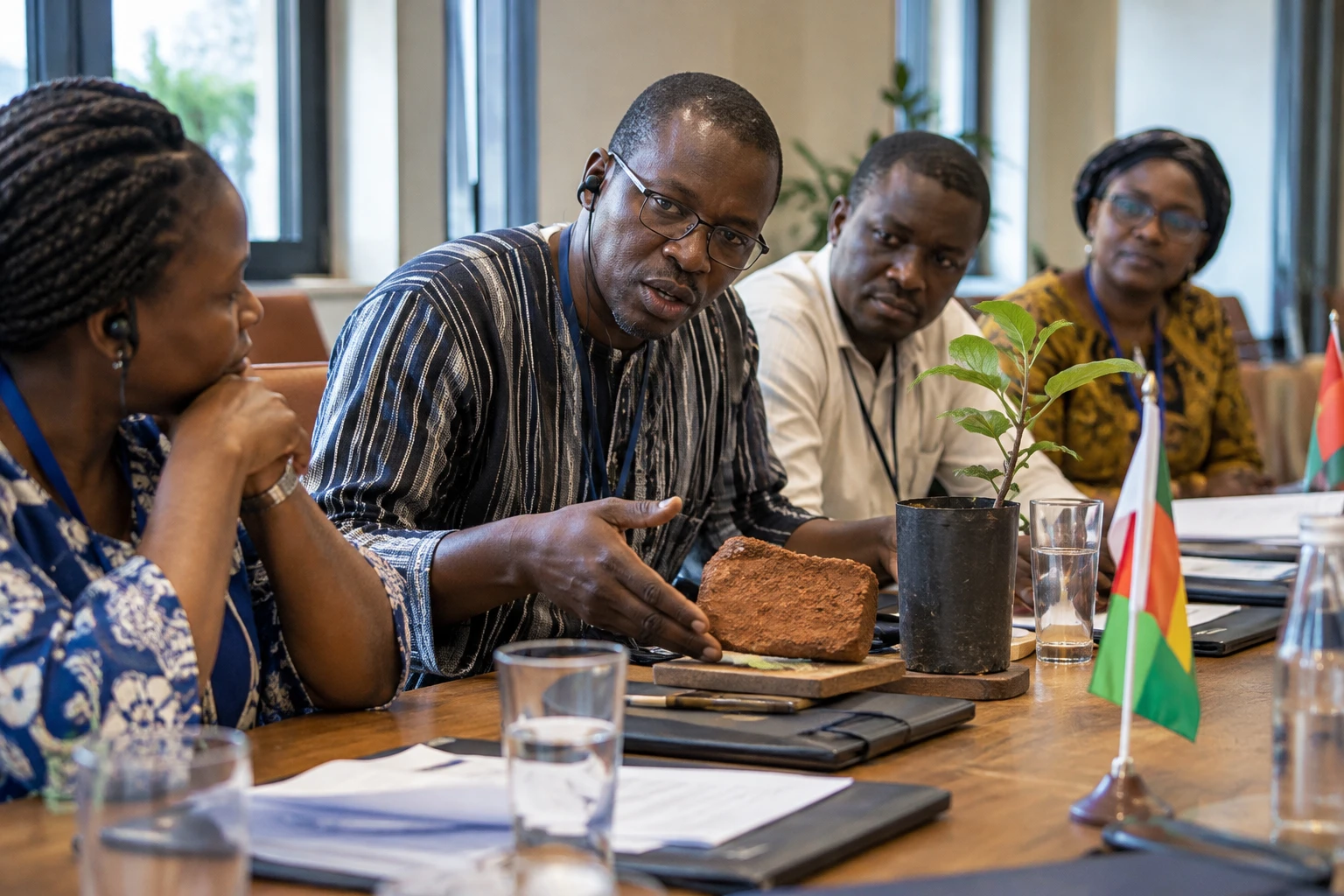
Where rock blocks roots just a few dozen centimetres below the surface, planting a tree is not enough. In Burkina Faso, teams have been testing a labour-intensive solution for several decades: breaking through the laterite crust so young plants can draw on moisture deeper underground.
Retaining water and preparing the soil in the Central Plateau
The method is part of a broader rural development approach led by Terre Verte and village associations. Since 1989, the NGO has supported the creation of bocage areas, known as “wégoubri” in Mooré. Live hedges, cultivated plots, communal spaces, earth bunds and ponds shape the landscape to retain rainwater and limit runoff.
The first major area, at Tankouri, near the village of Guiè in the Central Plateau region, was developed from 1998 across 100 hectares. The model was later adopted by other pilot farms, notably at Filly, Goèma, Barga and Tougo. This local work is also part of West African efforts to promote agroecology, including the ECOWAS Agroecology Programme, run by the Economic Community of West African States.
In some areas, however, the laterite crust forms a barrier that roots struggle to penetrate. A tree may benefit from water available near the surface during the rainy season, then lack moisture when the long dry season sets in. Terre Verte says that plants protected from livestock have consequently languished or died despite carefully managed planting.
Manual work tailored to each site
The root pit is designed to break through this rocky layer. Work is generally carried out in the dry season, from November to early May. Teams mark out a circle about 90 centimetres in diameter, then dig through the crust and continue into the loose soil beneath it.
Terre Verte’s technical guide says the work is generally considered unnecessary if laterite is found only below a depth of 80 to 100 centimetres. Where it lies closer to the surface, its thickness can vary from 1 to 4 metres, depending on the site. Two people take turns: one breaks the rock with a pickaxe and crowbar, while the other removes the spoil. The work can take a day or last up to a week.
Mechanisation has not solved the problem of cost. The organisation says it tried using a jackhammer, but abandoned it because the expense became too high. The excavated materials are mixed and then put back into the hole. After the first rains, the fill settles; it is topped up with the remaining spoil and compost. Half-moon structures then channel runoff towards the plant, which is planted at the start of the rainy season.
The method can also be used for hedges in bocage areas. Where their route crosses heavily lateritic ground, teams dig a root trench. This work shows that the technique involves more than planting: it takes time, trained labour and adjustments to the depth and hardness of the soil.
Promising results, but more measurement needed
Terre Verte says the pits reduce or even eliminate watering during the dry season. Its guide cites a plant survival rate “close to 100%” and says they are used for orchards or roadside plantings. But it does not specify how many trees were monitored or for how long. The figure should therefore be understood as the organisation’s estimate, not as a finding established by an independent study of root pits.
There is, however, external research on bocage areas as a whole. A report published in December 2022 by Gret, drawing on work conducted with AZN, IRD and Nazi Boni University, examines three areas in Guiè and Douré. It describes agricultural and socio-economic effects, but does not specifically assess the survival of trees planted in root pits. The results for the bocage therefore cannot be attributed to this technique alone.
The report also notes that results depend on local people’s adoption of the developments and on land tenure security. In these areas, the organisation of plots relies in particular on collective agreements and local management rules. For farmers, the prospect of benefiting from a tree or plot over the long term matters as much as agronomic performance. Gret’s assessment thus highlights the importance of social and land-tenure conditions in ensuring the long-term viability of these developments.
The next challenge: establishing costs and how long the effects last
For farming families, the potential benefit is clear: a plant with access to deep moisture could need less watering and better withstand the dry season. But digging requires a great deal of labour, and the time needed varies considerably from one site to another. Without comparable data on the cost per tree, survival after several years and differences between soil types, it remains difficult to know where the investment makes most sense.
The bocage experience shows both the value of an experiment designed with local communities and the need for evaluation. Gret has published a review of these developments, while Terre Verte now distributes its technical guide on root pits. These initiatives do not yet address the same question: one concerns entire areas, while the other sets out a planting method.
Across the western Sahel, the Burkina Faso experience could interest other areas where hardpan soils make it difficult to establish trees. But whether it can be replicated will depend on local conditions, labour costs and the availability of monitoring data. The decisive next step will therefore be to compare trees planted in root pits with other plantings over several years, without conflating the results of a bocage development with those of a specific technique.
For more information, see Terre Verte’s overview of bocage areas and technical documents, as well as Gret’s review of the areas in Guiè and Douré.