Algeria
 Egypt
 Libya
 Morocco
 Sudan
 Tunisia
 Benin
 Burkina Faso
 Cabo Verde
 Côte d'Ivoire
 Ghana
 Guinea
 Guinea-Bissau
 Liberia
 Mali
 Mauritania
 Niger
 Nigeria
 Senegal
 Sierra Leone
 The Gambia
 Togo
 Cameroon
 Central African Republic
 Chad
 DR Congo
 Equatorial Guinea
 Gabon
 Republic of the Congo
 São Tomé and Príncipe
 Burundi
 Comoros
 Djibouti
 Eritrea
 Ethiopia
 Kenya
 Madagascar
 Malawi
 Mauritius
 Mozambique
 Rwanda
 Seychelles
 Somalia
 South Sudan
 Tanzania
 Uganda
 Angola
 Eswatini
 Lesotho
 Namibia
 South Africa
 Zambia
 Zimbabwe
In Gaborone, the question is no longer simply how long diamonds will finance the economy. It is now about preparing for the post-diamond era without giving up the value created by the industry. Copper, nickel, cobalt and manganese offer a path, but they do not yet guarantee renewed prosperity.
A mining shift in an economy under pressure
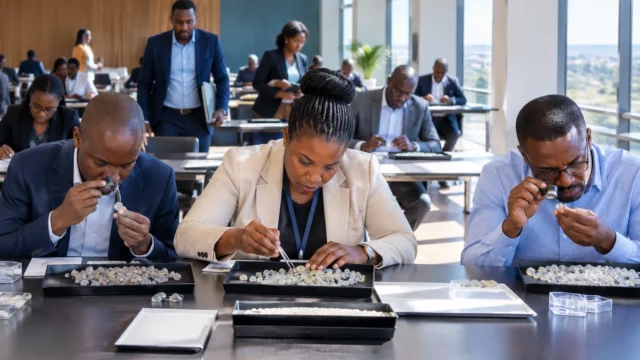
Botswana remains one of the world’s major diamond producers. Yet slowing demand and falling sales have highlighted the fragility of a highly concentrated model. Diamonds have accounted for about 80% of the country’s exports in recent years, as well as a quarter of its gross domestic product, according to data cited by the International Monetary Fund.
This dependence directly affects public revenues, employment and investment. It explains the urgency of diversifying productive activities. The Botswana government is therefore seeking to develop other mining segments, while also strengthening local processing and non-extractive sectors.
The challenge is set against a distinctive regional backdrop. Botswana is a member of the Southern African Development Community, SADC, which includes South Africa, Zambia, Namibia and Tanzania, among others. This proximity brings the country into contact with several established mining basins, while offering logistical and industrial opportunities.
Selebi confirms copper and nickel potential
The Selebi project in eastern Botswana has recently reached a new milestone. NexMetals Mining announced on 1 October 2026 an upward revision of the site’s mineral resources. The estimate identifies 495,400 tonnes of contained copper and 316,800 tonnes of contained nickel in the identified resources.
The company says total tonnage has risen by 72% compared with the estimate published in 2024. Cobalt is also part of the project’s geological potential. The metal is used in some battery chemistries and remains in demand among manufacturers seeking to secure their supplies.
These figures describe a mineral resource. They do not yet represent commercial production. Before any decision to mine, NexMetals will need to clarify costs, processing methods, required infrastructure and the project’s profitability. The next economic studies will therefore be decisive.
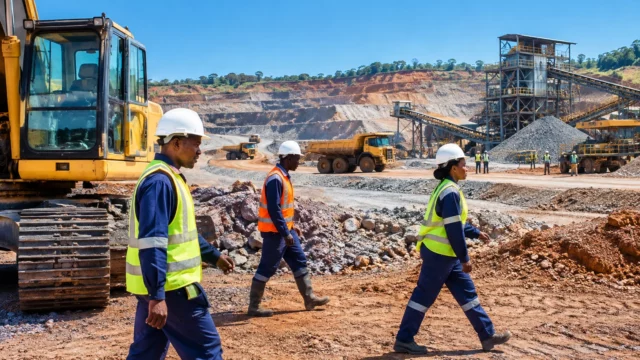
Selebi nevertheless has an important advantage. The site has been mined in the past. The former Selebi and Selebi North mines operated until 2016 under BCL, a state-owned Botswana mining and metallurgical company. This industrial history may facilitate some work, although refurbishing facilities and financing a restart remain complex.
The neighbouring Selkirk project is following a similar path. NexMetals reported a 70% increase in defined mineral potential there in June 2026. Copper, nickel and cobalt are also present. For now, Selkirk remains at the assessment stage. Moving from exploration to mining will require stronger technical and financial data.
Manganese offers another route
Diversification is not based solely on copper and nickel. The K.Hill project, led by Giyani Metals, aims to produce manganese-based products for electric vehicle batteries and energy storage systems.
The definitive feasibility study published in May 2026 puts the required initial investment at about $535 million. The plan calls for a mine and processing plant capable of producing battery-grade manganese. This sets the project apart from the simple extraction of raw ore.
K.Hill still has several milestones to clear before a possible final investment decision. It will need to secure financing, confirm permits, arrange access to water and energy, and establish commercial terms with future buyers. The letter of intent for up to $225 million discussed with the US Export-Import Bank is a financial signal, but does not yet constitute final financing.
The project could nevertheless contribute to a broader ambition: making Botswana a supplier of intermediate materials rather than simply an exporter of resources. This transformation is essential to create more skilled jobs and retain a greater share of value in the country.
From rare earths to African value chains
Tsodilo Resources’ exploration work at Gcwihaba adds to this picture. The company is investigating potential for rare earths and several minerals considered strategic for the digital industry, renewable energy and electrical equipment.
At this stage, these indications do not support the conclusion that a future mine will be developed. They nevertheless show that Botswana’s subsoil could be more diverse than its image as a country primarily associated with diamonds suggests.
This shift comes as the United States, China, the European Union and Japan seek to reduce risks in their supply chains. Copper, nickel, cobalt, manganese and rare earths have become strategic resources. Competition among investors could therefore improve access to capital, but it also strengthens the bargaining power of producing countries.
Botswana will need to use this position carefully. A new dependence on a handful of critical minerals would not solve the current problem. It would merely shift it. Diversification will therefore need to include local processing, training, contract transparency and stronger links with Botswana’s businesses.
Production will be the real test
The country returned to copper production in the early 2020s, notably through the operations of Khoemacau and Motheo. However, its output remains modest compared with that of the Democratic Republic of the Congo and Zambia, two major copper producers in Africa.
Botswana nevertheless has advantages recognised by investors: long-standing institutional experience, an established mining framework and a reputation for relative stability in southern Africa. These strengths will not be enough if projects fail to become competitive.
The next step will be to turn geological estimates into industrial decisions. For Selebi and Selkirk, this means publishing credible economic studies and setting out a development timetable. For K.Hill, the challenge will be to raise the necessary capital and demonstrate that manganese production tailored to battery manufacturers’ requirements is viable.
Success will also be measured by its local impact. Residents of Selebi-Phikwe are waiting for jobs and sustainable activity after the closure of the former mines. Communities near K.Hill will need clear information about land use, water and economic benefits. In rural areas, these issues will matter as much as announcements made in trading rooms.
For Botswana, critical minerals are therefore an opportunity, not yet a guarantee. The country can benefit from global demand without abandoning its governance standards. Its place on Africa’s new mining map will depend less on the number of resources announced than on its ability to produce, process and distribute the value created fairly.
For technical data on the Selebi project, see the official presentation of the Selebi mine. K.Hill’s financial details are set out in the Botswana manganese project information sheet. The context of dependence on diamonds is also documented in the IMF report on the Botswana economy.