Algeria
 Egypt
 Libya
 Morocco
 Sudan
 Tunisia
 Benin
 Burkina Faso
 Cabo Verde
 Côte d'Ivoire
 Ghana
 Guinea
 Guinea-Bissau
 Liberia
 Mali
 Mauritania
 Niger
 Nigeria
 Senegal
 Sierra Leone
 The Gambia
 Togo
 Cameroon
 Central African Republic
 Chad
 DR Congo
 Equatorial Guinea
 Gabon
 Republic of the Congo
 São Tomé and Príncipe
 Burundi
 Comoros
 Djibouti
 Eritrea
 Ethiopia
 Kenya
 Madagascar
 Malawi
 Mauritius
 Mozambique
 Rwanda
 Seychelles
 Somalia
 South Sudan
 Tanzania
 Uganda
 Angola
 Eswatini
 Lesotho
 Namibia
 South Africa
 Zambia
 Zimbabwe
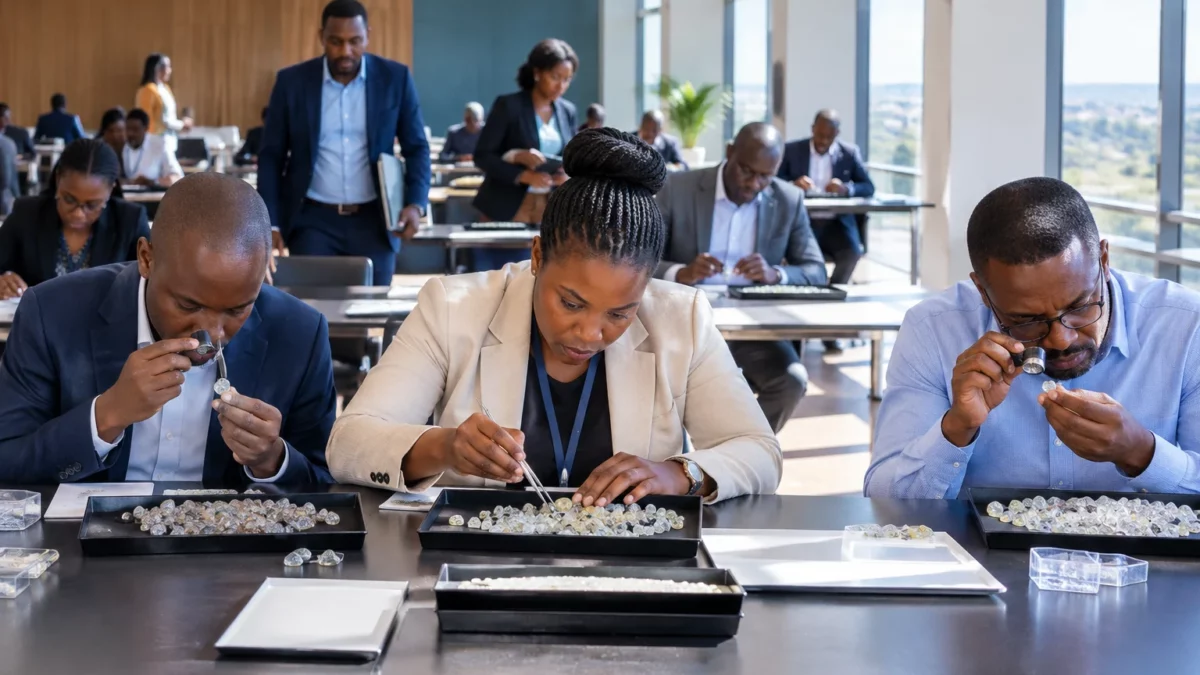
A rise in diamond sales can ease Botswana’s finances. But it does not, by itself, answer the central question: how will the country turn a resource exposed to market shocks into more sustainable revenue and local jobs?
The answer lies in Gaborone’s auctions, negotiations with De Beers and Botswana’s ability to diversify its economy. Okavango Diamond Company (ODC), the country’s state-owned trader, has just announced a return to profit after a year of significantly stronger sales.
A global market still under pressure
Botswana, in southern Africa, is a member of the Southern African Development Community (SADC), which brings together countries in the region to strengthen economic and political cooperation. But in the diamond sector, the difficulties extend beyond national borders. Global demand for natural stones remains fragile, while lab-grown diamonds are gaining ground and accumulated stocks are holding back orders.
The Bank of Botswana described the market in 2026 as still facing competition from substitute products and weak external demand. It also points to a broader vulnerability: difficulties in mining expose the economy to external shocks and increase the need to diversify exports.
This dependence has consequences beyond company balance sheets. Mining revenues contribute to public finances, while local businesses, workers and shops linked to the sector depend on activity levels. The sales recovery is therefore a positive signal, but it does not guarantee an equivalent improvement for all stakeholders.
ODC sells more, but figures remain based on statements
On 17 November 2026, ODC board chairman Yoram Dvash said the company had sold 8.11 million carats since January. Those sales reportedly generated $645.2 million, compared with $457 million for all of 2025, according to government statistics cited in available reports.
Spot auction sales reportedly brought in $147.2 million, for about 1.85 million carats. These auctions, where parcels are offered to buyers according to market conditions, give the state a direct sales channel. Dvash also attributed the return to profit to an increase in sales and in the number of buyers.
The detailed figures come from the executive’s statements and government data reported by the press. They should not be confused with an audited annual result: 2026 is not yet over, and the available information does not provide a breakdown of costs or margins.
ODC markets a share of Debswana’s production, a joint venture equally owned by the Botswana government and De Beers. The sales agreement concluded in 2025 increased the share entrusted to ODC to 30%. The rise in volumes gives it greater commercial visibility, but does not mean that Botswana alone controls production or prices.
A negotiating lever, not yet a transformation of the sector
Gaborone’s strategy includes seeking greater influence in the value chain, from selling rough stones to cutting and polishing them. Local processing, however, remains a point of friction. Belgian group HB Antwerp had announced projects in Botswana, with the state expected to take a stake and ODC to supply rough diamonds.
In September 2026, HB Antwerp managing partner Boaz Lev said that promised deliveries had not been made and that the company was scaling back its activities in the country. The statement, reported in the available material, illustrates the possible gap between industrial commitments and their implementation. Without regular supplies, ambitions to cut and polish stones locally remain difficult to realise.
For buyers, a larger ODC offering can diversify supply channels. For the government, it can improve access to market information and strengthen its position vis-à-vis De Beers. But these benefits will depend on sales terms, demand and the ability to establish a profitable industrial activity in Botswana.
This distinction also matters to the population. An increase in a state-owned trader’s turnover does not automatically translate into more jobs or income for local businesses. The results will depend in particular on processing contracts, Botswana-based companies’ access to stones and the share of revenues that actually reaches public finances.
De Beers sale opens a new regional chapter
The debate is now widening to include De Beers’ ownership. On 9 November, President Duma Boko announced that Botswana supported the Global Diamond Consortium, which is bidding to buy Anglo American’s 85% stake. If the deal goes through, the Botswana government’s holding would rise from 15% to 30%, making it the largest individual shareholder, according to announcements reported by national and international media.
The transaction has not yet been finalised. Binding documents remain to be negotiated. The president also referred to the involvement of neighbouring producer countries, including Namibia and Angola, without specifying the terms. Such cooperation could give southern African countries greater influence in a company that buys and markets diamonds and organises part of the supply chain. It does not, by itself, guarantee a different distribution of revenues.
The next step will therefore be twofold: clarify the governance and financing of the De Beers deal, then assess whether ODC’s increased sales lead to industrial opportunities and local benefits. The 2026 commercial recovery strengthens Botswana’s position in the discussions. It does not remove either market volatility or the urgency of building other economic drivers.