Algeria
 Egypt
 Libya
 Morocco
 Sudan
 Tunisia
 Burkina Faso
 Cabo Verde
 Côte d'Ivoire
 Ghana
 Guinea
 Guinea-Bissau
 Liberia
 Mali
 Mauritania
 Niger
 Nigeria
 Senegal
 Sierra Leone
 The Gambia
 Togo
 Cameroon
 Central African Republic
 Chad
 DR Congo
 Equatorial Guinea
 Gabon
 Republic of the Congo
 São Tomé and Príncipe
 Burundi
 Comoros
 Djibouti
 Eritrea
 Ethiopia
 Kenya
 Madagascar
 Malawi
 Mauritius
 Mozambique
 Rwanda
 Seychelles
 Somalia
 South Sudan
 Tanzania
 Uganda
 Angola
 Botswana
 Eswatini
 Lesotho
 Namibia
 South Africa
 Zambia
 Zimbabwe
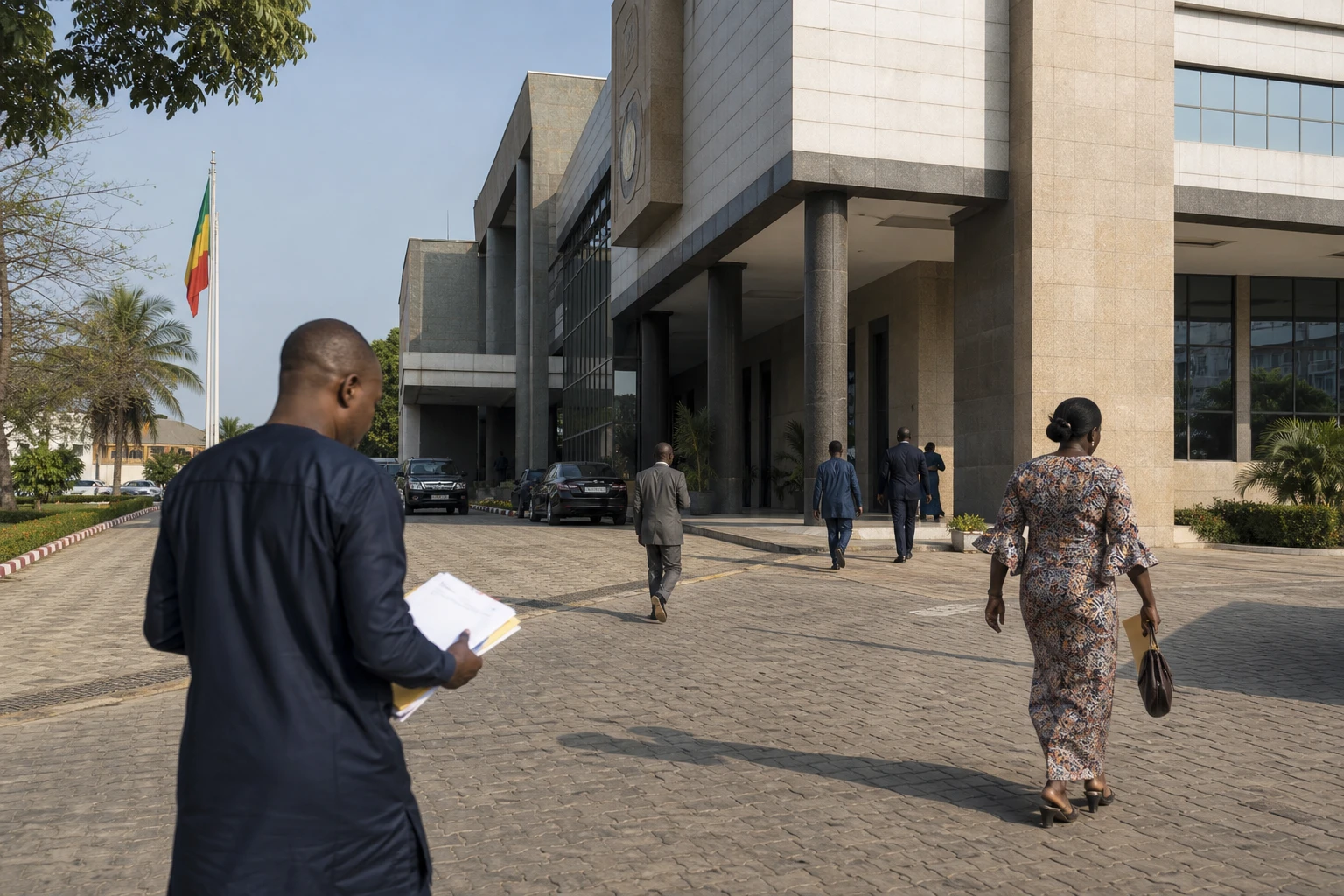
A Senate to heal wounds or reopen the political game?
In Benin, the creation of the Senate is about more than institutional reorganisation. It touches on a broader question: how to sustain political dialogue in a country where the National Assembly is already the only chamber provided for under the 1990 Constitution, revised in 2019 and then amended again by the 2025 constitutional law. The Beninese presidency also points out that, until now, Parliament remained a single chamber.
It was in this context that Thomas Boni Yayi, a former president of the Republic, announced on 22 July 2026 that he would ultimately sit in the Senate as an ex officio senator. His change of course comes just days before the new upper chamber is due to be inaugurated, on 30 July 2026 in Porto-Novo, the country’s political capital.
The move is political, but it is also institutional. Boni Yayi says he is not « seeking » the seat, simply considering himself to be exercising a prerogative provided for by the Constitution. He wants to turn the Senate into a forum for dialogue, in a context he considers less open than before.
A contested reform, now part of the new institutional landscape
The constitutional reform that paved the way for the Senate was at the heart of tensions in Benin. Even before the bill was considered by the Laws Committee, Boni Yayi had denounced an institution he then considered unnecessary and contrary to the democratic spirit. But since the reform was passed and promulgated, the legal framework has changed. The Beninese authorities have confirmed the establishment of new bodies and the growing importance of a more complex institutional architecture.
For the opposition and several Beninese observers, the sensitive issue is the real place this upper chamber will occupy in the political game. Boni Yayi believes the country needs spaces for dialogue at a time when, in his view, one political tendency dominates Parliament. This reading points to a familiar reality in Benin: political life has been more tightly regulated for several years, with tangible effects on electoral competition and the opposition’s room for manoeuvre.
The Senate must therefore be seen both as a tool for stability and as a test of pluralism. If it becomes a forum for consultation, it could provide an institutional outlet for tensions that might otherwise spill over into the streets, onto social media or into informal power struggles. If it remains a rubber-stamp chamber, on the other hand, it risks reinforcing the impression of a political system resistant to a diversity of voices. This ambivalence explains the caution surrounding the current debate in Porto-Novo and Cotonou.
What Boni Yayi’s statement changes
The former head of state’s decision matters first because it comes from a central figure in Beninese political life. The Presidency of Benin notes that he led the country from 2006 to 2016. His announced return to a new institutional arena is therefore more than a personal gesture. It could influence how the reform is perceived, accepted or challenged by the people of Benin.
Boni Yayi is highlighting recurring themes in Benin’s political crisis: human rights, fundamental freedoms, peace, security and national unity, as well as the question of political prisoners and exiles. By raising these issues, he sets a specific expectation for the Senate: that it become a place where disagreements are addressed politically, rather than only administratively or judicially.
For the population, the stakes are tangible. In urban centres and more remote communes alike, citizens judge a reform above all by its ability to ease tensions, clarify the rules of the game and prevent institutional deadlock. For political actors, by contrast, the Senate could reshuffle the cards: it will offer platforms, appointments and probably new power dynamics around major national decisions.
Boni Yayi’s choice is also part of a broader sequence of events. Benin has just entered a delicate institutional phase, on the eve of electoral deadlines and the establishment of new power balances. The current presidency is sending out numerous signals of bilateral cooperation with neighbours in the sub-region, from Togo to Burkina Faso and Mali. In this context, domestic political stability is both a diplomatic asset and a national imperative.
Significance beyond Cotonou
The debate in Benin resonates beyond its borders because it touches on a continental theme: the ability of African institutions to absorb political tensions without breaking the democratic bond. In the ECOWAS region, where transitions, constitutional revisions and crises of confidence follow one another, each new mechanism of representation is scrutinised as a signal. Benin, often portrayed as an institutional laboratory in West Africa, is once again being watched to see how it makes this upper chamber work.
Above all, attention will focus on the Senate’s actual inauguration in Porto-Novo, the make-up of its membership and the role former presidents will play, foremost among them Boni Yayi. If the upper chamber helps smooth relations between institutions, it could strengthen the image of a country seeking to resolve disputes through the law. If it becomes a symbolic battleground, it will open a new front in an already tense Beninese political life.
In a country whose political capital remains Porto-Novo, and where democratic balances are watched far beyond the Gulf of Guinea, Boni Yayi’s announced return to the institutional arena is no mere change of stance. It is a signal about whether Benin intends to reconcile political memory, constitutional reform and the need for dialogue.