Algeria
 Egypt
 Libya
 Morocco
 Sudan
 Tunisia
 Benin
 Burkina Faso
 Cabo Verde
 Côte d'Ivoire
 Ghana
 Guinea
 Guinea-Bissau
 Liberia
 Mali
 Mauritania
 Niger
 Nigeria
 Senegal
 Sierra Leone
 The Gambia
 Togo
 Cameroon
 Central African Republic
 Chad
 DR Congo
 Equatorial Guinea
 Gabon
 Republic of the Congo
 São Tomé and Príncipe
 Burundi
 Comoros
 Djibouti
 Eritrea
 Ethiopia
 Kenya
 Madagascar
 Malawi
 Mauritius
 Mozambique
 Rwanda
 Seychelles
 Somalia
 South Sudan
 Tanzania
 Angola
 Botswana
 Eswatini
 Lesotho
 Namibia
 South Africa
 Zambia
 Zimbabwe

Fragile health at the heart of a political standoff
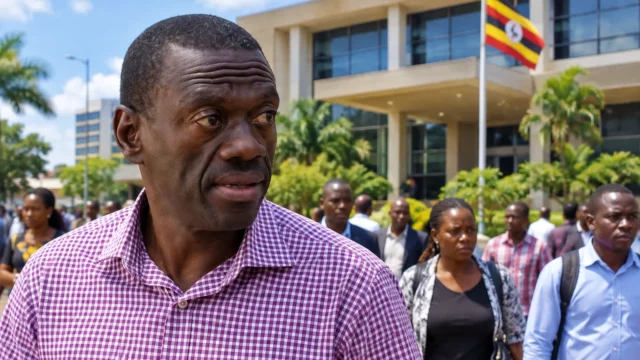
In Kampala, the Kizza Besigye case has long gone beyond the plight of a weakened opposition figure. It is testing Uganda’s judiciary, the role of the military in public life and the way East African capitals deal with their own opposition movements. The former presidential candidate, a historic figure in the Forum for Democratic Change, remains one of the most visible faces of the power struggle between the government and dissent in Uganda.
Besigye, a doctor by training, once a close ally of Yoweri Museveni and now a longstanding opponent, was arrested in Nairobi on 16 November 2024 before reappearing in Kampala and being brought before a military court. His transfer outside any conventional judicial process immediately raised questions about security co-operation between Kenya and Uganda, and then about the law applicable to a civilian prosecuted before a military court.
What the judicial and diplomatic record shows
On 31 January 2025, Uganda’s Supreme Court ruled that the prosecution of civilians in courts martial was unconstitutional. Uganda’s parliament subsequently summarised the ruling as ending, with immediate effect, the trial of civilians in military courts. The decision put the Besigye case at the centre of a wider debate about the rule of law in Uganda.
Yet the proceedings have not disappeared from view. In February 2025, news agency reports showed Besigye appearing weak and then briefly appearing before a civilian court, while his family and lawyers raised the alarm about his health. In May 2025, Kenya’s foreign affairs minister, Musalia Mudavadi, acknowledged in a television interview that Nairobi had “co-operated with the Ugandan authorities” in the case, citing the national interest. This admission reinforced the view that the arrest was not merely an internal Ugandan matter.
The case has also taken on a regional dimension before the East African Court of Justice. The petition filed by Besigye and other claimants argues that the cross-border arrest, incommunicado detention and forced transfer from Nairobi to Kampala violated the principles of the East African Community treaty, which protects fundamental rights and the rule of law, among other things. At this stage, the case illustrates a simple fact: when security services co-operate across borders, judicial remedies must follow the same geography.
On 12 February 2026, Amnesty International said Besigye had been arbitrarily detained for more than 400 days at Luzira prison in Kampala and was suffering from an illness requiring urgent specialist care. In July 2026, the Associated Press was still reporting his hospitalisation after he fell ill during a court hearing. These developments confirm that the case is not closed and that his physical condition has now become a political issue in its own right.
What the Besigye case reveals about Uganda and the region
The Besigye case first shows how central the army is to Uganda’s machinery of power. For more than 40 years, Yoweri Museveni has dominated the national political scene, while the presence of his son, General Muhoozi Kainerugaba, at the head of the army has fuelled questions about the boundary between military command, domestic security and political competition. In this context, the arrest of an opposition figure is not simply a police action; it becomes a signal to the government’s opponents.
The case also has a tangible impact on ordinary Ugandans. In Kampala, the issue is not abstract: it concerns access to a fair trial, the right to a doctor chosen by the detainee, and a citizen’s ability to challenge the government without risking a spiral of repression. Lawyers, human rights organisations and some opposition figures see it as a precedent for other political cases, in a country where the recent period has also been marked by the arrests of activists and lawyers.
Kenya, meanwhile, has emerged weakened from this episode. Nairobi has long presented itself as a relative haven for political refugees in the region. The Besigye case, alongside other reported disappearances and abductions in Nairobi, has blurred that image. Above all, it suggests that in East Africa, security co-operation can sometimes take precedence over the safeguards afforded to opposition figures, activists and exiles. This development alarms human rights defenders, as well as lawyers concerned with the credibility of the East African Community.
Institutionally, the precedent carries considerable weight. The Supreme Court’s ruling of 31 January 2025 reaffirmed that civilians do not fall under the jurisdiction of military courts. If an opposition figure of such stature can remain in detention despite that reminder, the question becomes broader: how binding do the authorities consider judicial decisions when they conflict with the security agenda? This is what makes the Besigye case more than a political news story.
A case weighing on the 2026 election campaign and the region’s image
With Uganda’s 2026 presidential election only months away, the case is already weighing on the political climate. It further narrows the space for the opposition as the country enters a period in which restrictions on rallies, targeted arrests and control of public narratives take on particular importance. Besigye is no longer just a sick man. He has become a symbol of a style of government that his opponents consider increasingly closed.
At continental level, the case also raises questions about the spread of democratic standards within African regional bodies. The East African Court of Justice, Uganda’s Supreme Court and the Kenyan authorities are now linked by a case involving political freedom, de facto extradition and respect for procedural safeguards. In the region, the next point to watch is simple: whether judicial decisions and appeal mechanisms will be followed through, or whether security logic will continue to prevail over the protections set out in law.