Algeria
 Egypt
 Libya
 Morocco
 Sudan
 Tunisia
 Burkina Faso
 Cabo Verde
 Côte d'Ivoire
 Ghana
 Guinea
 Guinea-Bissau
 Liberia
 Mali
 Mauritania
 Niger
 Nigeria
 Senegal
 Sierra Leone
 The Gambia
 Togo
 Cameroon
 Central African Republic
 Chad
 DR Congo
 Equatorial Guinea
 Gabon
 Republic of the Congo
 São Tomé and Príncipe
 Burundi
 Comoros
 Djibouti
 Eritrea
 Ethiopia
 Kenya
 Madagascar
 Malawi
 Mauritius
 Mozambique
 Rwanda
 Seychelles
 Somalia
 South Sudan
 Tanzania
 Uganda
 Angola
 Botswana
 Eswatini
 Lesotho
 Namibia
 South Africa
 Zambia
 Zimbabwe
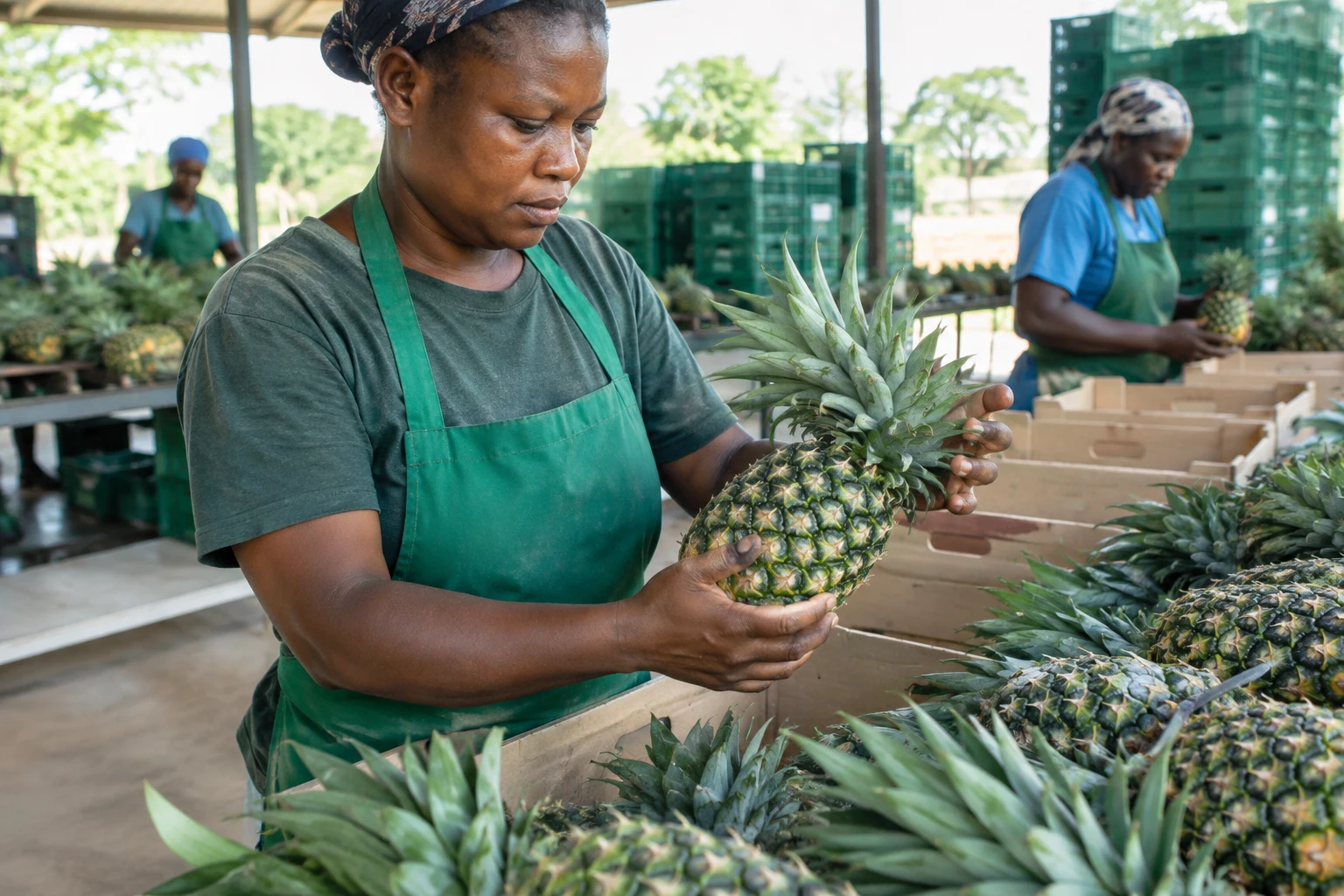
A pineapple can be ripe without being yellow. For Benin’s “Sugarloaf” variety, this difference in colour is a taste advantage, but also a commercial challenge: convincing buyers, protecting the fruit during transport and ensuring consistent quality from the field to the shop shelf.
Allada, its terroir and a mark of quality
Production is concentrated in particular on the Allada plateau, in southern Benin. The variety is known for its sweet, low-acid flesh. In October 2020, the African Intellectual Property Organization (OAPI) registered the Sugarloaf pineapple from the Allada Plateau as a protected geographical indication (PGI). This label links the product’s reputation to its territory and to a set of specifications. However, it does not by itself guarantee that every fruit will be uniform. Recognition of the PGI for Benin’s Sugarloaf was announced on 30 October 2020.
This added value forms part of a broader strategy: selling more processed or differentiated agricultural products, rather than relying solely on volumes. For producers in Allada and neighbouring municipalities, the challenge is to earn a better return from the harvest. For exporters, it is about delivering a product that is identifiable, traceable and compliant with market requirements. PGI rules entail collective organisation and inspections; the protected name therefore does not replace sorting or sound agricultural practices.
A fragile fruit and demanding logistics
In European markets, the colour can puzzle consumers accustomed to yellow pineapples. Sugarloaf often remains greenish when ripe. Explaining this characteristic becomes part of the commercial effort: without clear information, its appearance can be mistaken for a lack of ripeness.
Air freight reduces the time between harvesting and sale, but its cost puts the fruit in the premium segment. The source material cites a price of five to seven euros per fruit in France and describes delivery in about 24 hours. These figures depend on the market, season and operator; they are not a uniform price or transit time. The supply chain must therefore balance freshness, an acceptable price and consistent supply.
The challenge does not end at the airport. Irregular sizes or variations in quality complicate wholesalers’ orders and can undermine buyers’ confidence. Producers, packing stations and transporters depend on one another: a break in the cold chain or inadequate sorting can reduce the value of an entire shipment. The PGI gives the product an identity; consistent quality must make that identity credible, harvest after harvest.
China, a new market now open
The Chinese market is no longer merely a prospective destination. On 18 March 2026, the first official shipment of Sugarloaf pineapples to China was launched in Allada. Beninese media and the Chinese embassy in Benin reported the milestone, following the protocol concluded between the two countries in 2023. The market opening marks a beginning, not yet proof of a regular, large-scale outlet.
Diversification can reduce dependence on a single overseas market. But access to China also requires compliance with phytosanitary requirements, the maintenance of traceability and the development of lasting commercial relationships. A first shipment introduces the product; repeat orders will depend on quality, prices and the ability to deliver on time.
Production figures, too, need to be dated. A publication by the Beninese government reports production of 483 539 tonnes in 2024 and forecasts 511 000 tonnes for 2025. These figures cover national pineapple production and should not be confused with the export volume of the Sugarloaf variety alone. The older estimates of 500 000 tonnes produced and 6 000 tonnes exported, cited in the original material, therefore do not necessarily describe the current situation.
The fruit terminal, a link in the chain awaited
As China becomes accessible, Benin is also strengthening its export facilities. The fruit terminal at Cotonou airport is intended to bring together handling, pre-cooling, temperature-controlled storage and shipping formalities. The project has an announced capacity of 736 pallets. According to an update published by the PACOFIDE programme on 30 September 2026, construction is complete, but the facility is still being prepared ahead of commissioning. It would therefore be premature to present it as already fully operational.
This infrastructure can limit losses and facilitate the dispatch of fresh fruit. On its own, it does not resolve the difficulties faced on farms: plant selection, harvest timing, uniformity of batches and producers’ access to equipment. The benefits will also depend on how small-scale producers can access packing and logistics services, rather than being left out of export channels.
Beyond Benin, the battle for value
For Benin, whose capital is Porto-Novo, Sugarloaf links local agriculture, rural jobs and international trade. Across West Africa, the case highlights a question shared by agricultural supply chains: how to turn a reputation and a terroir into lasting incomes without sacrificing quality or concentrating the gains in the hands of intermediaries alone.
The next steps are concrete: the terminal’s effective commissioning, regular shipments to China and maintaining quality in European markets. Success will not be measured only by the number of pallets sent. It will also depend on the share of value that reaches producers and the supply chain’s ability to honour its commitments over several seasons.