Algeria
 Egypt
 Libya
 Morocco
 Sudan
 Tunisia
 Burkina Faso
 Cabo Verde
 Côte d'Ivoire
 Ghana
 Guinea
 Guinea-Bissau
 Liberia
 Mali
 Mauritania
 Niger
 Nigeria
 Senegal
 Sierra Leone
 The Gambia
 Togo
 Cameroon
 Central African Republic
 Chad
 DR Congo
 Equatorial Guinea
 Gabon
 Republic of the Congo
 São Tomé and Príncipe
 Burundi
 Comoros
 Djibouti
 Eritrea
 Ethiopia
 Kenya
 Madagascar
 Malawi
 Mauritius
 Mozambique
 Rwanda
 Seychelles
 Somalia
 South Sudan
 Tanzania
 Uganda
 Angola
 Botswana
 Eswatini
 Lesotho
 Namibia
 South Africa
 Zambia
 Zimbabwe
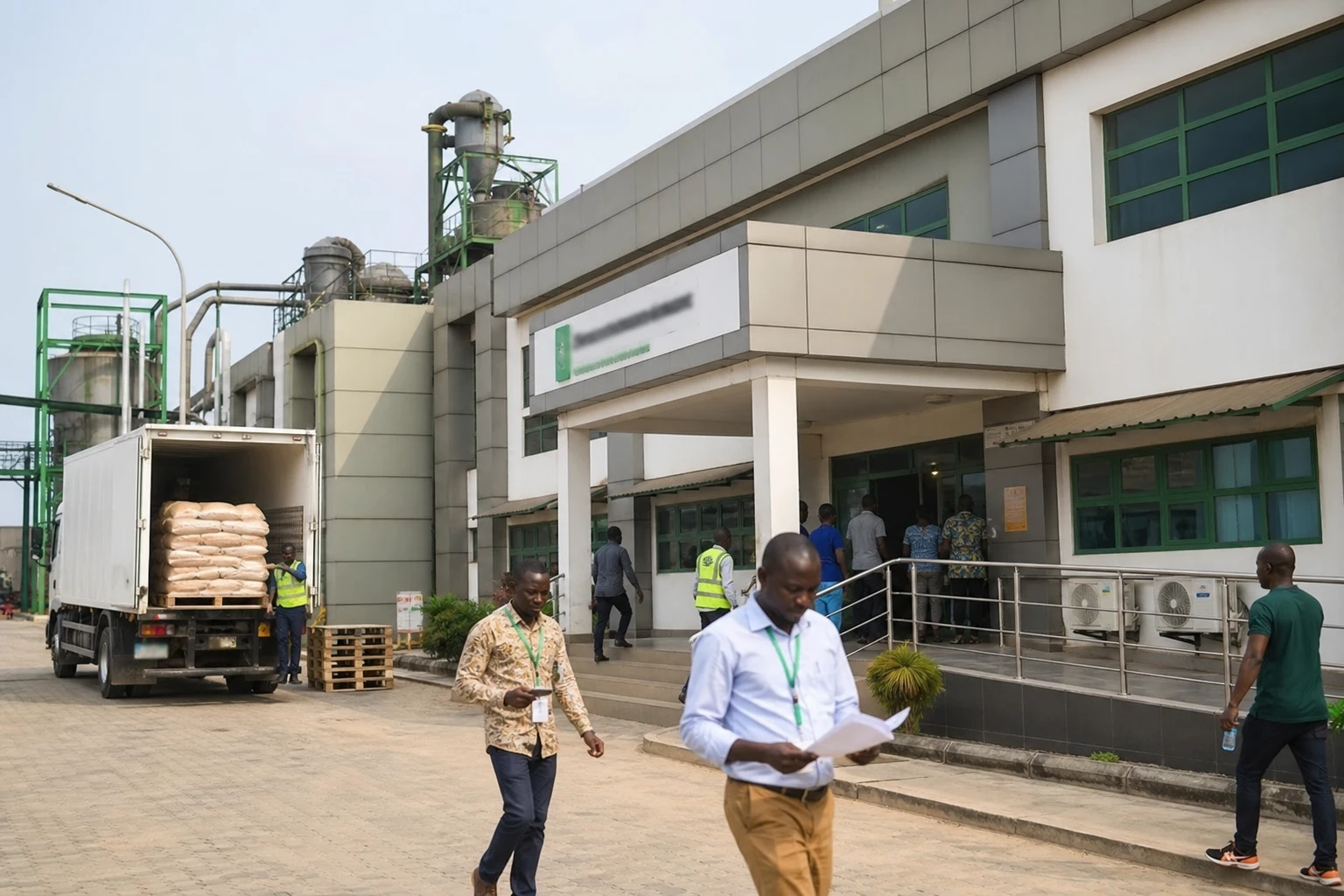
Beninese soybeans enter the industrial era
In Porto-Novo, the debate is no longer just about agriculture. It now centres on a simple question: what should be done with production that is rising fast, when outlets for raw crops are closing and added value can stay in the country? In the soybean sector, Benin is moving along precisely this fault line, between expanding harvests and building a stronger industrial base.
This shift forms part of the industrialisation strategy pursued by the Beninese state for several years, with the Glo-Djigbé Industrial Zone, north of Cotonou, as its centrepiece. The GDIZ was designed to process agricultural raw materials on site, including cotton, cashew nuts and soybeans. It is also intended to bring production, processing and exports closer together in a member country of ECOWAS, where regional trade remains closely tied to trade policy decisions.
One plant, two functions, one value-chain approach
On 4 September 2026, EHUA Industries commissioned its agro-industrial complex at the GDIZ. The site, spread across 8 hectares, represents an announced investment of CFA francs 28 billion, or around $50 million. It includes a soybean crushing unit with a stated capacity of 300 tonnes a day, as well as a plant producing complete animal and poultry feed, capable of turning out up to 180,000 tonnes a year. Several Beninese media outlets confirmed the ceremony and the announced specifications of the project.
This is not simply an addition to capacity. The project’s significance lies in its dual function. On the one hand, it takes in more locally grown beans. On the other, it turns soybean by-products into inputs for livestock farming. In other words, the bean is no longer just a commodity to be sold, but the starting point of a longer chain linking agriculture, animal feed and industry. This is where some of the food sovereignty sought by the Beninese authorities is at stake.
The investment is also part of an already more developed industrial landscape. As early as 2023, the GDIZ announced soybean-processing capacity of 260,000 tonnes a year, with an expected increase to 600,000 tonnes by the end of 2024. The new site is therefore not arriving in an industrial vacuum. Rather, it is driving forward a system seeking to keep pace with a sector that has become strategic for the national economy.
Producers more tied to the domestic market, but better connected to industry
The expansion of factories comes as the Beninese state has tightened controls on the marketing of whole soybeans. The Council of Ministers on 11 December 2024 confirmed the ban on exporting soybeans by land for the 2024-2025 season. The stated aim is clear: to keep more raw material in the country to supply local plants and limit fraudulent shipments to neighbouring countries.
For producers, this policy has two sides. It reduces the flexibility to sell abroad, but it can also stabilise sales if industry keeps pace. The real challenge then becomes striking a balance between the price paid at the farm gate, factories’ purchasing capacity and the regularity of supply. If industrial buyers are scarce, the constraint turns against producers. If plants are operating, the sector gains a clearer market and more predictable demand.
The figures show that Benin is entering this phase with an already expanded agricultural base. Soybean production rose from 257,000 tonnes in 2019 to 520,929 tonnes in 2023, according to the Directorate of Agricultural Statistics, as cited by INStaD. The government is targeting 770,000 tonnes for the 2026-2027 season. Between 2019 and that target, the country is therefore aiming for an almost threefold increase in volumes in less than a decade.
The new crushing unit’s theoretical capacity illustrates this change in scale. At 300 tonnes a day, operating for 300 days would mean processing around 90,000 tonnes a year. That is not enough to absorb the entire national harvest, but it provides a significant additional outlet, especially when the animal-feed plant is included. In practice, the impact will depend on supply levels, logistics and collection costs in production areas.
What this means for Benin and West Africa
For Benin’s economy, the stakes go beyond soybeans themselves. The country is seeking to move away from a model in which raw materials leave the country before being processed. In this approach, the GDIZ serves as a bridge between agriculture and industry, while strengthening related sectors such as livestock farming, animal nutrition and port logistics. The Port of Cotonou, land corridors and neighbouring markets therefore remain central to the system, even as current policy seeks to exercise greater control over outflows.
The regional significance is real. Benin trades within an area where economic borders are porous, particularly with Nigeria, its natural leading partner in the neighbourhood. A soybean-crushing and animal-feed plant can supply not only the domestic market but also sub-regional outlets, provided quality, volumes and rules governing movement are in place. It is also a signal to other ECOWAS countries: the contest is no longer just about production, but about the capacity to process locally.
Across Africa, Benin’s case illustrates a broader trend: states want to capture more value from their agricultural products instead of leaving most of the margins to external markets. Beninese soybeans are thus becoming a marker of industrial policy, not merely a cash crop. The next stage to watch will therefore be less the inauguration ceremony than the plant’s actual operating rate, its capacity to buy from producers, and the consistency between national production, collection and processing.