Algeria
 Egypt
 Libya
 Morocco
 Sudan
 Tunisia
 Burkina Faso
 Cabo Verde
 Côte d'Ivoire
 Ghana
 Guinea
 Guinea-Bissau
 Liberia
 Mali
 Mauritania
 Niger
 Nigeria
 Senegal
 Sierra Leone
 The Gambia
 Togo
 Cameroon
 Central African Republic
 Chad
 DR Congo
 Equatorial Guinea
 Gabon
 Republic of the Congo
 São Tomé and Príncipe
 Burundi
 Comoros
 Djibouti
 Eritrea
 Ethiopia
 Kenya
 Madagascar
 Malawi
 Mauritius
 Mozambique
 Rwanda
 Seychelles
 Somalia
 South Sudan
 Tanzania
 Uganda
 Angola
 Botswana
 Eswatini
 Lesotho
 Namibia
 South Africa
 Zambia
 Zimbabwe
Heritage still dispersed, but strategy now more structured
In Porto-Novo, the issue is no longer only the return of works of art. It also concerns how a country reclaims its archives, narratives and landmarks. For Benin, heritage restitution is no longer an isolated symbolic gesture; it is now part of a broader public policy, developed with legal experts, curators and museums under construction.
The movement has gathered pace since the return, in November 2021, of 26 royal treasures from Dahomey, following a specific French law and a bilateral agreement between Paris and Cotonou. The pieces, from the palace of Abomey, set an important precedent in cultural relations between the two countries.
Four years later, the issue has returned with a new request: 35 cultural artefacts and archives held in French public collections. On 14 July 2026, the Beninese government established a national scientific committee in Cotonou to compile the dossier and support the future joint Franco-Beninese scientific commission.
What Cotonou is seeking, and why France’s legal framework changes the picture
France adopted a framework law in May 2026 on the restitution of cultural property that has been unlawfully appropriated. The law, passed definitively in the spring, is intended to facilitate restitutions without challenging the principle that public collections are inalienable — that is, that works belonging to national museums cannot be freely sold.
Until now, each return required a specific law. This was the case for the 26 Beninese works in 2020, and then for the talking drum Djidji Ayôkwé, returned to Côte d’Ivoire in 2026. With this new framework, Paris has a more flexible tool for handling requests already submitted or in preparation. The French Ministry of Culture describes the change as a historic step in heritage policy.
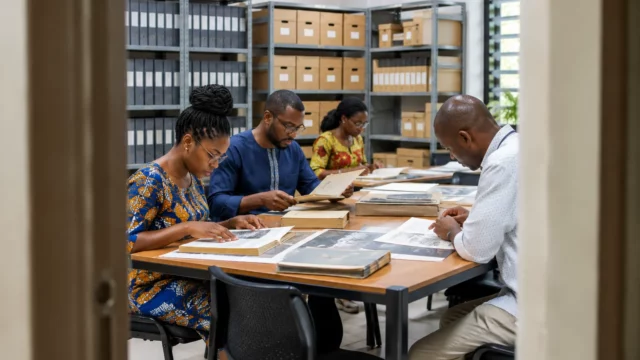
In Benin’s case, the authorities are referring to cultural property and archives. This distinction matters. The works relate to the material history of the kingdom of Dahomey, while the archives help document the country’s political, diplomatic and museum histories. The expected return would therefore involve not only objects for display, but also sources of knowledge.
Benin is not starting from scratch. The country has already strengthened its legal framework for heritage protection and launched several museum projects. The preparatory committee for the Museum of the Kings and Amazons of Dahomey, in Abomey, is among the institutional mechanisms established to prepare for the reception of restituted collections.
A heritage claim, but also a diplomatic signal
The return of the 26 works in 2021 had already shown that Cotonou could turn a matter of historical memory into diplomatic leverage. The Beninese government presented the return of the royal treasures as a step, not an end point. The new request for 35 artefacts and archives extends that approach: broadening its scope, stabilising the mechanisms and embedding heritage in a more balanced bilateral relationship.
Domestically, the stakes extend beyond expert circles. Museums and conservation centres can become places of education, cultural tourism and research. For cities such as Abomey and Cotonou, this means different kinds of benefits: skilled jobs, cultural engagement, more visitors to sites, and the promotion of a history long kept outside the country.
The issue also has political significance. In an ECOWAS country, heritage restitution concerns cultural sovereignty as much as international co-operation. Benin says it is not asking for an act of goodwill, but for recognition of a specific historical trajectory, documented and now better supported by law. This view reflects a wider trend across the continent, where several West African states have long called for the return of objects taken during colonisation.
At the same time, France is seeking to show that it can handle these cases without departing from principle, by incorporating them into stronger cultural, scientific and museum co-operation. In other words, restitution is no longer seen only as a correction of the past. It is also becoming a shared field of work for institutions, researchers and curators in both countries.
What to watch in the coming months
What happens next will depend on the work of the Beninese scientific committee, the quality of the documentary dossier and the establishment of the joint Franco-Beninese scientific commission. The decisions to come will show whether France’s framework law becomes a genuine tool for restitution or merely a procedural framework.
For Benin, the stakes are clear: to establish continuity between the restitutions already secured, the new requests and the development of infrastructure capable of conserving, studying and displaying these items in suitable conditions. For West Africa, the case confirms that dispersed heritage can once again become a matter of public policy, regional co-operation and shared memory.