Algeria
 Egypt
 Libya
 Morocco
 Sudan
 Tunisia
 Burkina Faso
 Cabo Verde
 Côte d'Ivoire
 Ghana
 Guinea
 Guinea-Bissau
 Liberia
 Mali
 Mauritania
 Niger
 Nigeria
 Senegal
 Sierra Leone
 The Gambia
 Togo
 Cameroon
 Central African Republic
 Chad
 DR Congo
 Equatorial Guinea
 Gabon
 Republic of the Congo
 São Tomé and Príncipe
 Burundi
 Comoros
 Djibouti
 Eritrea
 Ethiopia
 Kenya
 Madagascar
 Malawi
 Mauritius
 Mozambique
 Rwanda
 Seychelles
 Somalia
 South Sudan
 Tanzania
 Uganda
 Angola
 Botswana
 Eswatini
 Lesotho
 Namibia
 South Africa
 Zambia
 Zimbabwe
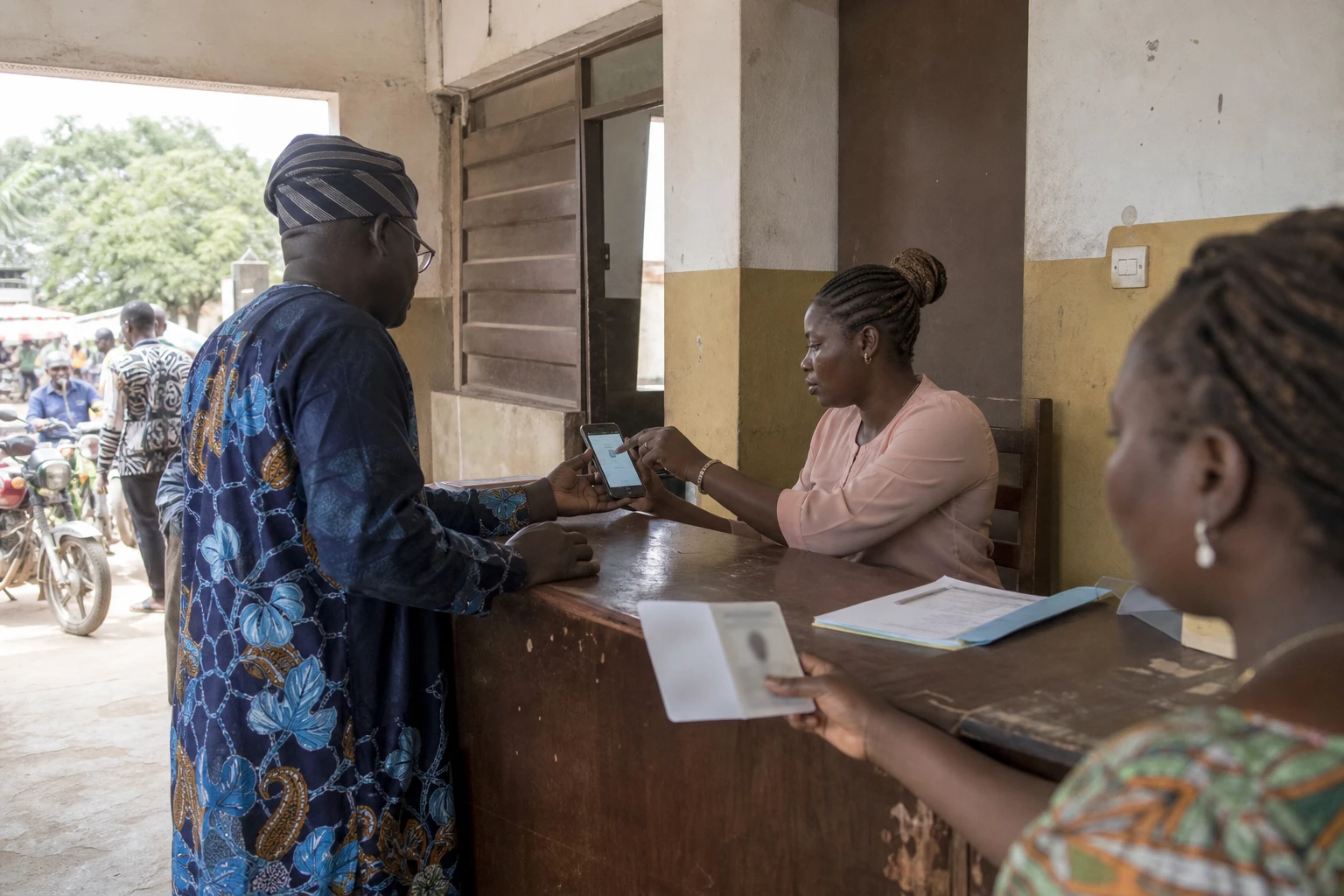
In Porto-Novo and in decentralised government services, public servants’ travel is entering a new era of oversight. In Benin, the payment of expenses for missions within the country must now be made through electronic channels, with the aim of linking authorisation, spending and verification in a single digital chain.
SEMO moves from administrative oversight to financial monitoring
On Sunday 27 September 2026, the Beninese government announced the implementation of a new phase of the System for Managing Official Missions, or SEMO. The system manages work-related travel by public administration staff.
The first version of SEMO was launched on 19 November 2020. It centralised the creation, approval and monitoring of mission orders. According to the Ministry of Economy and Finance, the platform was intended in particular to limit overlapping trips and identify fictitious staff or irregular missions.
The second phase extends this oversight to payments. Mission expenses must be processed electronically for travel within Benin. The system therefore aims to reduce the circulation of cash and leave a verifiable record of every transaction.
This development is based on new IT modules. They make it possible to monitor expenses incurred, link payments to mission orders and document the completion of trips more fully. The ministry describes this phase as a prerequisite for the effective operation of electronic payments for mission expenses.
A reform in line with Benin’s digital transformation
SEMO is not an isolated initiative. It is part of the gradual transformation of Benin’s administration, which has been under way for several years and focuses on digitising procedures, securing data and monitoring public resources.
When the platform was launched, the authorities had already announced their intention to move towards bank or electronic payments for mission expenses. The reform announced in September 2026 therefore delivers on a policy direction already included in the timetable for modernising public-sector management.
The intended process is relatively simple. An administration prepares a mission. The order is checked and approved. Expenses are then calculated and paid through an electronic channel. Finally, the information should make it possible to verify whether the trip actually took place and whether it matched the authorisation granted.
The next planned step is the geolocation of public servants. This should make it possible to compare the authorised mission, the route taken and the expenses incurred. However, this feature raises an important requirement: rules on the use of data will need to be clearly defined, particularly to protect staff members’ personal information.
A response to duplicate bookings and hard-to-verify spending
In an administration where missions involve both ministries and local services, manual monitoring can multiply risks. The same staff member may be listed for several trips. An expense may be recorded late. A mission may still be declared without sufficiently precise proof that it took place.
Digital centralisation does not automatically eliminate these risks. However, it gives auditors a more complete picture of transactions. Data can be cross-checked. Anomalies become easier to identify. Managers also have a record of approvals and payments.
For public servants, the change should reduce cash payments and make processing times more formal. But its effectiveness will depend on access to banking services or electronic money, particularly in rural areas and municipalities far from Cotonou.
The move to digital systems will also need to take administrative realities into account. Staff responsible for entering and approving missions will need training. Departments will need a sufficiently reliable internet connection. Contingency procedures will have to remain available in the event of a breakdown or network outage.
Budget transparency is improving, but oversight must keep pace
The reform comes as Benin seeks to improve the traceability of its public finances. In the 2023 Open Budget Survey, published by the International Budget Partnership, the country scored 79 out of 100 for budget transparency. The score measures, among other things, public access to information on the collection and use of state resources.
The same ranking gave Benin 31 out of 100 for public participation and 61 out of 100 for budget oversight. These results point to a mixed picture: financial information is more accessible, but citizen oversight and monitoring mechanisms can still be strengthened.
The 2025 edition of the survey reports a 21-point increase in public participation, to 52 out of 100. This change is linked to the introduction of mechanisms enabling civil society to monitor and examine budget execution more closely. SEMO can complement this progress, provided its data are used by oversight bodies and, where possible, made available to the public.
The official platform for the System for Managing Official Missions says the system is intended to help manage spending more efficiently, safeguard public resources and take account of electronic payments for expenses.
An issue extending beyond central government
The main test will be how the reform is implemented in practice. A platform can record mission orders and payments. On its own, it cannot replace managerial oversight, audits or penalties for irregularities.
Equity between regions will also be an issue. Administrations in Porto-Novo, Cotonou and the major cities generally have better digital equipment. Services in less connected departments will need appropriate support to ensure the reform does not create a new administrative divide.
At the level of the Economic Community of West African States, Benin’s approach is part of a broader drive to modernise public finances. Governments are seeking to monitor spending more closely, secure payments and bring administrations closer to digital tools.
For Benin, the next milestone will be the effective rollout of the new features, followed by the planned integration of geolocation. SEMO’s success will then depend on three conditions: reliable data, protection for public servants and the ability of oversight institutions to use the information produced.