Algeria
 Egypt
 Libya
 Morocco
 Sudan
 Tunisia
 Burkina Faso
 Cabo Verde
 Côte d'Ivoire
 Ghana
 Guinea
 Guinea-Bissau
 Liberia
 Mali
 Mauritania
 Niger
 Nigeria
 Senegal
 Sierra Leone
 The Gambia
 Togo
 Cameroon
 Central African Republic
 Chad
 DR Congo
 Equatorial Guinea
 Gabon
 Republic of the Congo
 São Tomé and Príncipe
 Burundi
 Comoros
 Djibouti
 Eritrea
 Ethiopia
 Kenya
 Madagascar
 Malawi
 Mauritius
 Mozambique
 Rwanda
 Seychelles
 Somalia
 South Sudan
 Tanzania
 Uganda
 Angola
 Botswana
 Eswatini
 Lesotho
 Namibia
 South Africa
 Zambia
 Zimbabwe
In Benin, restitution does not end with the return of objects. It raises a broader question: how can these pieces be made accessible, documented and given a place in the national narrative ?
After the 26 royal treasures returned from France in November 2021, followed by the kataklè returned by Finland in May 2025, Cotonou is preparing a new stage. Beninese authorities have begun the scientific work required for a request covering 35 cultural objects and archives held in France.
A new request, but not yet a restitution
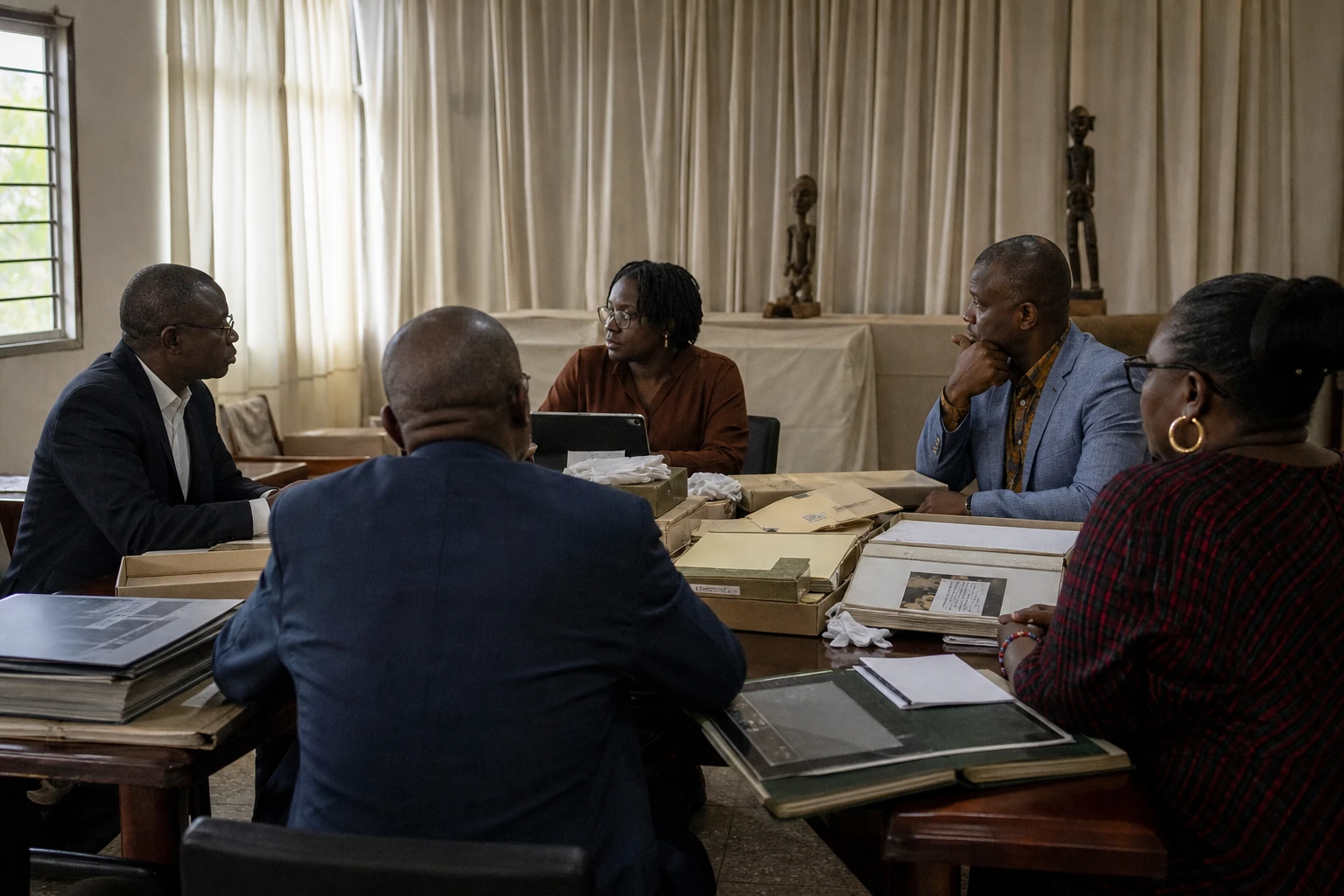
Benin’s Ministry of Culture has announced the creation of a joint scientific commission with France. Its task is to strengthen the national case, establish the objects’ provenance and prepare discussions between the two states.
This distinction is important. The 35 objects have not yet returned to Benin. They are the subject of a request and an assessment process. Restitution will then depend on identifying the pieces, proving their illicit appropriation and following the procedures set out in French law.
The case follows on from the official request made by Benin in 2016. Five years later, it led to the transfer of ownership of 26 works from the royal treasury of Abomey. The agreement signed on 9 November 2021 enabled their permanent return after more than a century in French collections.
The French legal context has since changed. Law No. 2026-351 of 9 May 2026 establishes a general framework for returning foreign cultural objects acquired through illicit appropriation. However, it requires each request to be supported by historical research and an opinion from a specialist national commission.
In other words, this new framework may make the process easier. It does not automatically turn every claim into a restitution decision. Each object will have to be examined separately, together with the requesting state and the institutions holding it.
From royal treasures to archives: a broader heritage
The first restitution mainly concerned objects associated with the court of Abomey, the historic capital of the kingdom of Danxomè. The collection included thrones, récades, statues and objects associated with royal power.
Beninese specialists still need to finalise the list of the 35 new objects. The announced work therefore concerns both physical objects and archives. These documents can shed light on political institutions, religious practices, diplomatic relations and the circumstances in which the collections left the country.
This approach broadens the scope of restitution. An object is not just a museum piece. It can be a historical source, a vehicle for passing on knowledge and an element of cultural sovereignty. It can also connect family narratives, oral traditions and academic research.
The case of the kataklè illustrates the need for such documentation. This three-legged royal stool, associated with the Kingdom of Dahomey, had been held at the National Museum of Finland since 1939. An official request submitted by Benin in November 2024 led to its transfer at a ceremony in Cotonou on 13 May 2025.
The kataklè thus joined the 26 works returned by France. It completes a group of 27 pieces taken during the conquest of the Kingdom of Dahomey in the late 19th century. This history also shows how African objects often passed between several European institutions before being claimed by their countries of origin.
The challenge of welcoming the objects in Benin
The return of the works does not, by itself, resolve the question of museums. In 2022, the 26 pieces from France were displayed at the Marina Palace in Cotonou. The exhibition attracted around 230 000 visitors between February and August.
Since then, the works have been held in storage pending their permanent installation in Abomey. Their announced destination is the Museum of the Kings and Amazons of Danxomè, or MuRAD, which is part of the royal palaces site listed as a Unesco World Heritage site.
The construction work must respect a fragile historic environment. The site’s palaces, courtyards and earthen walls cannot be treated as a simple building plot. Preserving the historic buildings, securing the works, training staff and providing high-quality educational content must therefore go hand in hand.
This wait is fuelling a legitimate debate in Benin. Should restitution end with the legal transfer of ownership ? Or should it also guarantee regular access for the public, researchers, schools and the communities concerned ?
The answer involves several stakeholders. The state must fund and oversee the facilities. Curators must ensure preservation and interpretation. Local authorities can strengthen the site’s local roots. Abomey residents, in turn, should benefit from the cultural, educational and economic opportunities generated by visits to the site.
A cultural network extending beyond Abomey
Benin’s strategy is not limited to the future museum in Abomey. In Porto-Novo, Benin’s political capital, the planned International Vodun Museum is intended to give a central place to religious, artistic and intangible heritage associated with vodun.
In Ouidah, the House of Memory and Slavery is part of a historic route that includes the Portuguese fort, the Slave Route and the Door of No Return. In Cotonou, the Museum of Contemporary Art is intended to link historic collections with contemporary art from Benin and its diasporas.
This network could help prevent the concentration of the entire national memory in one place. It could also spread jobs, training and tourism activity across several cities. Its success, however, will depend on consistent investment and the ability to make museums part of everyday life.
The Beninese government presents this policy as a means of passing on heritage, as well as a lever for the cultural and creative industries. Exhibitions devoted to contemporary Beninese art, shown in Morocco, Martinique and Europe, already demonstrate how heritage can engage with contemporary creation.
Regional and continental significance
The Beninese case resonates beyond West Africa. In several African countries, return requests concern objects taken during conquests, military expeditions or colonial rule. Nigeria, Côte d’Ivoire, Senegal, Ghana and the Democratic Republic of the Congo have also lodged claims with foreign institutions.
For the Economic Community of West African States, ECOWAS, these efforts concern the movement of researchers, cultural policies and the development of regional exchanges. They also raise questions about states’ ability to catalogue their collections and negotiate on the basis of documented cases.
The next milestone will therefore be less dramatic than a return ceremony. It will take place in archives, inventories and scientific commissions. Benin will have to demonstrate the provenance of the 35 objects it is seeking, while France will have to apply its new legal framework transparently.
In this process, the issue is not only who possesses the objects. It is also about control over narratives, access to knowledge and the ability of African institutions to preserve, exhibit and pass on their own heritage.
Benin’s Ministry of Culture on the case of the 35 cultural objects, the return of the kataklè from Finland and the French law of 9 May 2026 provide the main institutional information on the case.