Algeria
 Egypt
 Libya
 Morocco
 Sudan
 Tunisia
 Burkina Faso
 Cabo Verde
 Côte d'Ivoire
 Ghana
 Guinea
 Guinea-Bissau
 Liberia
 Mali
 Mauritania
 Niger
 Nigeria
 Senegal
 Sierra Leone
 The Gambia
 Togo
 Cameroon
 Central African Republic
 Chad
 DR Congo
 Equatorial Guinea
 Gabon
 Republic of the Congo
 São Tomé and Príncipe
 Burundi
 Comoros
 Djibouti
 Eritrea
 Ethiopia
 Kenya
 Madagascar
 Malawi
 Mauritius
 Mozambique
 Rwanda
 Seychelles
 Somalia
 South Sudan
 Tanzania
 Uganda
 Angola
 Botswana
 Eswatini
 Lesotho
 Namibia
 South Africa
 Zambia
 Zimbabwe
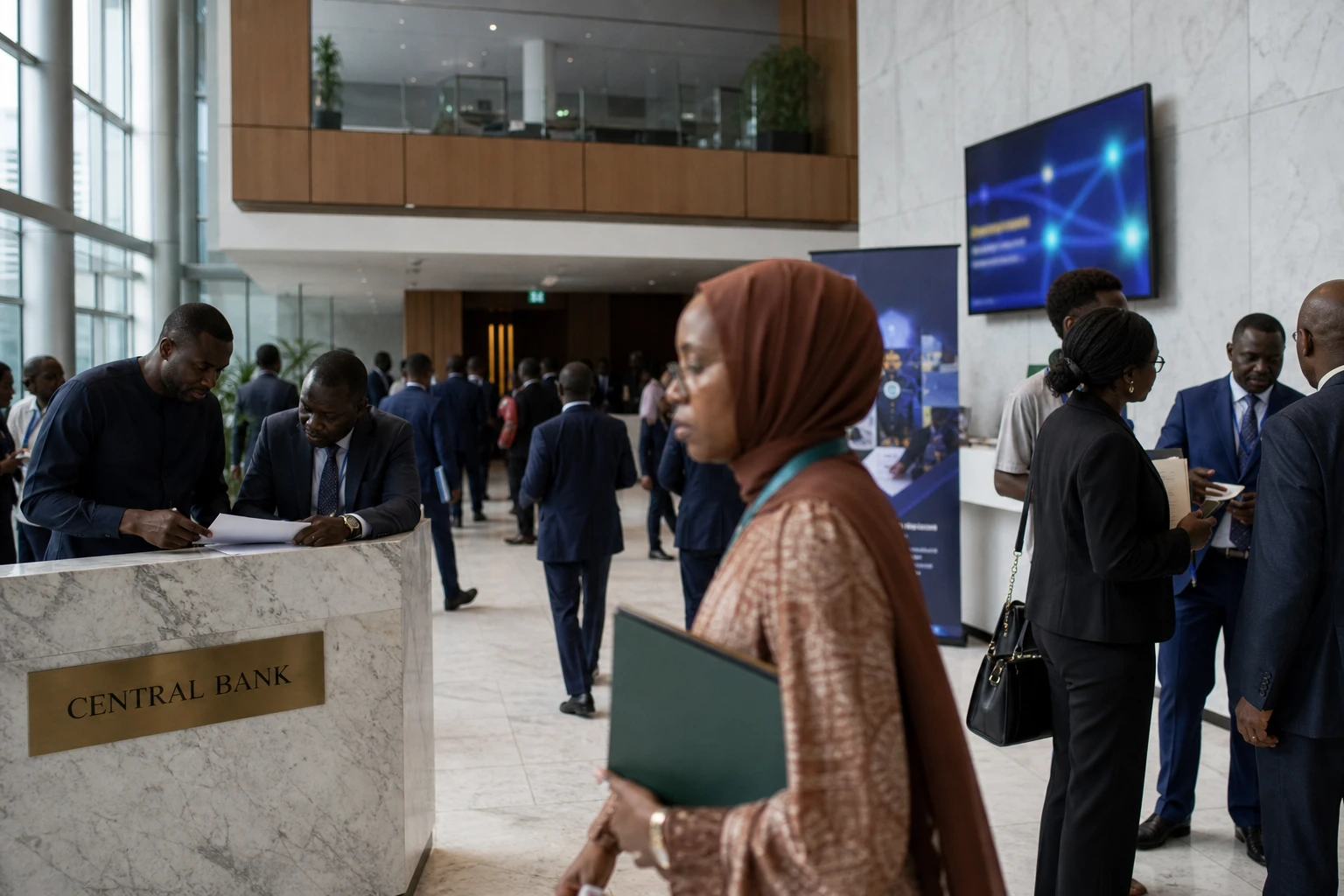
Payments still too often trapped in slow channels
Between Dakar and the other capitals of the West African Economic and Monetary Union, the issue is not merely technical. It affects the actual cost of a transfer, the speed of settlement and, ultimately, businesses’ ability to trade without unnecessarily tying up their cash. In a region where intra-African trade is still held back by correspondent banks outside the continent, every minute saved on a payment matters. The Pan-African Payment and Settlement System, or PAPSS, was specifically designed to reduce this dependence and enable settlement in local currencies.
BCEAO is proceeding cautiously on this issue. It is preparing a six-month pilot with more than 80 commercial banks in WAEMU, but intends to act as an observer, not a direct participant. This position reflects a regulatory oversight approach. Before opening the door more widely, the central bank wants to verify that the system complies with Union rules and that its technical integrations are robust.
A regional architecture already in motion
The initiative is taking shape in a particular monetary environment. WAEMU brings together eight West African countries under BCEAO, headquartered in Dakar. Further east on the continent, the African Continental Free Trade Area, or AfCFTA, provides the political framework for developing intra-African trade. PAPSS has been built into this ambition, linking central banks, commercial banks, payment service providers and fintechs in a single settlement infrastructure.
The regional timetable also shows that French-speaking Africa is picking up pace. The Bank of Central African States, BEAC, officially announced its accession to PAPSS in July 2026, according to its public communications, after several months of preparation. CEMAC, which comprises six Central African countries, thus becomes an additional anchor for the system. Convergence between CEMAC and WAEMU gives PAPSS a new reach in the CFA franc zone.
What BCEAO is preparing, and why it is taking its time
At the UMOA Economic Journalists’ Seminar in Dakar, BCEAO said it was not yet involved in PAPSS as an operator, but as an observer. The idea is simple: test first, validate afterwards. At this stage, technical and commercial agreements with the banks concerned and with the system’s operators are still being finalised. The pilot is expected to last six months, but its start date had not been publicly announced at that point.
The chosen format is not a trivial matter. Bringing more than 80 banks into a regional trial means addressing very practical questions: system interoperability, settlement procedures, risk management, foreign exchange processing and compliance with exchange-control rules. BCEAO wants to ensure that a tool designed to speed up payments does not create new regulatory bottlenecks in a monetary union where cross-border transactions remain tightly controlled.
The contrast with the path already taken in the domestic market is clear. The Interoperable Instant Payment System Platform, or PI-SPI, was launched by BCEAO in Dakar on 30 September 2025. In August 2024, the central bank had already said that 90 institutions were participating in its pilot phase, including 67 banks, nine electronic money institutions and 14 decentralised financial systems. In June 2026, it extended the connection deadlines: banks, electronic money institutions and payment institutions now have until 30 September 2026, while microfinance institutions have until 30 June 2027.
PAPSS, a tool for integration and a test of operational sovereignty
PAPSS was developed by Afreximbank with the African Union Commission and the AfCFTA Secretariat. Its principle is to make fast cross-border payments in local currencies, without routing each transaction through the US dollar or the euro or through a chain of correspondent banks outside Africa. The system says it processes transfers in under two minutes and claims an expanding network of central banks, commercial banks, fintechs and other intermediaries.
The available figures are changing rapidly. In a briefing document published in June 2026, PAPSS says it connects more than 270 financial institutions in 15 African countries, with a further 170 institutions accessible through its extended network. On its website, the system also highlights its growing presence across the continent, with new entrants announced in 2025 and 2026, including Morocco and Algeria, as well as a partnership in Kenya. This points to a genuine expansion, even if coverage remains uneven across sub-regions.
For WAEMU banks, the stakes go beyond the speed of transfers. More direct access to PAPSS could reduce some of the friction associated with external correspondent banks, lower transaction costs and keep more value within African payment channels. For small and medium-sized enterprises, the expected benefits are even more tangible: less waiting, greater certainty over settlement and better visibility over cash flow. For the authorities, however, opening up the system requires close monitoring of flows, compliance risks and foreign-currency settlement rules.
What to expect for WAEMU and beyond
The continental significance of the issue lies in the convergence of three trends. First, the growing reach of a pan-African payment tool. Second, the consolidation of regional building blocks such as PI-SPI in West Africa. Finally, CEMAC’s gradual entry into the same ecosystem. If BCEAO continues its assessment and the pilot confirms PAPSS’s compatibility with the WAEMU framework, French-speaking Africa could gain a clearer and faster cross-border payment corridor.
One simple reality remains: technology alone is not enough. In payment systems, success depends as much on IT interfaces as on trust between central banks, the pace of regulatory harmonisation and institutions’ ability to connect without service interruptions. That is why BCEAO’s caution is not a sign of delay. It looks more like a methodical phase of safeguards before a possible expansion.
In the short term, the points to watch are clear: the pilot announced by BCEAO, the effective expansion of PI-SPI in WAEMU and the integration of CEMAC banks into PAPSS must now be monitored together. This is where the next stage in African payment integration will take shape in practice.