Algeria
 Egypt
 Libya
 Morocco
 Sudan
 Tunisia
 Benin
 Burkina Faso
 Cabo Verde
 Côte d'Ivoire
 Ghana
 Guinea
 Guinea-Bissau
 Liberia
 Mali
 Mauritania
 Niger
 Nigeria
 Senegal
 Sierra Leone
 The Gambia
 Togo
 Cameroon
 Central African Republic
 Chad
 DR Congo
 Equatorial Guinea
 Gabon
 Republic of the Congo
 São Tomé and Príncipe
 Burundi
 Comoros
 Djibouti
 Eritrea
 Ethiopia
 Kenya
 Madagascar
 Malawi
 Mauritius
 Mozambique
 Rwanda
 Seychelles
 Somalia
 South Sudan
 Tanzania
 Uganda
 Botswana
 Eswatini
 Lesotho
 Namibia
 South Africa
 Zambia
 Zimbabwe

In Luau, Angola seeks to move the corridor from rail to the real economy
In Angola’s far east, the question is no longer simply how to move copper or fuel. It is who will capture the value when trains stop, trucks load and goods switch modes of transport. That is the challenge at the heart of a planned logistics platform announced in Luau, in Moxico-Leste province, on the border with the Democratic Republic of Congo and not far from Zambia.
The project forms part of a broader trajectory: that of the Lobito Corridor, a strategic route linking the Atlantic port of Lobito to the country’s interior and then to the markets of the DRC and Zambia. Angola is taking a regional view of its infrastructure. The country is a member of the SADC, the Southern African Development Community, and the corridor is intended to serve mining exports as well as agricultural, industrial and commercial trade.
What is planned in Luau, and why this border location matters
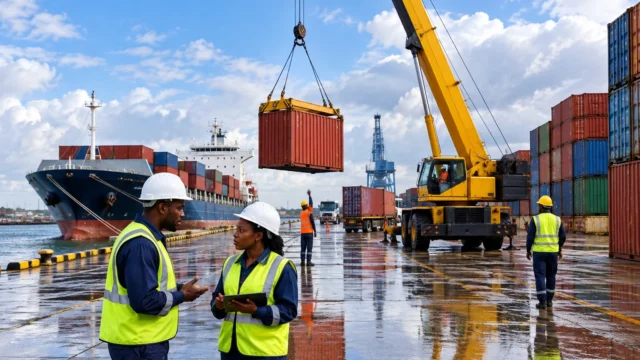
Angolan authorities opened a public tender in 2022 for the concession to develop the Luau logistics platform. The contract covers the design, construction, operation and commercial management of the site for 30 years. The corridor’s presentation documents also refer to ambient-temperature warehouses with an initial capacity of about 583 tonnes, a fuel terminal, a mining terminal and industrial areas focused on grain milling and precast concrete.
This technical detail says a great deal about Angola’s strategy. The aim is not only to move minerals to the coast more quickly. It is also to create, inland, a transhipment hub where storage, light processing, distribution and services come together. In short, Luau could become a place where freight does not merely pass through; it can also be consolidated, handled, rerouted and taxed locally.
Luau’s location reinforces this logic. The town lies on the roughly 1,300-kilometre Lobito-Luau railway, which crosses several Angolan provinces before reaching the DRC. The EITI platform’s report on the corridor notes that the line forms part of a broader system combining rail, port and logistics facilities along the route.
An industrial gamble as much as a governance issue
For Angola, the issue goes beyond logistics alone. Moxico-Leste province, where Luau is a key hub, is also seeking to attract industrial investment. The provincial government presents the site as a future development hub capable of hosting transport, industrial and commercial activities. This direction aligns with the national diversification strategy in a country long dependent on oil and still focused on the tangible benefits of its major projects.
But the Lobito Corridor is not without questions. The EITI report notes that the Angolan railway is already operating under a 30-year concession awarded to Lobito Atlantic Railway, while other parts of the corridor rely on public-private arrangements that remain fragile. The same document highlights the financial and operational constraints affecting cross-border links, particularly in the DRC and Zambia. In other words, the corridor’s effectiveness depends less on any single piece of infrastructure than on coherence among several states, operators and governance systems.
That is where much of the contest will be decided. If co-ordination holds, Luau can become a gateway for mining exports, but also an entry point for consumer goods, agricultural inputs and construction materials bound for eastern Angola. If it falters, the platform risks remaining another project on a route already highly exposed to implementation delays, administrative bottlenecks and imbalances between mining interests and the needs of the domestic market.
What Luau could change for Angola and southern Africa
At regional level, the corridor’s appeal is clear. It links three countries, two major mining basins and an Atlantic port. For Zambia and the DRC, it offers an alternative to longer routes to the Indian Ocean. For Angola, it could strengthen Lobito’s position as southern Africa’s maritime gateway. For SADC, it is a practical test of whether cross-border infrastructure can genuinely support trade integration, beyond statements of principle.
The corridor is already attracting significant external backing. The European Union has included it among its flagship Global Gateway projects, while the United States and other partners see it as a lever for critical minerals value chains, trade and training. But the work is still under way. The next steps will be decisive: completion of studies, launch of the tender, selection of the concessionaire and, above all, the ability to make rail, port, road and industrial zones work together. Only then will Luau cease to be a mere border terminus and become a genuine development platform for eastern Angola.