Algeria
 Egypt
 Libya
 Morocco
 Sudan
 Tunisia
 Benin
 Burkina Faso
 Cabo Verde
 Côte d'Ivoire
 Ghana
 Guinea
 Guinea-Bissau
 Liberia
 Mali
 Mauritania
 Niger
 Nigeria
 Senegal
 Sierra Leone
 The Gambia
 Togo
 Cameroon
 Central African Republic
 Chad
 DR Congo
 Equatorial Guinea
 Gabon
 Republic of the Congo
 São Tomé and Príncipe
 Burundi
 Comoros
 Djibouti
 Eritrea
 Ethiopia
 Kenya
 Madagascar
 Malawi
 Mauritius
 Mozambique
 Rwanda
 Seychelles
 Somalia
 South Sudan
 Tanzania
 Uganda
 Botswana
 Eswatini
 Lesotho
 Namibia
 South Africa
 Zambia
 Zimbabwe
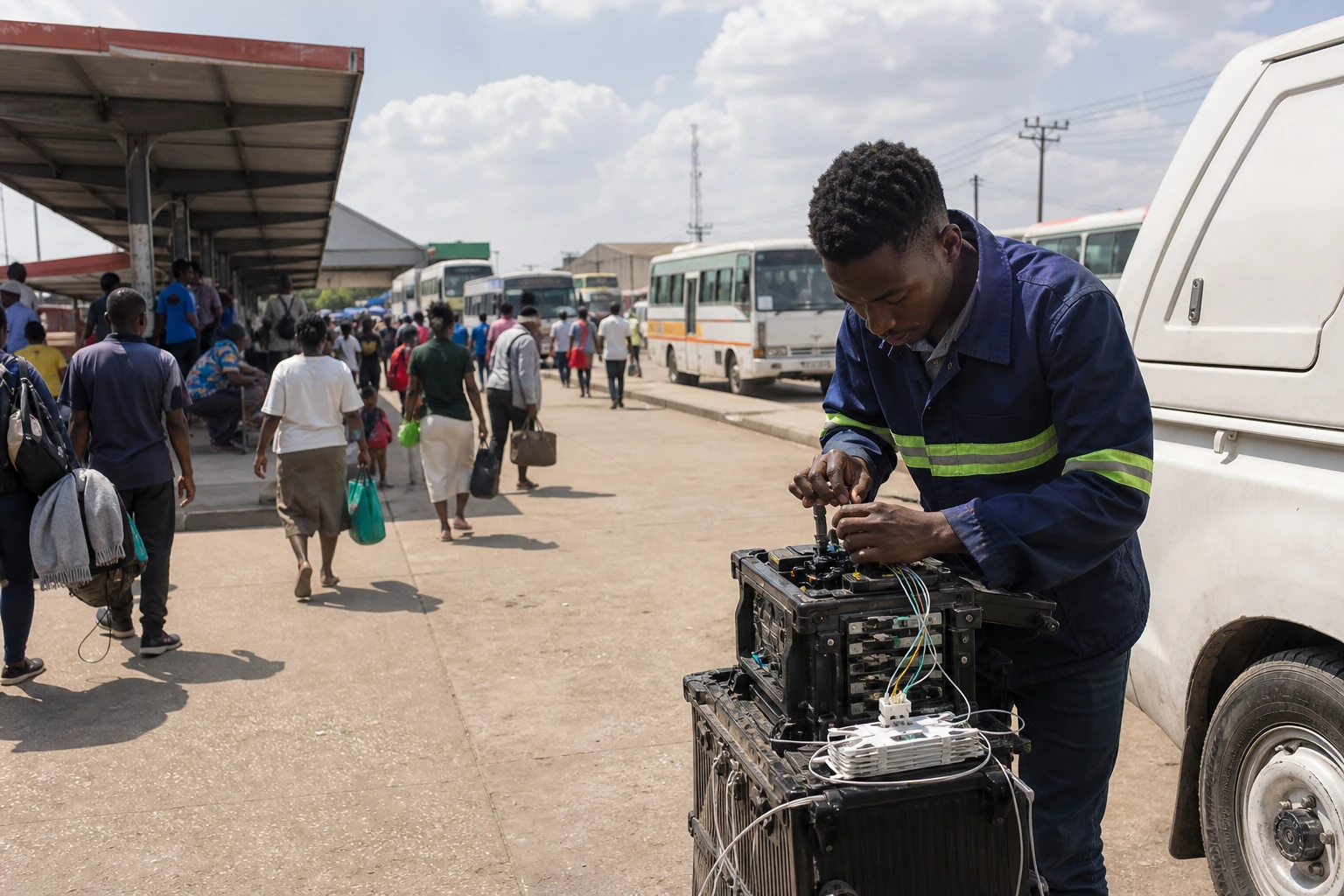
In Luanda and the remote provinces alike, internet access no longer depends solely on the presence of a mobile network. It also depends on the capacity to transport data over long distances, at an affordable cost and with consistent quality. Angola is now looking to focus some of its efforts on this less visible link in the chain.
A national project to better connect the provinces
The Angolan government announced on 30 September 2026 that it would extend the national terrestrial fibre-optic network. The project also includes a domestic submarine cable intended to interconnect several coastal cities. The authorities present this combination as a way to increase broadband coverage and strengthen links between different parts of the country.
Fibre-optic cables can carry large volumes of data at high speed. They therefore form the backbone of fixed, mobile and government networks. In a country as large as Angola, they also play a strategic role in reducing dependence on satellite links or microwave radio links, which can be useful in hard-to-reach areas but have more limited capacity for large volumes of traffic.
The country already has a substantial network. The World Bank estimated it at about 32,000 kilometres in 2023. However, the total length of cables is not enough to measure the quality of coverage. Their distribution, condition, interconnection and the terms on which operators can access them are just as important.
The assessment of Angola’s digital economy noted, in particular, that existing infrastructure was being used unevenly. It also highlighted the limited sharing of some networks between operators. This situation can slow the arrival of new services and keep costs high for businesses that do not have their own transport capacity.
The challenge is not just to build
The announced expansion will therefore have to address a central question: how can the infrastructure benefit multiple players and territories? A network can be technically available without immediately bringing down prices or improving access for households.
The issue concerns Angola Telecom, the longstanding state-owned operator, as well as the networks run by mobile operators. Unitel has significant fibre transport infrastructure, according to the World Bank assessment. But making spare capacity available to other operators remains an issue of competition and sector efficiency.
Other infrastructure can also contribute to the national network. Networks associated with the Benguela railway and electricity transmission are among the most reliable third-party solutions cited in the assessment. However, their reach is tied to the railway and electricity corridors they follow. They cannot, on their own, replace a national network designed to serve cities, municipalities and rural areas.
The planned domestic submarine cable could strengthen the continuity of connections between coastal cities. However, it will need to be accompanied by terrestrial access points, connections to the country’s interior and a clear maintenance framework. Without these elements, coastal infrastructure risks concentrating capacity even more heavily around major urban centres.
Satellite for hard-to-reach areas
Luanda is pursuing a complementary approach in parallel with ANGOSAT-2, the national telecommunications satellite. The Conecta Angola programme uses this capacity to provide a connection in localities where terrestrial or mobile networks remain inadequate.
The programme’s official website says more than 366,000 people have already been reached through the connectivity points installed. The system relies on local partners responsible for distributing services in several provinces. This approach can shorten deployment times, since a satellite link does not require hundreds of kilometres of cable to be laid immediately.
However, the satellite does not replace fibre. Rather, it provides a stopgap for isolated areas, public institutions, local economic activity and communities far from major routes. Combining the two technologies addresses two distinct needs: carrying large volumes of data between urban centres and quickly serving areas where construction is more expensive.
Connecting the system to international submarine cables should also increase the capacity available to terminals installed in remote areas. This integration of satellite, terrestrial networks and submarine cables can improve the system’s resilience, provided the equipment is maintained and services remain affordable.
A deep digital divide persists
Infrastructure efforts are under way while a majority of Angolans still do not use the internet regularly. Available data for 2024 indicate a usage rate of about 40.7% of the population. In other words, nearly six in 10 people did not use the internet that year.
This national average masks significant disparities. Luanda accounts for a large share of the infrastructure, businesses and digital services. Rural areas, by contrast, often have to contend with less consistent coverage, lower purchasing power and long distances between localities.
For households, better connectivity can improve access to online education, digital payments, government services and information. For small businesses, it can support e-commerce, management tools and exchanges with suppliers. In government departments, it can reduce travel and speed up the circulation of documents.
But coverage does not guarantee use. The price of devices, the cost of data plans, the quality of electricity supply and digital skills also influence adoption. Public policy will therefore need to address the entire chain, not just the kilometres of fibre laid.
An issue for Southern Africa
Angola is pursuing this project in a region where data flows are growing. The country is a member of the Southern African Development Community, or SADC, which brings together several states working to improve trade, infrastructure and economic integration.
Land links already exist between Angola and some neighbouring countries, notably the Democratic Republic of the Congo, Zambia and Namibia. Their development could strengthen regional digital exchanges, but also create new requirements for security, redundancy and data regulation.
The next step will be to verify how the announced project is implemented: the construction timetable, the cities involved, the financing model, the operators taking part and the terms of network access. For people, the outcome will be measured less by the number of kilometres built than by the actual availability of services, in Luanda’s neighbourhoods as well as in municipalities far from the main corridors.