Algeria
 Egypt
 Libya
 Morocco
 Sudan
 Tunisia
 Benin
 Burkina Faso
 Cabo Verde
 Côte d'Ivoire
 Ghana
 Guinea
 Guinea-Bissau
 Liberia
 Mali
 Mauritania
 Niger
 Nigeria
 Senegal
 Sierra Leone
 The Gambia
 Togo
 Central African Republic
 Chad
 DR Congo
 Equatorial Guinea
 Gabon
 Republic of the Congo
 São Tomé and Príncipe
 Burundi
 Comoros
 Djibouti
 Eritrea
 Ethiopia
 Kenya
 Madagascar
 Malawi
 Mauritius
 Mozambique
 Rwanda
 Seychelles
 Somalia
 South Sudan
 Tanzania
 Uganda
 Angola
 Botswana
 Eswatini
 Lesotho
 Namibia
 South Africa
 Zambia
 Zimbabwe
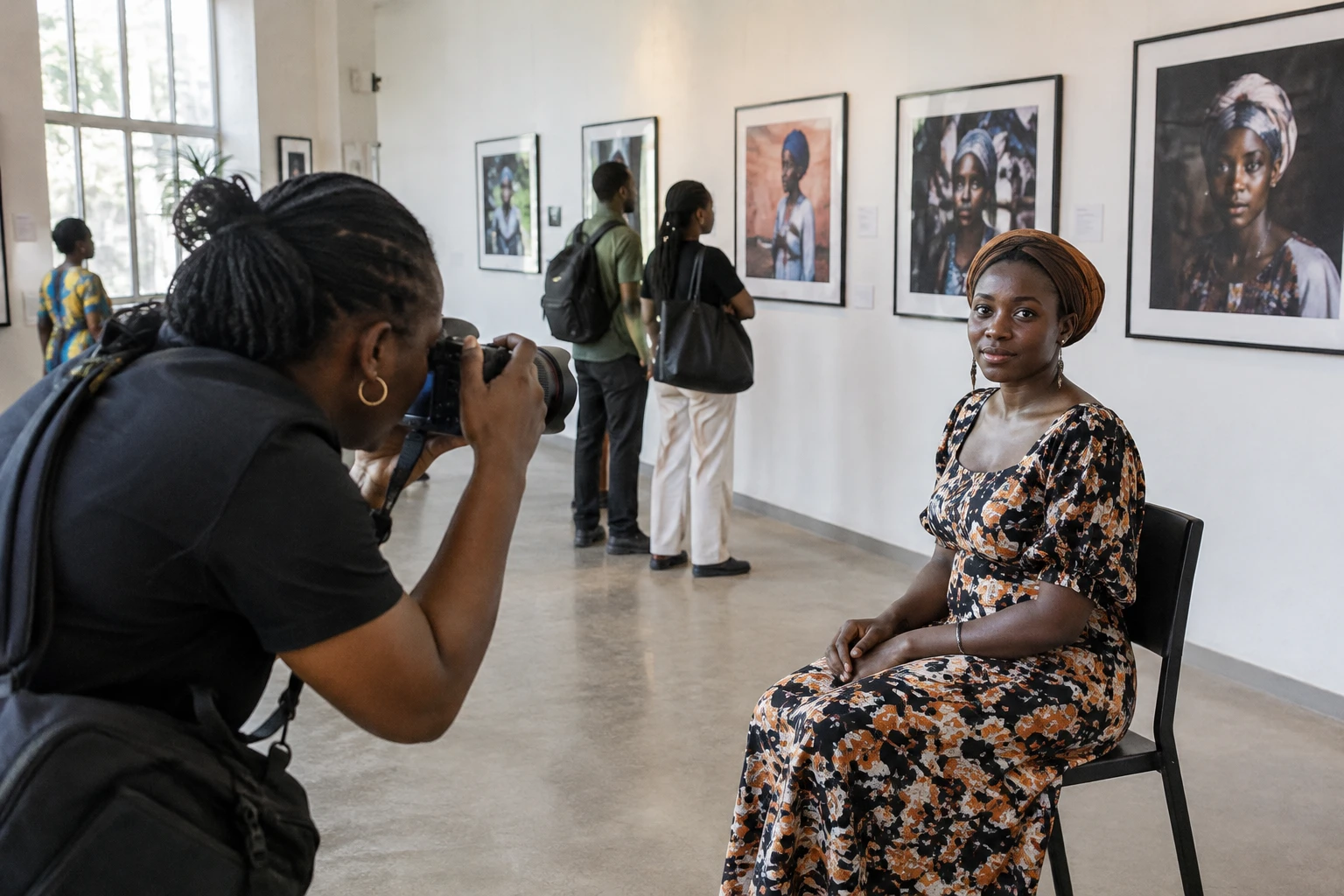
Who decides a woman’s place in an image? For four decades, Cameroonian photographer Angèle Etoundi Essamba has built her portraits around this question. Her models are neither anonymous silhouettes nor figures confined to a role: they look back, occupy space and assert their presence.
This approach finds a new resonance in Paris, where the contemporary African art fair AKAA is showcasing her work from 23 to 25 October 2026. A work inspired by Johannes Vermeer, « Girl with an Amber Earring 1 », accompanies this edition. The artist shifts the references of European painting without relinquishing her own visual language.
Images that reclaim the gaze
Born in Douala in 1962, Angèle Etoundi Essamba grew up between Cameroon, France and the Netherlands. She studied photography in Amsterdam, where she lives and works. Her first exhibition was held there in 1985. Since then, her career has spanned art scenes in Africa, Europe and other parts of the world.
Photography early established itself as a way to observe faces, gestures and emotions. But looking is not enough. The artist is also interested in how images shape perceptions. In the dominant representations she encounters in Europe, she finds no figures of Black women with whom she can identify. She describes images that are often stereotyped, sexualised or confined to subordinate positions.
Her portraits propose a different relationship between subject and viewer. The women photographed appear with their individuality, strength and vulnerability. The gaze becomes central: it can invite connection while refusing to be reduced to an explanation or a cliché. The artist does not seek to replace one fixed image with another. Instead, she opens up a space where her models can exist on their own terms.
This exploration is part of a broader history of photography and visual arts, in which Black people have often been portrayed from someone else’s point of view. Here, staging, light and composition shift that convention. The people photographed are not merely subjects to be observed: they take part in constructing the image.
Vermeer, without asking permission
In « Girl with an Amber Earring 1 », Angèle Etoundi Essamba engages with « Girl with a Pearl Earring », the 17th-century portrait painted by Johannes Vermeer. The reference is recognisable, but the gesture is not a copy. The direct gaze, the amber and the model’s presence shift the codes of the European painting towards a different visual history.
This choice also responds to a persistent expectation of African and Afro-descendant artists: that they should deal exclusively with their cultural heritage or subjects deemed « local ». The artist challenges this categorisation. References have long travelled between continents. In an interview, she points out that Picasso’s borrowings from African and Oceanian art did not prompt the same demands for justification.
The question, then, is not whether a Cameroonian artist can draw inspiration from Vermeer. It is why this freedom sometimes seems to require explanation. By taking up the codes of a famous portrait, Essamba is not asking for a place in an immutable canon: she shows that works of the past can be reread, discussed and brought into relation from the perspective of different experiences.
The artist’s work is not limited to this series. Her portraits have long explored identity, the representation of Black women and the narratives associated with contemporary Africa. This continuity gives the image a significance beyond its play with references: it also concerns the conditions under which artists are viewed, exhibited and interpreted.
A Cameroonian career in global art networks
Essamba’s presence at a Paris fair does not sum up her relationship with Cameroon. In 2022, she was among the artists representing the country at its first participation in the Venice Biennale. She has also exhibited in Yaoundé. These milestones connect her international career with Cameroonian institutions and audiences, beyond her place of residence in the Netherlands.
For audiences in Yaoundé, Douala and the regions, these movements make visible a Cameroonian artist working across several histories of art. They also serve as a reminder that African art scenes are not merely subjects observed from abroad: their artists take part in the exchanges, aesthetic choices and debates that run through international institutions.
Fairs such as AKAA provide a showcase and bring artists, galleries and buyers together. But they do not replace exhibitions on the continent or national cultural policies. Recognition of a work also depends on the possibility of seeing, studying and preserving it in African institutions. This question concerns artists and audiences alike, with access to cultural venues varying between capitals, secondary cities and rural areas.
A retrospective announced for 2027
The next date in the calendar has already been confirmed by the Nederlands Fotomuseum: a retrospective exhibition dedicated to four decades of Angèle Etoundi Essamba’s photography is due to open on 19 March 2027 in Rotterdam. The announcement puts the Paris event in the context of a long career, rather than reducing the artist to a single image or a single fair.
Across Africa, her work resonates with debates about the visibility of artists from the continent and the diaspora, as well as the power of images to define who can look and who is looked at. Her journey between Douala, Yaoundé, Paris and Amsterdam cannot be confined to a single identity. It is a reminder that Cameroonian artists can draw on multiple references while contributing, from their own experience, to reshaping the narratives of art.
The AKAA programme and the meeting with Angèle Etoundi Essamba place this presentation within the Paris event in October. For the forthcoming retrospective, the Nederlands Fotomuseum announces an opening on 19 March 2027. These dates will make it possible to follow her work as it moves between fair, museum and different audiences.