Algeria
 Egypt
 Libya
 Morocco
 Sudan
 Tunisia
 Benin
 Burkina Faso
 Cabo Verde
 Côte d'Ivoire
 Ghana
 Guinea
 Guinea-Bissau
 Liberia
 Mauritania
 Niger
 Nigeria
 Senegal
 Sierra Leone
 The Gambia
 Togo
 Cameroon
 Central African Republic
 Chad
 DR Congo
 Equatorial Guinea
 Gabon
 Republic of the Congo
 São Tomé and Príncipe
 Burundi
 Comoros
 Djibouti
 Eritrea
 Ethiopia
 Kenya
 Madagascar
 Malawi
 Mauritius
 Mozambique
 Rwanda
 Seychelles
 Somalia
 South Sudan
 Tanzania
 Uganda
 Angola
 Botswana
 Eswatini
 Lesotho
 Namibia
 South Africa
 Zambia
 Zimbabwe
A low-profile metal that has become central
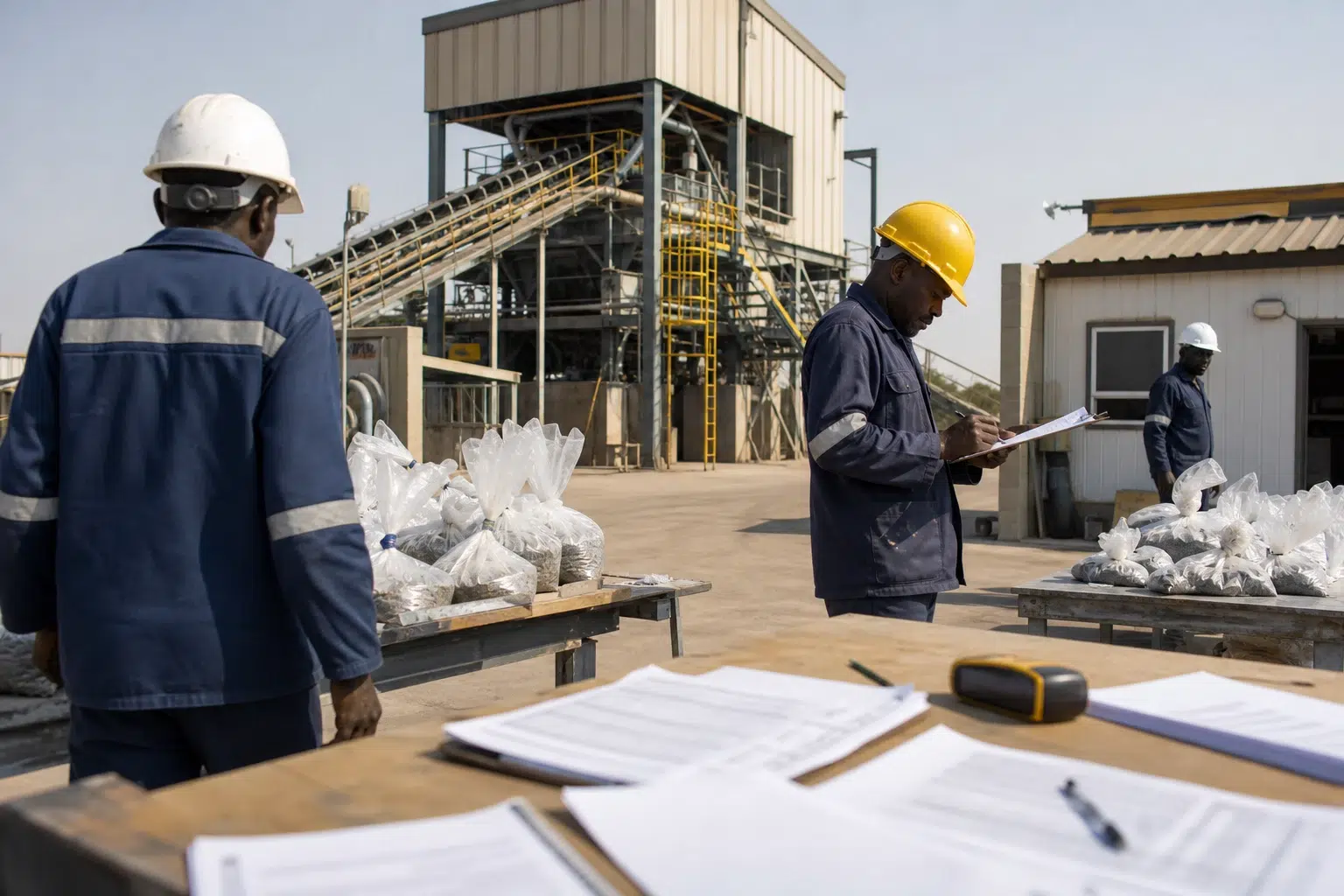
Lithium does not make the headlines every day. Yet it is already shaping industrial choices, mining revenues and the balance of power between states, investors and battery buyers. In Africa, the question is no longer simply who extracts this strategic mineral, but who captures its value, from the mine to chemical processing.
This rise comes in a market still dominated by a handful of hubs: China for refining, Australia for extraction, and the southern cone of South America for lithium concentrate. The challenge for African countries is therefore clear: move beyond the role of supplier of exported rock, often at low prices, and secure a stronger position in the value chain.
In several African capitals, this shift has become an economic policy issue as much as a mining one. Zimbabwe has tightened its rules on exports of raw concentrate to encourage local processing. Mali, too, has highlighted the industrialisation of the sector. At the same time, the Democratic Republic of the Congo, Ghana and Namibia are seeking to turn their projects into revenue, jobs and infrastructure.
Rapid growth, but highly concentrated
According to the International Energy Agency, Africa accounted for 14% of global lithium supply in 2025, up from 11% in 2024 and 6% in 2023. The same body reports that African production rose by 44% year on year. This growth remains spectacular, but is based mainly on a handful of major projects that have started production or ramped up output.
Zimbabwe remains the main driver of this momentum. In the country, sites such as Bikita, Arcadia and Sabi Star have scaled up in recent years. Arcadia also illustrates another trend: the emergence of lithium sulphate plants, producing a more processed product than simple concentrate. Huayou confirmed that it had commissioned a lithium sulphate project at Arcadia, with a stated capacity of 50,000 tonnes a year.
In Mali, the start of production at Goulamina, inaugurated in December 2024, marked a turning point. Its operators describe the site as a world-class asset, while Mali’s mining ministry announced in 2025 that Bougouni further strengthened the country’s position among producers. Malian authorities cite 500 jobs already created at Bougouni, with the number expected to rise to 800, as well as an investment of $65 million for the first phase. ORTM, meanwhile, had reported an operating agreement worth 175 billion CFA francs for Bougouni.
The Democratic Republic of the Congo is also moving forward, with Manono, which Kinshasa has described as the first lithium mine in its history. The Ministry of Foreign Trade has called for local processing to be prioritised, in order to create added value before exports. Zijin Mining says the project is progressing in phases. In Congolese communications, the first phase is put at 500,000 tonnes a year, while other project documents refer to a gradual ramp-up.
Chinese capital and the battle for added value
The geography of African lithium is measured not only in tonnes. It is also shaped by the nationalities of the financiers, builders and buyers. The IEA estimates that 65% of new lithium extraction capacity developed in Africa is controlled by companies headquartered in China. The same report says China’s share of global refined lithium production rose from 70% in 2024 to 75% in 2025. In other words, African extraction is growing, but processing remains largely captured outside the continent.
This is where the real political trade-off lies. Exporting spodumene concentrate generates revenue, but creates little local industry. A processing plant, by contrast, requires reliable electricity, roads, industrial standards and a skilled workforce. That is why Harare emphasises beneficiation, a term often used in southern Africa to mean the local processing of minerals. Zimbabwe wants to prevent the country from remaining merely a point of departure on the map of cargo shipments.
Mali’s strategy appears similar, although it is being pursued in the context of a military transition in which the state is seeking to regain control of strategic resources. The official message is consistent: lithium must support local employment, tax revenues and greater industrial autonomy. But dependence on foreign capital remains. Ganfeng Lithium at Goulamina, Huayou at Arcadia, Zijin at Manono and Huayou’s interests in Ewoyaa in Ghana show that most funding, technology and market access are still structured by groups from China.
Ghana illustrates this tension clearly. The Ewoyaa project, presented as the country’s first lithium site, had its mining licence ratified by parliament in March 2026. Atlantic Lithium describes the project as advanced towards production, while Elevra announced in May 2026 an agreement to sell its stake to Zhejiang Huayou Cobalt. The country wants revenue, but it is also seeking to avoid a repeat of the old African mining scenario: rapid extraction, limited value created locally, and profits captured far away.
What Africa can gain, and what it still needs to secure
The current trajectory opens up new opportunities. It could increase public revenues, create direct and indirect jobs, support local subcontractors and attract infrastructure that benefits other sectors. It could also revive broader industrial ambitions, particularly if states manage to link extraction, processing and low-cost energy. But none of this is automatic. A mining project can improve the trade balance without bringing lasting change to the productive fabric.
The impacts vary considerably between stakeholders. For governments, lithium is becoming an instrument of economic sovereignty and international negotiation. For investors, it is a race for reserves and long-term contracts. For local communities, expectations centre on real jobs, land compensation, usable roads, water and credible environmental monitoring. The gap between capitals and mining areas may remain vast if redistribution does not follow.
At continental level, Africa’s growing role in lithium raises a broader question: how can it influence the global energy transition without remaining at the bottom of the value chain? The answer will not come from the ground alone. It will also depend on industrial policies, regional markets, co-operation within regional economic communities and states’ ability to negotiate more balanced contracts. The next milestones to watch will therefore be found as much in factories, parliaments, mining codes and investment decisions as in the mines themselves.