Algeria
 Egypt
 Libya
 Morocco
 Sudan
 Tunisia
 Benin
 Burkina Faso
 Cabo Verde
 Côte d'Ivoire
 Ghana
 Guinea
 Guinea-Bissau
 Liberia
 Mali
 Mauritania
 Niger
 Nigeria
 Senegal
 Sierra Leone
 The Gambia
 Togo
 Cameroon
 Central African Republic
 Chad
 DR Congo
 Equatorial Guinea
 Gabon
 Republic of the Congo
 São Tomé and Príncipe
 Burundi
 Comoros
 Djibouti
 Eritrea
 Ethiopia
 Kenya
 Madagascar
 Malawi
 Mauritius
 Mozambique
 Rwanda
 Seychelles
 Somalia
 South Sudan
 Tanzania
 Uganda
 Angola
 Botswana
 Eswatini
 Lesotho
 Namibia
 South Africa
 Zambia
 Zimbabwe
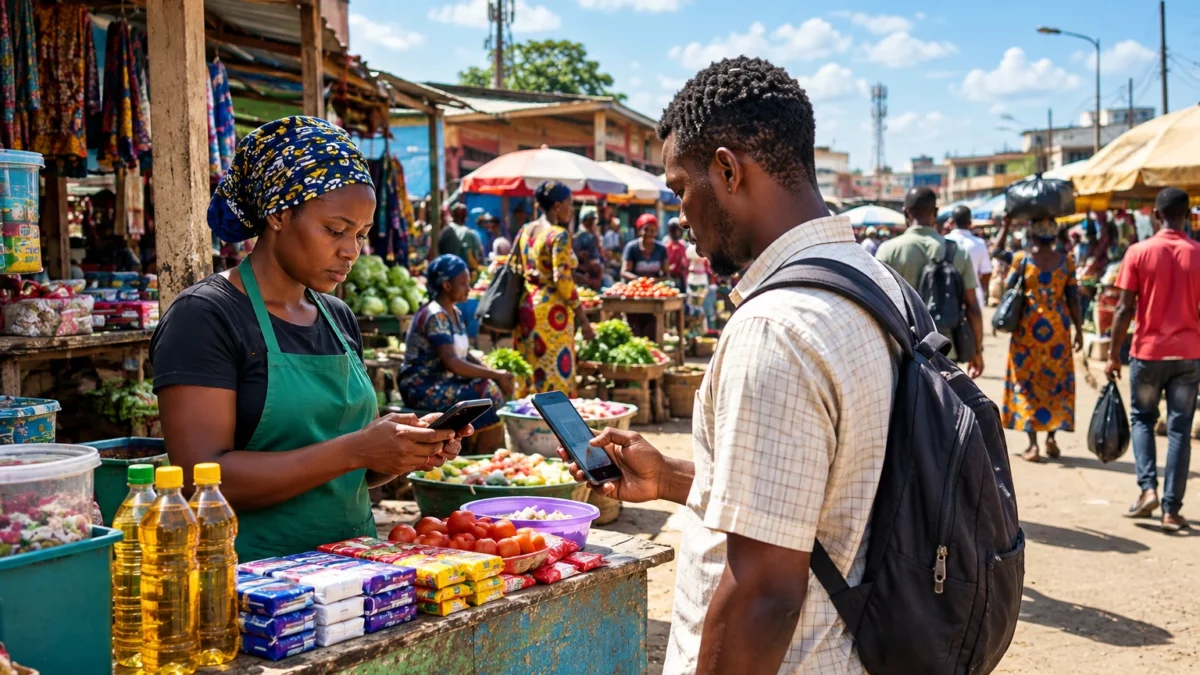
A merchant can take payment on their phone, then withdraw the money to pay a supplier who uses another network. Instant payments aim to remove this step. But connecting accounts is not enough: services must also be accessible, affordable and reliable enough to replace cash in everyday life.
Networks are beginning to talk to each other
The momentum is accelerating across the continent. The SIIPS 2026 report, published by AfricaNenda, identifies 39 instant payment systems in 43 countries. It draws on data from central banks and operators, among other sources, as well as a survey of 1,403 users in 15 African markets. National systems connect different providers within one country; regional systems seek to make payments easier across borders.
In West Africa, the BCEAO — the central bank shared by the eight countries of the West African Economic and Monetary Union (WAEMU) — officially launched PI-SPI on 30 September 2025. The platform is intended to enable transfers between banks, electronic money services and other providers, without requiring sender and recipient to use the same network. The BCEAO and the Ivorian Press Agency confirmed the date and the launch in the Union’s eight countries. The BCEAO’s official presentation of PI-SPI says the service operates continuously.
This regional integration is part of a broader effort. In Central Africa, CEMAC has GIMACPAY; six countries in southern Africa are covered by TCIB, while the pan-African PAPSS aims to facilitate cross-border payments in local currencies. These tools do not yet form a single continental network. They are progressing at different speeds and must contend with the rules, currencies and infrastructure of each region. PAPSS explains its payment and settlement mechanism: transfers rely in particular on pre-funding and net settlement.
Digital payments are reaching even small purchases
According to the SIIPS 2026 report, the systems studied processed 71.4 billion transactions in 2025, worth close to $1.8tn. Volumes have risen sharply since 2021. However, the total value in dollars fell compared with the previous year, partly as a result of exchange-rate fluctuations. The average payment amount also declined: from about $45 to $26 across all channels, and from $17 to $9 for mobile money.
This decline does not necessarily indicate a fall in activity. It may signal that digital payments are being used more for everyday spending, and not only for large transfers. For a small trader, paying a supplier directly from a phone avoids a withdrawal and a journey. Recorded transactions can also provide evidence of activity to show a bank, microfinance institution or fintech when seeking financing.
The benefits remain uneven, however. Payment infrastructure does not, by itself, give a bank account or mobile wallet to someone who does not have one. AfricaNenda’s analysis instead finds an association between the presence of an instant payment system and more frequent use of digital payments. The report also stresses that these findings show statistical relationships: they do not, on their own, prove that the payment system caused every change observed.
Potential effects also extend to small businesses and public administrations. When an activity previously conducted in cash increasingly runs through business accounts, revenues become more visible and access to credit may be easier. A broader tax base can, in turn, give governments more room to fund services. The report finds an association with a 0.8 percentage-point increase in public spending as a share of gross domestic product. This figure describes a correlation, not a guaranteed increase in every country.
Trust is tested after the transfer
Cash nevertheless remains firmly entrenched. In the survey cited by AfricaNenda, 55% of respondents say they still settle about half of their transactions in cash. This finding concerns the users surveyed in 15 markets; it does not describe all populations across the continent uniformly. The availability of cash-out points, commercial habits and network access also influence choices, particularly outside major urban centres.
Incidents weigh on trust. The report says a significant share of people who have experienced a payment problem do not report it. Users’ expectations are practical: being able to verify the recipient’s name, know immediately whether a payment has arrived and receive clear confirmation. If a transfer fails or goes to the wrong place, they also need to know whom to contact, how long a complaint will take to resolve and whether a refund is possible.
This responsibility cannot rest solely with the customer. Central banks and regulators must set clear rules on handling fraud, response times and how losses are divided between providers. A shared-liability model, discussed in the report, could encourage both sides of a transfer to examine reports more carefully. But its application must take account of each country’s legal frameworks and means of redress.
From regional interoperability to continental trade
For traders, the issue goes beyond the convenience of a transfer. A fast, traceable payment can help them pay a supplier, track business activity and apply for credit. For households, the benefits will depend in particular on fees, ease of use and the ability to recover funds in the event of a dispute. A platform available 24 hours a day does not, on its own, guarantee that every provider offers the same level of service.
The African Continental Free Trade Area (AfCFTA) aims to facilitate trade between countries. For this ambition to translate into business transactions, national and regional systems will need to communicate better, with compatible rules and transparent costs. PAPSS is one part of this architecture, while PI-SPI connects providers in the eight WAEMU countries. Their coverage and operating arrangements differ: their existence does not yet mean that a trader can pay instantly everywhere on the continent.
The next stage will therefore be measured less by the number of platforms launched than by their actual use. Fees, access for fintechs and microfinance institutions, fraud protection and merchant payments will matter as much as the technology. Until digital money can move easily from customer to supplier, and be recovered if something goes wrong, cash will retain a central place in commerce.