Algeria
 Egypt
 Libya
 Morocco
 Sudan
 Tunisia
 Benin
 Burkina Faso
 Cabo Verde
 Côte d'Ivoire
 Ghana
 Guinea
 Guinea-Bissau
 Liberia
 Mali
 Mauritania
 Niger
 Nigeria
 Senegal
 Sierra Leone
 The Gambia
 Togo
 Cameroon
 Central African Republic
 Chad
 DR Congo
 Equatorial Guinea
 Gabon
 Republic of the Congo
 São Tomé and Príncipe
 Burundi
 Comoros
 Djibouti
 Eritrea
 Ethiopia
 Kenya
 Madagascar
 Malawi
 Mauritius
 Mozambique
 Rwanda
 Seychelles
 Somalia
 South Sudan
 Tanzania
 Uganda
 Angola
 Botswana
 Eswatini
 Lesotho
 Namibia
 South Africa
 Zambia
 Zimbabwe

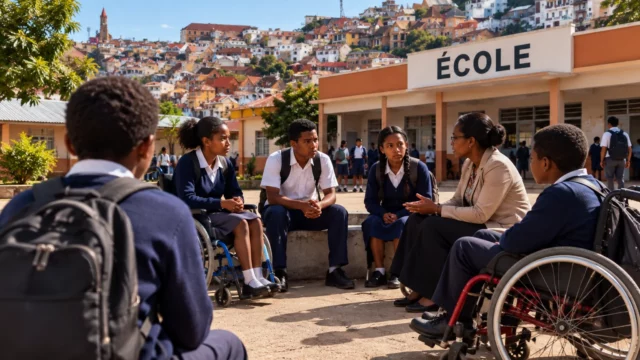
Returning to class is not always enough to regain a place in the school system. For children who have missed several years, the challenge is also to have their learning recognised, to be able to attend lessons despite family constraints and to remain in school after catch-up classes.
In Ethiopia, Côte d’Ivoire, Nigeria and Burkina Faso, accelerated learning programmes offer tailored pathways for children who have never been to school or have dropped out. They condense several years of teaching into a few months or one to two years. But their effectiveness is measured less by the number of enrolments than by what happens next.
Shortened pathways, but not all the same
The programmes respond to distinct national circumstances. In Ethiopia, interruptions to schooling are linked, among other things, to displacement, economic hardship and the distance to schools. On 2 November 2026, the Ministry of Education published Directive No. 1160 on non-formal accelerated learning. It targets, in particular, children aged 12 to 14 who have never been to school or have left primary school for at least two years. The Ethiopian Ministry of Education directive provides for the first four years of primary school to be grouped into two levels, each corresponding to a year of 650 hours of learning.
The entry level must take the child’s previous schooling into account. A pupil who completed the second year before dropping out can, for example, join the fifth year after a year of catch-up classes. For children who have never been to school, the first level opens the way to the third year; the two levels can lead to the fifth. An initial assessment determines placement, after which progress depends on achieving minimum competencies. The directive also provides for specific teacher training and adapted timetables.
The national framework builds on activities already under way in several regions. The Global Partnership for Education reports that in 2026 the Ethiopian programme had supported 52,180 children in seven regions, including 22,978 girls and 921 children with disabilities. These are children enrolled in or returned to school, not a measure of their long-term retention. Published data on the Ethiopian programme thus highlight a first step: restoring access to learning, without presuming what happens next.
Returning to class also depends on living conditions
In Côte d’Ivoire, bridge classes are intended to link non-formal education with mainstream schooling. On 15 October 2025, the Ivorian government announced the roll-out of 30 classes to accommodate 900 children aged 9 to 14. The 28-week programme is intended to facilitate their reintegration into the school system. The classes are spread across several regional directorates, including in Abidjan, Bouaké, Man, Boundiali and Bondoukou. The official Ivorian announcement says that facilitators and supervisors were trained beforehand.
In Nigeria, the organisation of classes also seeks to accommodate families’ activities. In Borno State, in the country’s north-east, the Accelerated Basic Education Programme (ABEP) provides nine months of teaching in local languages and English, with a transition to formal education planned. In Kaleri, near Maiduguri, afternoon classes allow pupils to attend after completing their morning chores. Facilitators receive stipends, raise awareness among parents and distribute supplies to learners, according to UNICEF Nigeria’s account of the ABEP programme.
These adjustments are not incidental. Fees, a lack of materials, family work or distance can prevent a child from attending classes regularly, even if a place is offered. Flexible provision can reduce some barriers; it cannot remove them all. Regular attendance also depends on households’ economic circumstances and on programmes’ ability to reach children outside urban centres.
Recognising learning to prevent another break in education
A bridge programme only makes sense if there is a next step. To continue in the mainstream curriculum, pupils must be able to have what they have learned recognised and be directed to a class suited to their level. A comparative analysis of accelerated learning programmes published by the Global Partnership for Education highlights the importance of public accreditation and equivalency rules. These mechanisms give children official proof of their learning and the prospect of continuing their studies. The Global Partnership for Education’s evaluation work more broadly underlines the role of evidence-based data and education decisions.
Burkina Faso offers another example of a bridge programme. According to data from the Burkinabe Ministry of Education reported by UNICEF, 16,700 children attended accelerated schooling/bridge classes in 2025, particularly in areas facing security challenges. The figure relates to participation in the programme. On its own, it does not show how many pupils subsequently joined a mainstream school, remained there or completed their cycle. The figures cited by UNICEF in Burkina Faso illustrate the scale of the effort, but also the importance of tracking pupils’ progress beyond enrolment.
In this Sahelian country, as in the other contexts concerned, mainstream schools must be able to accommodate pupils after catch-up classes. That requires available places, teachers, recognised school documents and support when children encounter new difficulties. Without this continuity, the bridge risks becoming an interlude rather than a lasting return to education.
Measuring success beyond enrolment
The experiences of these four countries do not constitute a single model. In Ethiopia, the directive sets national rules for condensing primary education. In Côte d’Ivoire, bridge classes are being rolled out as part of non-formal education. In Nigeria, the ABEP combines accelerated classes, local languages and timetables compatible with family activities. In Burkina Faso, SSA/P centres operate in a context where interruptions to schooling may also be linked to insecurity.
To compare their results, it will be necessary to distinguish between children who enrol, those who complete the programme, those who join mainstream schools and those who continue their studies there. The available data do not always answer all these questions. Monitoring over time will show whether the skills acquired are recognised and whether pupils, in cities and rural areas alike, can progress to the next stages.
At regional and continental level, these programmes therefore pose a practical question for education authorities: how can flexible pathways be linked to national school systems without creating a track that leads nowhere? The answer will depend on certification rules, the resources of receiving schools and monitoring that does not stop on the last day of the accelerated course.