Algeria
 Egypt
 Libya
 Morocco
 Sudan
 Tunisia
 Benin
 Burkina Faso
 Cabo Verde
 Côte d'Ivoire
 Ghana
 Guinea
 Guinea-Bissau
 Liberia
 Mali
 Mauritania
 Niger
 Nigeria
 Senegal
 Sierra Leone
 The Gambia
 Togo
 Cameroon
 Central African Republic
 Chad
 DR Congo
 Equatorial Guinea
 Gabon
 Republic of the Congo
 São Tomé and Príncipe
 Burundi
 Comoros
 Djibouti
 Eritrea
 Ethiopia
 Madagascar
 Malawi
 Mauritius
 Mozambique
 Rwanda
 Seychelles
 Somalia
 South Sudan
 Tanzania
 Uganda
 Angola
 Botswana
 Eswatini
 Lesotho
 Namibia
 South Africa
 Zambia
 Zimbabwe
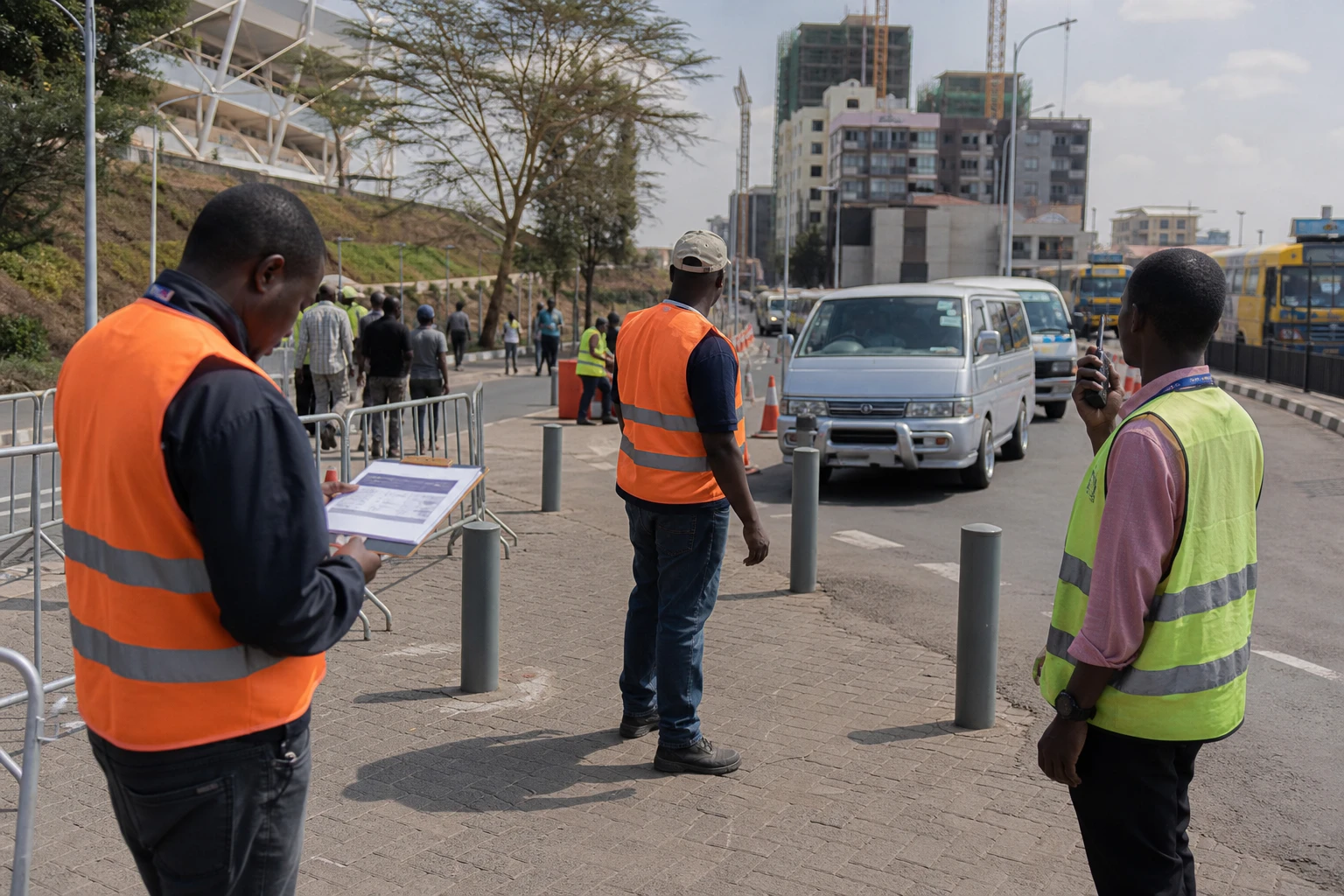
In Nairobi, Kampala and Dar es Salaam, the countdown to AFCON 2027 is now playing out on construction sites. The three capitals must turn infrastructure promises into a system capable of welcoming 24 teams, their delegations and thousands of supporters.
The competition will run from 19 June to 17 July 2027. It will be hosted for the first time by Kenya, Uganda and Tanzania. For East Africa, the stakes therefore go beyond football: the region must show that a continental tournament can be staged by several countries with different economic and administrative profiles.
A regional project, not three separate preparations
The Confederation of African Football (CAF), the governing body of continental football, awarded the hosting rights to the joint bid known as “Pamoja” in September 2023. The term means “together” in Swahili. It sums up the ambition shared by the three countries: to pool facilities, expertise and supporter traffic.
This cooperation is taking place within the East African Community, which brings several countries in the region together around common economic and political projects. AFCON, however, will demand closer coordination. Competition venues will be spread across several cities. Teams will have to travel between areas separated by several hundred kilometres.
CAF completed an eight-day inspection mission at the beginning of September 2026. The visit covered stadiums, training pitches and the infrastructure needed to host the tournament. The governing body is officially sticking to the planned timetable and has not announced a withdrawal from the hosting arrangement.
The qualifiers also began in September 2026. Kenya, Tanzania and Uganda have qualified automatically as host countries, but are taking part in the campaign to allow another team in each of their groups to earn a place in the finals.
In Kenya, Nairobi bears most of the pressure
The Kenyan capital is home to one of AFCON 2027’s most prominent projects. Talanta Stadium, part of the Talanta Sports City complex, is set to become a major tournament venue. Its announced capacity is 60,000.
The project must still meet several requirements: the pitch, lighting, media facilities, spectator access, security and broadcast systems. A stadium’s capacity alone is not enough to secure approval. CAF also assesses movement around the venue, areas reserved for teams and the reliability of technical installations.
Kasarani Stadium, already used for major competitions in Nairobi, is also undergoing renovation. The Kenyan authorities must at the same time prepare training pitches, expand hotel accommodation and ease travel from Jomo Kenyatta International Airport.
In August 2026, the Kenyan parliament said the country was still working on the hosting road map and aimed to be able to stage the opening and closing ceremonies. The government presents the work as a lasting investment in sport. The central question, however, remains whether deadlines will be met and facilities will actually be available for the next rounds of testing.
Tanzania is relying on a network of existing stadiums
Tanzania has a different advantage. Several stadiums are already in place and need to be brought up to CAF standards rather than built from scratch. Dar es Salaam, the economic capital, is the country’s main logistics hub. Benjamin Mkapa Stadium is among the facilities inspected by CAF.
Tanzanian authorities have announced that work on the main stadiums concerned is more than 80% complete. This figure should nevertheless be treated with caution: the progress of construction alone does not determine a venue’s final compliance. Safety, transport, lighting and broadcast tests could still affect the timetable.
The plan also includes five training pitches in each host city. Roads, accommodation and connections between the different venues therefore remain central to preparations. For supporters, these factors will directly affect the cost and ease of travel. For teams, they will determine the quality of recovery between matches.
CAF president Patrice Motsepe’s visit to Dar es Salaam in September 2026 provided an opportunity to review progress with the Tanzanian authorities. The visit raised the project’s profile, but does not replace the technical checks still to come.
Uganda must turn construction projects into fully operational venues
In Uganda, Hoima Stadium is presented as complete. Work is continuing in Lira and on several training pitches, however. Kampala, the capital, will also play a central role in hosting delegations, media and supporters.
The Ugandan government has set the end of 2026 as its target for completing most of the infrastructure. It has also deployed the army on some construction sites to speed up delivery. This approach could strengthen short-term delivery capacity. It will nevertheless need to be accompanied by independent checks on the quality of the work and the facilities’ use after the competition.
President Yoweri Museveni reaffirmed Uganda’s commitment to hosting the tournament with its two neighbours on 22 September 2026. The authorities point to the experience gained when the African Nations Championship was held in 2024. But AFCON is on a larger scale, with more teams, media, flights, checks and supporter movements.
The real test will be logistical
The stadiums are attracting attention, but the main risk may lie between venues. The tournament’s success will depend on the coordination of road and air transport, smooth border crossings, hotel availability and secure routes.
The three countries will also have to align their procedures. A supporter arriving in Nairobi, attending a match in Kampala and then travelling to Dar es Salaam should not have to deal with three incompatible systems. Ticketing, visas, access controls, telecommunications and traveller information will all need to operate within a common framework.
The economic impact will also be uneven. Major cities are likely to benefit from spending on hotels, transport and services. Smaller host cities could benefit from construction work and the tournament’s profile. But these gains will depend on the authorities’ ability to involve local businesses, particularly in the informal economy, without permanently displacing activity around the stadiums.
A deadline that involves all of East Africa
AFCON 2027 will mark the competition’s return to East Africa, more than five decades after Ethiopia hosted the 1976 edition. It will also be the first AFCON jointly hosted by three countries.
The next decisive step will be to verify infrastructure progress and compliance with CAF requirements. The qualifiers, scheduled to run until March 2027, will add further pressure on the organisers.
For Kenya, Uganda and Tanzania, the challenge is therefore not just to finish stadiums. It is to make a regional sporting space work for almost a month. AFCON 2027 will give East Africa a continental showcase. Above all, it will reveal how robust its practical cooperation is.