Algeria
 Egypt
 Libya
 Morocco
 Sudan
 Tunisia
 Benin
 Burkina Faso
 Cabo Verde
 Ghana
 Guinea
 Guinea-Bissau
 Liberia
 Mali
 Mauritania
 Niger
 Nigeria
 Senegal
 Sierra Leone
 The Gambia
 Togo
 Cameroon
 Central African Republic
 Chad
 DR Congo
 Equatorial Guinea
 Gabon
 Republic of the Congo
 São Tomé and Príncipe
 Burundi
 Comoros
 Djibouti
 Eritrea
 Ethiopia
 Kenya
 Madagascar
 Malawi
 Mauritius
 Mozambique
 Rwanda
 Seychelles
 Somalia
 South Sudan
 Tanzania
 Uganda
 Angola
 Botswana
 Eswatini
 Lesotho
 Namibia
 South Africa
 Zambia
 Zimbabwe
On the lagoon’s edge, a symbol of the state
In Abidjan, Ivorian power is visible not only in legal texts. It can be seen in a building, an address and an institutional routine. The presidential palace still hosts most of the country’s most visible political business, even though Yamoussoukro is the political and administrative capital. This coexistence says much about contemporary Côte d’Ivoire: a state divided between its constitutional centre and its real centre of gravity.
The contrast is all the sharper because Côte d’Ivoire chose Yamoussoukro as its political and administrative capital on 21 March 1983, while Abidjan remains the economic capital. The Ivorian presidency itself notes this in its heritage pages. Yet the executive’s major events continue to take place in Abidjan, which is also home to a large share of the administration and economic networks.
From colonial palace to the reinvented heart of the republic
The site’s history dates back to the colonial period. The Governor’s Palace, seat of colonial authority, stood on the site now occupied by the presidential palace. After independence on 7 August 1960, Félix Houphouët-Boigny wanted to erase this marker by replacing it with a presidential palace, conceived as an assertion of sovereignty and a symbolic break. The Ivorian presidency still presents the site as a major landmark in the state’s heritage.
The Abidjan palace was designed by French architect Pierre Dufau. Its silhouette, with its curved roof, has often been likened to the Akan stool, a motif laden with meaning in several Ivorian cultures. The building was inaugurated on 7 August 1961, the day after the first anniversary of independence. The symbolism was clear: to place the young republic within a national continuity while turning the page on colonial rule.
The decision was not unanimous at the time. Debates pitted supporters of preserving the Governor’s Palace against those backing the presidential project. The issue was not merely architectural. It touched on memory, the use of the site and its vulnerability, on the edge of the lagoon and close to major transport routes. This tension between heritage and reinvention remains a useful key to understanding the site.
Why Abidjan retains its hold
The gap between the official capital and the real centre of power is no accident. In Côte d’Ivoire, Abidjan still concentrates economic power, company headquarters, many government departments and most diplomatic activity. The transfer of the administrative capital to Yamoussoukro, decided in 1983, did not suddenly change the habits of government. Institutions moved on paper, but in practice they remained largely in Abidjan.
This situation is also linked to the history of the founder of the modern country. Houphouët-Boigny made Yamoussoukro both a personal and a political domain. The city became home to his residence, infrastructure, sites of memory and places of representation. It became the political and administrative capital, but not automatically the main daily stage for executive decision-making. Ivorian power thus kept two faces: one institutional, the other functional.
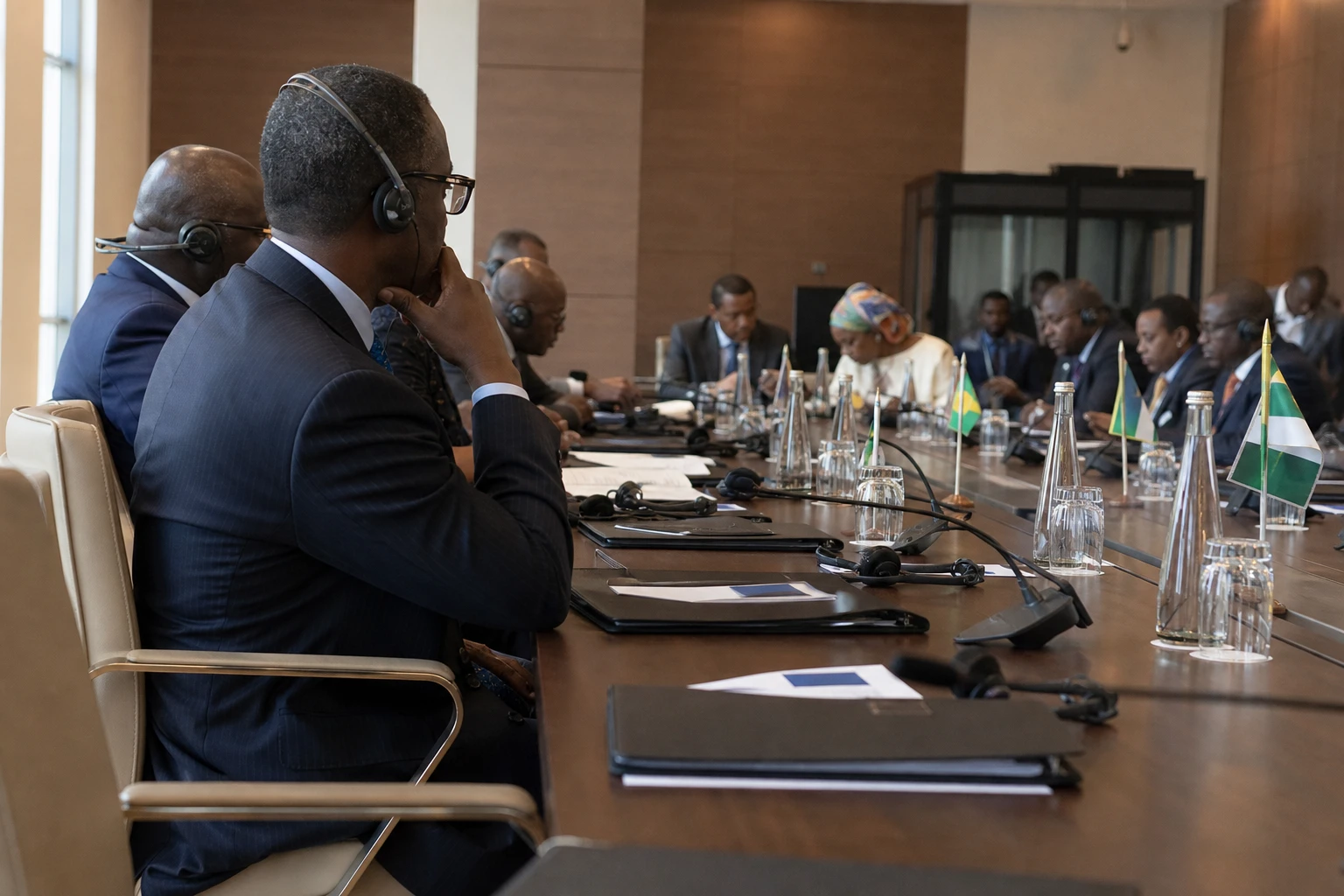
In practice, the Abidjan palace remains the venue for cabinet meetings, presidential audiences, the presentation of ambassadors’ credentials and receptions for heads of state on official visits. The presidency’s 2025 communiqués indicate that several cabinet meetings were held at the Presidential Palace in Abidjan under the chairmanship of Alassane Ouattara. The symbolism is significant: this is where the authority of the state is on display.
A setting for power, an instrument of governance
The palace is more than a backdrop. It serves as a stage for institutional power struggles. In West Africa, where states often have to contend with dominant economic capitals, the location of power says much about how a country is governed. In Côte d’Ivoire, Abidjan’s centrality reflects the weight of infrastructure, diplomacy, finance and the executive. It also reveals how difficult it has been to make Yamoussoukro a fully fledged centre of day-to-day decision-making.
L’Esplanade, a more recent building inspired by a Senufo mask, now forms part of the presidential complex. It houses several offices, including the vice-president’s cabinet. This detail matters. It shows that a wider administrative apparatus has grown up around the palace, with architecture expressing a desire for continuity between national memory and the modern exercise of power. The Ivorian presidency presents it as part of the country’s institutional heritage.
The palace’s restoration to its original appearance, including its rooms and chandeliers, is part of the same logic. The site has not been turned into a museum. It remains in use. Houphouët-Boigny’s marble desk is still cited as an emblematic piece embodying the continuity of the state. Across Africa, presidential palaces are often instruments of political storytelling. Abidjan’s tells a story both of the break with colonial rule and of fidelity to a particular republican pageantry.
What the palace says about Côte d’Ivoire and the region
For Ivorians, the question goes beyond architecture. It concerns the balance between the country as it exists and the country as it is administered. Abidjan remains the beating heart of the economy, while Yamoussoukro bears the symbolic weight of the capital. This duality affects public services, the flow of decisions, diplomatic representation and regional planning. It also reflects an old political choice that has never been fully readjusted.
Across West Africa, Côte d’Ivoire is not alone. Several states in the region have experienced or continue to experience a gap between their constitutional capital, economic capital and real centre of power. But Côte d’Ivoire stands out for the consistency with which its government operates from Abidjan, despite the formal transfer of the capital. This says something about the strength of major urban centres, but also about the limits of moving a capital without fully transferring government departments and political habits.
The next thing to watch has less to do with the building itself than with how it is used. As long as major cabinet meetings, diplomatic ceremonies and executive decisions remain concentrated there, Abidjan’s presidential palace will be more than a monument. It will remain the visible heart of a state that established its political capital elsewhere but still governs, for the most part, from the lagoon.