
 Algeria
 Egypt
 Libya
 Morocco
 Sudan
 Tunisia
 Benin
 Burkina Faso
 Cabo Verde
 Côte d'Ivoire
 Ghana
 Guinea
 Guinea-Bissau
 Liberia
 Mali
 Mauritania
 Niger
 Nigeria
 Sierra Leone
 The Gambia
 Togo
 Cameroon
 Central African Republic
 Chad
 DR Congo
 Equatorial Guinea
 Gabon
 Republic of the Congo
 São Tomé and Príncipe
 Burundi
 Comoros
 Djibouti
 Eritrea
 Ethiopia
 Kenya
 Madagascar
 Malawi
 Mauritius
 Mozambique
 Rwanda
 Seychelles
 Somalia
 South Sudan
 Tanzania
 Uganda
 Angola
 Botswana
 Eswatini
 Lesotho
 Namibia
 South Africa
 Zambia
 Zimbabwe
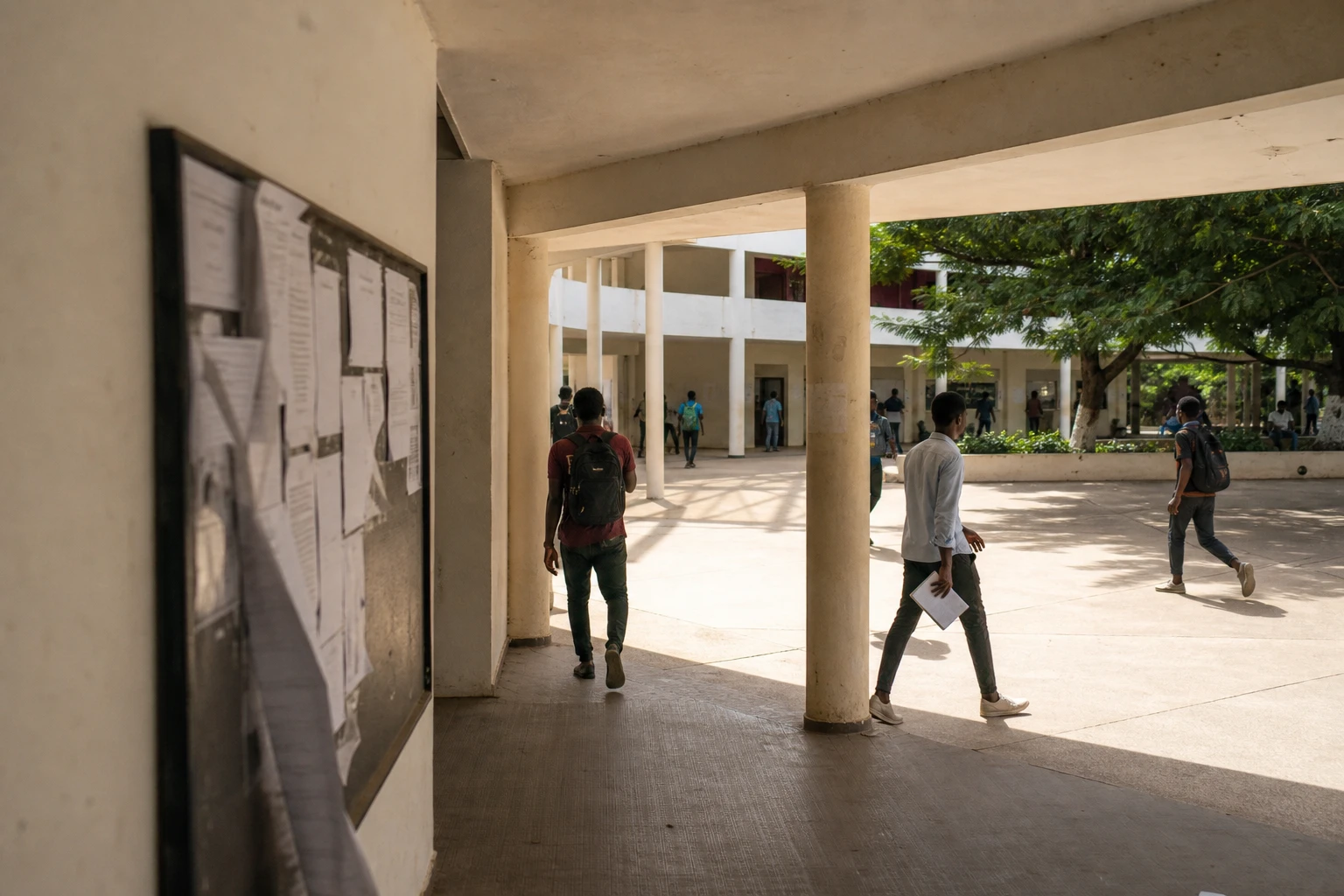
Six months on, UCAD still bears the scars
In Dakar, the quiet of August has not erased the memory of 9 February. On the social campus of Cheikh Anta Diop University, Abdoulaye Ba’s death continues to crystallise a question that is both simple and weighty: how could a demand over grants turn into tragedy at Senegal’s largest public university? Six months after the events, students’ grief is compounded by a specific expectation: established explanations, clearly assigned responsibility and visible judicial follow-up.
The issue extends beyond the campus. For several weeks at the start of 2026, the Senegalese executive had already been pursuing a reform of grant policy, linking it to the academic calendar and budgetary sustainability. At the same time, public universities were experiencing recurrent tensions over payments, living conditions and the role of student organisations. In Senegal, campuses are also a social barometer: when tensions rise there, pressure is quickly felt across the capital.
What happened in Dakar on 9 February
The events are now firmly dated. On 9 February 2026, clashes broke out at UCAD between students and security forces amid protests against reform of the grant allocation system. Abdoulaye Ba, a medical student, died that day on the social campus. The government immediately announced an investigation, while the prime minister offered his condolences to the family, condemned the violence and called for judicial follow-up to establish responsibility.
A few days later, Dakar’s prosecutor put forward a different account. On 17 February, drawing on the autopsy and investigations carried out up to that point, he said the death had resulted from a fall from Pavilion F and indicated that there was then no evidence that the deceased had been beaten. This account was challenged by some students, unions and many campus observers, who called for greater transparency about the exact circumstances of the death.
The campus did not return to normal all at once. On 12 February, UCAD’s Academic Council provisionally suspended student associations. Then the Dakar University Social Centre announced the gradual reopening of the social campus on 26 February, with restrictions on certain activities. These decisions reflect the state of the case: crisis management sought to restore order, but did not dispel the mistrust sparked by the tragedy.
A student case becomes a matter of state
Beyond Abdoulaye Ba’s death, the central issue remains grant policy. On 2 February 2026, the Ministry of Higher Education announced a “far-reaching” reform of the system, citing fairness, academic performance and budgetary constraints. On the same day, the grants directorate said payments would henceforth be aligned with the academic calendar, with 12 monthly instalments and no backdating in some cases. Students saw this change as a challenge to a long-standing social entitlement; the state presented it as financial and administrative rationalisation.
This divergence explains the intensity of the conflict. On one side, the authorities talk of management, sustainability and alignment. On the other, students talk of daily survival, social mobility and protection on a campus where grants often determine access to accommodation and meals, as well as the ability to continue studying. In Dakar, then, the question is not merely an accounting one. It concerns how the state supports its educated young people in a country where university remains a major route to social advancement for both urban families and households from the regions.
The political significance is also clear. On 3 April 2026, President Bassirou Diomaye Faye himself referred to the “vulnerabilities” of the higher education system in an address to the nation, linking the events at UCAD to the need for national consultations and an agenda to transform the sector. In other words, the Abdoulaye Ba case has moved beyond the university sphere and into public-sector reform, with a central challenge: how to bring lasting calm to campuses without dismissing students’ demands.
What West Africa is watching in this case
In Senegal, this case resonates far beyond Dakar. Across West Africa, the funding of studies, university autonomy and campus security regularly return to the public debate. The UCAD case is a reminder that a reform designed by the administration can run up against very concrete social realities if it is not explained, negotiated and accompanied. It is also a timely reminder for ECOWAS, whose member states are each confronting, in their own way, the same tension between budgetary discipline and the social expectations of young graduates.
For the Senegalese authorities, the immediate challenge is judicial and institutional: conclude the investigation, clarify the chain of responsibility and prevent doubt from becoming entrenched. For students, the issue is broader: to have it recognised that grants can no longer be treated solely as a line of expenditure, but as a pillar of university stability. Six months after Abdoulaye Ba’s death, that contest over approach is still unfolding in Dakar, between the memory of a young student, the demand for truth and reform of a system expected to endure.



