Algeria
 Egypt
 Morocco
 Sudan
 Tunisia
 Benin
 Burkina Faso
 Cabo Verde
 Côte d'Ivoire
 Ghana
 Guinea
 Guinea-Bissau
 Liberia
 Mali
 Mauritania
 Niger
 Nigeria
 Senegal
 Sierra Leone
 The Gambia
 Togo
 Cameroon
 Central African Republic
 Chad
 DR Congo
 Equatorial Guinea
 Gabon
 Republic of the Congo
 São Tomé and Príncipe
 Burundi
 Comoros
 Djibouti
 Eritrea
 Ethiopia
 Kenya
 Madagascar
 Malawi
 Mauritius
 Mozambique
 Rwanda
 Seychelles
 Somalia
 South Sudan
 Tanzania
 Uganda
 Angola
 Botswana
 Eswatini
 Lesotho
 Namibia
 South Africa
 Zambia
 Zimbabwe
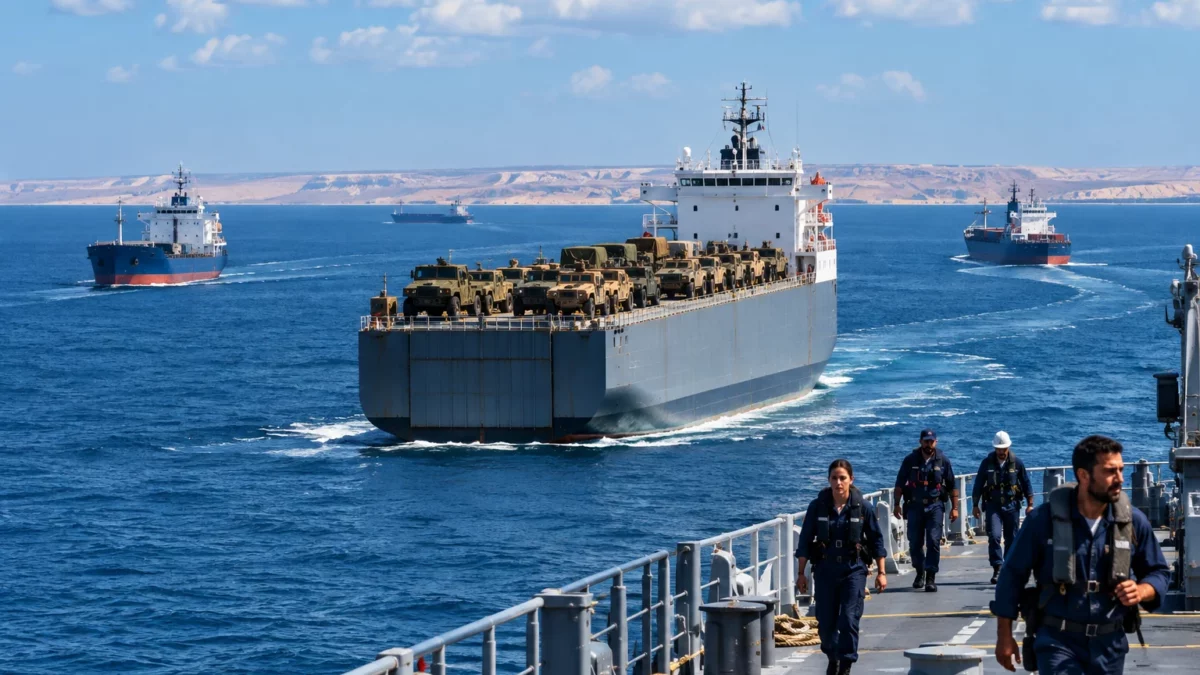
In the Mediterranean, a Russian military cargo expected in Libya changed route after an attack struck a warship in Benghazi. For Libyans, the stakes go beyond the movement of a convoy: their country, already divided between rival authorities, risks becoming even more of a staging post in a war being fought elsewhere.
A detour at sea after the Benghazi strikes
Three Russian ships carrying military vehicles halted their progress towards Libya, according to military and security officials cited by Reuters. Another convoy, escorted by the Russian frigate Admiral Golovko, reportedly turned back near the Strait of Sicily on 22 November, the day of the attack in Benghazi. Available information does not specify whether the ships later reached another port.
The group of three vessels reportedly comprises the cargo ships or roll-on/roll-off vessels Maia 1, Lady R and Lady D. Maritime tracking data last placed them in the Bay of Biscay on 12 November. Their subsequent route remains difficult to establish publicly: the ships stopped transmitting their positions, and their final destination has not been confirmed.
Sources cited by Reuters estimate that the vehicles may have been intended for Russia’s Africa Corps, active in several West African countries, or, in part, for the Libyan National Army (LNA), the dominant force in the east of the country. These destinations remain attributed hypotheses, not established facts. The ships’ operators are reportedly subject to Western sanctions, making their movements harder to track.
Attack claimed, Libyan accounts diverge
During the night of 21–22 November, an explosion struck the Russian corvette Merkury at the naval base in Benghazi. Authorities in eastern Libya initially described it as a drone attack. Ukrainian President Volodymyr Zelensky claimed responsibility for the operation on 23 November. Kyiv says it is targeting Russian assets linked to the war effort against Ukraine, not seeking to extend the conflict to Libya.
Libyan officials and satellite images confirmed that the ship was badly damaged and then sank. A second Russian vessel, the cargo ship Angara, was also targeted offshore, according to Ukrainian statements and reports by international media. Details of the means used and the damage should remain attributed to the authorities that provided them.
The Government of National Unity based in Tripoli condemned the operation and asked Kyiv for explanations. It denied any prior agreement. In the east, the rival administration called for an international inquiry into a possible Ukrainian presence. This institutional split is central: Libya has no unified authority able to speak alone on behalf of the entire country.
The United Nations Support Mission in Libya expressed concern and recalled the need to respect Libya’s sovereignty, territorial integrity and the security of its citizens. On 24 November, the African Union also condemned the attacks and called for respect for Libyan sovereignty. These reactions foreground the risk that operations linked to an external war could be conducted on the territory of a country that says it is not a party to it.
Political division puts ports and residents at risk
Since the fall of Muammar Gaddafi in 2011, attempts at political unification have failed to end the rivalry between the Tripoli-based government and the eastern authorities, which are backed militarily by the LNA. Benghazi, in the east, is home to facilities where relations between the local authorities and Moscow take on strategic significance. This cooperation is distinct from the ties maintained by the Tripoli government with Kyiv and several Western partners.
Russia’s presence in Africa is based on military agreements, equipment deliveries and partnerships with certain governments or armed forces. The Africa Corps, a structure within Russia’s Defence Ministry, has taken over some of Wagner’s activities on the continent. The movement of equipment through Libyan ports could link the Mediterranean to Russian operations in the Sahel. However, available information does not make it possible to establish with certainty the destination of the convoy in question.
For Benghazi’s residents, the risk is not abstract. A naval base or port used by foreign military actors can become a target, while local authorities must manage the security and diplomatic consequences. In Tripoli, the government faces another pressure: preventing the incident from being interpreted as Libyan involvement in the Russia-Ukraine war.
Uncertainty could also weigh on shipping routes and port activities. A change of course or a ship that stops transmitting its position does not, on its own, prove that a blockade is under way. But the possibility of further strikes may prompt carriers and their insurers to reassess risks in the central Mediterranean.
A signal for North Africa and the continent
The ships’ presumed turnabout shows that the attack has already altered security calculations around Russian supplies. It does not allow the conclusion that Moscow is abandoning its ties with Libyan actors or its operations in Africa. Rather, it signals that these logistical networks may be vulnerable far from the Ukrainian front.
For the African Union and North African countries, the affair raises a practical question: how can international rivalries be prevented from taking root in ports, bases and local political divisions? The answer will depend, among other things, on the findings of the requested inquiries, transparency over military agreements and the ability of Libyan authorities to co-ordinate their decisions.
In the short term, three developments remain worth watching: confirmation of the route taken by the ships, the eastern authorities’ response to the attack and Tripoli’s diplomatic steps towards Kyiv. As long as Libyan institutions remain divided, every military agreement or port call can strengthen domestic power dynamics as much as the interests of foreign partners.