Algeria
 Egypt
 Libya
 Morocco
 Sudan
 Tunisia
 Benin
 Burkina Faso
 Cabo Verde
 Côte d'Ivoire
 Ghana
 Guinea
 Guinea-Bissau
 Liberia
 Mali
 Mauritania
 Niger
 Nigeria
 Senegal
 Sierra Leone
 The Gambia
 Togo
 Cameroon
 Central African Republic
 Chad
 DR Congo
 Equatorial Guinea
 Gabon
 Republic of the Congo
 São Tomé and Príncipe
 Burundi
 Comoros
 Djibouti
 Eritrea
 Ethiopia
 Kenya
 Madagascar
 Malawi
 Mauritius
 Mozambique
 Rwanda
 Seychelles
 Somalia
 South Sudan
 Tanzania
 Uganda
 Angola
 Botswana
 Eswatini
 Lesotho
 Namibia
 South Africa
 Zambia
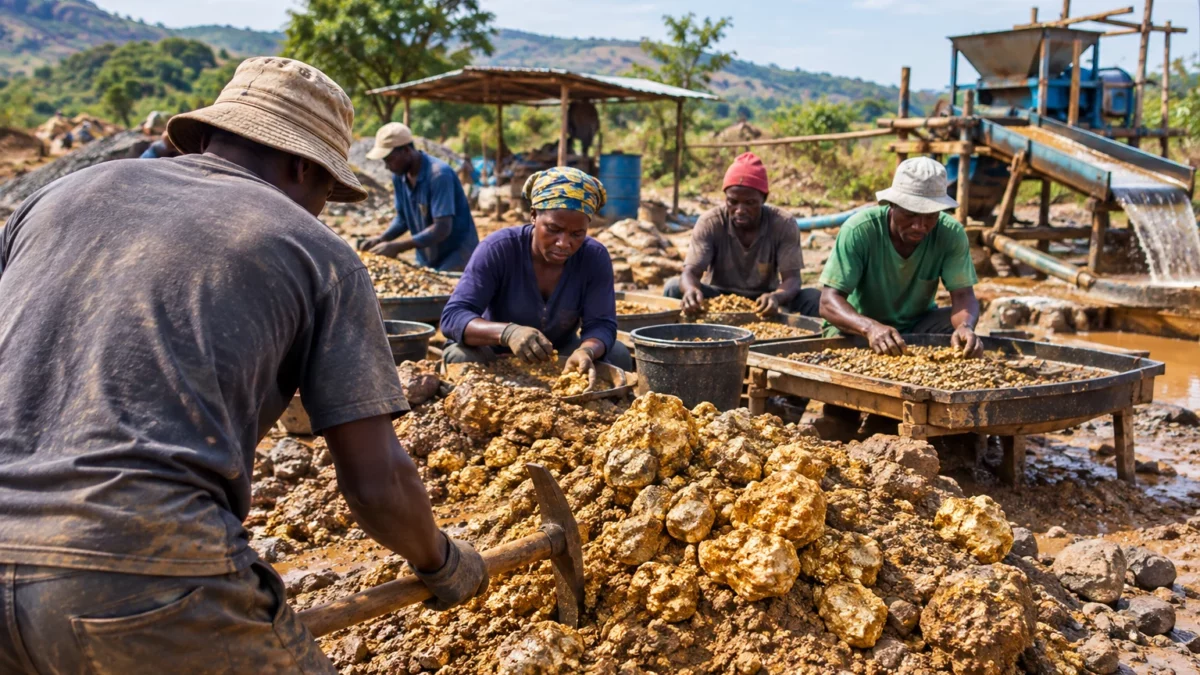
In Zimbabwe, the gold that generates revenue for the country still comes mainly from artisanal and small-scale operations. An industrial project worth more than $600 million could change the scale of some mines. But there is still a considerable gap between a framework agreement and funds actually committed.
Four projects, but no investment guaranteed at this stage
On 26 November 2026, in Harare, China Railway Resources Group (CRRG) and Zimbabwean mining company Duration Gold signed a memorandum of understanding. It opens the way for discussions on a potential investment of more than $600 million in four gold projects. Zimbabwean media outlets Herald and NewsDay also reported the signing and the announced amount.
The sites concerned are Vubachikwe, Gaika, Athens and Filabusi. According to information published by the two companies and reported by the local press, they have already produced gold. The proposed project would involve their rehabilitation, development and expansion, with modernised infrastructure and more digitalised operations.
The distinction is essential: the memorandum is not a firm financing commitment. It establishes a framework for exploring a partnership. The announced amount therefore does not mean that $600 million has already been paid, or that a timetable for the work has been set. The next steps — studies, financial arrangements, permits and investment decisions — will determine whether the announcement becomes a construction project.
Small-scale producers carry significant weight in the sector
The project comes amid an industry with two distinct sides. On the one hand, industrial mines require capital, equipment and infrastructure over several years. On the other, artisanal miners and small-scale operations play a central role in reported production.
Data from Zimbabwe’s Ministry of Finance show that in 2024, artisanal and small-scale producers accounted for 61.3% of recorded gold production, or 23,567 kilograms out of a total of 38,455 kilograms. The Herald puts their share of deliveries in the same year at close to 65%, while the ministry’s official series distinguishes between categories and gives a lower figure. The scopes are therefore not necessarily identical: it is best not to repeat, without qualification, the estimate of about 70% cited in some recent reports.
This difference matters for the analysis. A large project could increase industrial production without replacing small-scale producers, whose activity provides income for many households and brings foreign currency into the country. Other issues include access to official sales channels, mine safety, working conditions and the authorities’ ability to regulate operations.
Harare seeks foreign currency and local benefits
For the Zimbabwean government, increased production could support exports and public revenue in an economy where foreign currencies remain crucial. But extraction alone does not guarantee lasting benefits. Taxation, procurement from local businesses, skilled jobs, training and ore processing within the country will also affect the overall outcome.
For communities near the sites, the impact will depend on very practical decisions: jobs accessible to local people, shared infrastructure, water and waste management, and rehabilitation of land after mining. Any benefits will not automatically be distributed among company headquarters, the capital and mining regions. Social and environmental commitments will need to be assessed as permits are granted and operations proceed.
The announced use of digitalisation could improve production monitoring and operational efficiency. However, on its own, it is not enough to guarantee transparency or a fairer distribution of revenue. Details will be needed on the oversight arrangements, tax obligations and environmental monitoring mechanisms planned for each project.
Ties with China are diversifying, but cannot be reduced to one figure
China is already an important partner in Zimbabwe’s mining sector, particularly in lithium. The proposed gold project with CRRG would extend that presence to another mineral. It also reflects a regional trend: Southern African governments are seeking to attract mining capital while securing more local processing and economic benefits.
The relationship is not one-sided. Harare may seek financing and technical expertise, while foreign companies assess risks, costs and long-term profitability. Zimbabwe’s challenge is to negotiate terms that strengthen national capabilities. For investors, regulatory and infrastructure stability also matters.
The Southern African Development Community (SADC), a regional organisation of which Zimbabwe is a member, highlights the mineral resources and investment opportunities of its member states. But higher production alone does not guarantee more value added in the region. Decisions on refining, equipment, skills and markets will shape local and regional benefits.
Next steps will matter more than the announcement
The first indicator to watch will be the conversion of the memorandum into detailed investment agreements. It will then be important to verify the financing secured, the timetable, permits and the actual start of work at each of the four sites. The promised benefits for employment and local suppliers will also need to be documented.
Comparisons with projects by other investors will help measure the operation’s place in the country’s mining strategy. They should not, however, obscure the already significant role of small-scale producers. For Zimbabwe’s economy, the central question is not only whether more gold will be extracted from the ground, but what share of the value created will remain in the country, and who will benefit from it.