Algeria
 Egypt
 Libya
 Morocco
 Sudan
 Tunisia
 Benin
 Burkina Faso
 Cabo Verde
 Côte d'Ivoire
 Ghana
 Guinea
 Guinea-Bissau
 Liberia
 Mali
 Mauritania
 Niger
 Senegal
 Sierra Leone
 The Gambia
 Togo
 Cameroon
 Central African Republic
 Chad
 DR Congo
 Equatorial Guinea
 Gabon
 Republic of the Congo
 São Tomé and Príncipe
 Burundi
 Comoros
 Djibouti
 Eritrea
 Ethiopia
 Kenya
 Madagascar
 Malawi
 Mauritius
 Mozambique
 Rwanda
 Seychelles
 Somalia
 South Sudan
 Tanzania
 Uganda
 Angola
 Botswana
 Eswatini
 Lesotho
 Namibia
 South Africa
 Zambia
 Zimbabwe
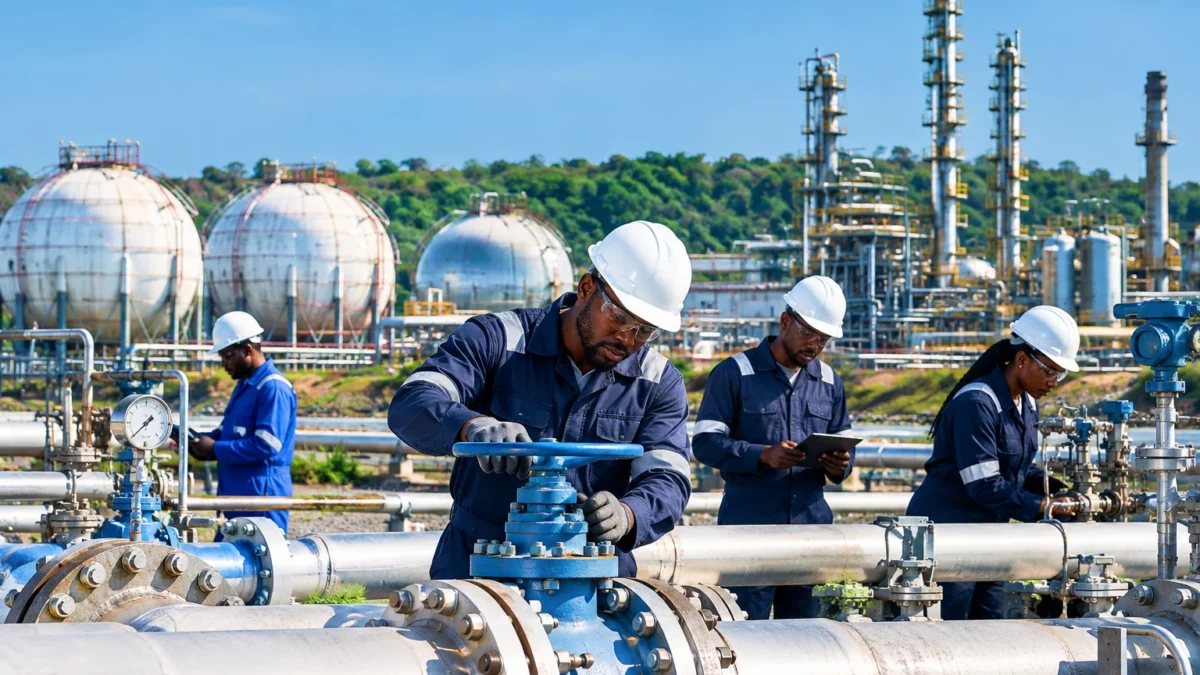
For households and businesses in Nigeria, abundant oil and gas do not guarantee a reliable supply. Between processing facilities, pipelines and depots, the missing link is often the one connecting resources to consumers.
Strengthening the network, from well to domestic market
The challenge spans the entire chain between extraction and the sale of products. The midstream sector processes and transports hydrocarbons; the downstream sector stores, distributes and markets them. Insufficient capacity in these segments can hold back both industry and access to energy.
Nigeria is a member of ECOWAS, the Economic Community of West African States. Its gas network already extends across borders: the West African Gas Pipeline transports Nigerian gas to Benin, Togo and Ghana. This regional infrastructure therefore also depends on Nigeria’s ability to produce, process and deliver available volumes.
ECOWAS is also working on larger-scale pipeline projects, including the African Atlantic Gas Pipeline project. These regional ambitions highlight a practical issue: without reliable national infrastructure, export or energy integration announcements are difficult to translate into regular deliveries.
$30 billion in needs by 2030
On 26 November in Lagos, Victor Ojiakor, representing the chief executive of Nigeria’s regulator, the NMDPRA, estimated that $30 billion in investment would be needed by 2030 for midstream and downstream oil and gas infrastructure. The figure was reported by several Nigerian media outlets after the Business Intelligence Africa summit.
The sums envisaged would cover, among other things, gas processing, storage, transport and distribution equipment. They do not represent funding already secured: this is a need estimated by the regulator, and its fulfilment will depend on projects, their costs and the ability to mobilise public and private capital.
This estimate follows a more targeted assessment presented earlier in 2026. In March, the NMDPRA put the gas infrastructure deficit at $22 billion, according to information published by Nigerian outlet Nairametrics. The two figures are not directly interchangeable: the $30 billion requirement covers the midstream and downstream segments of the oil and gas sector more broadly.
The regulator is also preparing a national strategic petroleum products reserve programme. The stated aim is to cover between 30 and 45 days of consumption, starting with certain depots before expanding to other facilities. No detailed national timetable was announced in the reports consulted.
October data cited when the announcement was made put stocks at 21.8 days of petrol consumption and 14.8 days for liquefied petroleum gas, or LPG, used notably for cooking. The programme aims to strengthen the country’s ability to absorb a supply disruption. It does not, however, by itself resolve the transport, availability or pricing problems affecting users.
Public capital to attract investors
For investors, underground resources are not enough. At the Lagos summit, Sarah Eugene, an analyst at International Energy Services, cited expected profitability, the presence of reliable buyers, infrastructure availability and payment security. She also pointed to risks related to pipelines and hydrocarbon evacuation facilities.
These conditions affect different players in different ways. Large operators can finance major equipment, but small businesses and local industries often depend on accessible networks and predictable deliveries. Households, meanwhile, feel supply disruptions or distribution costs directly, particularly when products have to travel long distances.
Gas illustrates the gap between major projects and local supply. Olufemi Rufai, commercial director of Falcon Corporation, noted that main pipelines are not enough to supply businesses and industrial areas. Secondary pipelines are needed to deliver gas to users. Without them, new transport capacity can remain out of reach of the customers who could use it.
A public mechanism is already seeking to reduce this risk for gas projects. In September, the Midstream and Downstream Gas Infrastructure Fund (MDGIF) said it had mobilised about 1,600 billion naira in private capital alongside 671 billion naira in public funds. The sums are linked to 31 projects and 205 infrastructure assets; once operational, these projects could supply 475 million cubic feet of gas a day to the domestic market.
Nigerian media outlets also reported these figures in September and October. They describe a portfolio of projects, not capacity already fully delivered. The distinction matters: announced funding only becomes useful supply after construction, commissioning and connection to consumers.
Regional reach, but first verifiable results
The West African gas network shows that Nigerian infrastructure has effects beyond the domestic market. A more regular supply could support regional trade and supply to countries connected to the existing pipeline. Conversely, production or transport constraints in Nigeria can limit the benefits expected by its neighbours.
For Nigerians, the test will be less the total amount announced than the tangible progress of works: depots built, secondary pipelines connected, MDGIF projects commissioned and strategic stocks actually established. The regulator has yet to provide a full timetable for these reserves. By 2030, the ability to turn financial commitments into accessible services will determine whether these investments genuinely strengthen domestic and regional supply.