Algeria
 Egypt
 Libya
 Sudan
 Tunisia
 Benin
 Burkina Faso
 Cabo Verde
 Côte d'Ivoire
 Ghana
 Guinea
 Guinea-Bissau
 Liberia
 Mali
 Mauritania
 Niger
 Nigeria
 Senegal
 Sierra Leone
 The Gambia
 Togo
 Cameroon
 Central African Republic
 Chad
 DR Congo
 Equatorial Guinea
 Gabon
 Republic of the Congo
 São Tomé and Príncipe
 Burundi
 Comoros
 Djibouti
 Eritrea
 Ethiopia
 Kenya
 Madagascar
 Malawi
 Mauritius
 Mozambique
 Rwanda
 Seychelles
 Somalia
 South Sudan
 Tanzania
 Uganda
 Angola
 Botswana
 Eswatini
 Lesotho
 Namibia
 South Africa
 Zambia
 Zimbabwe
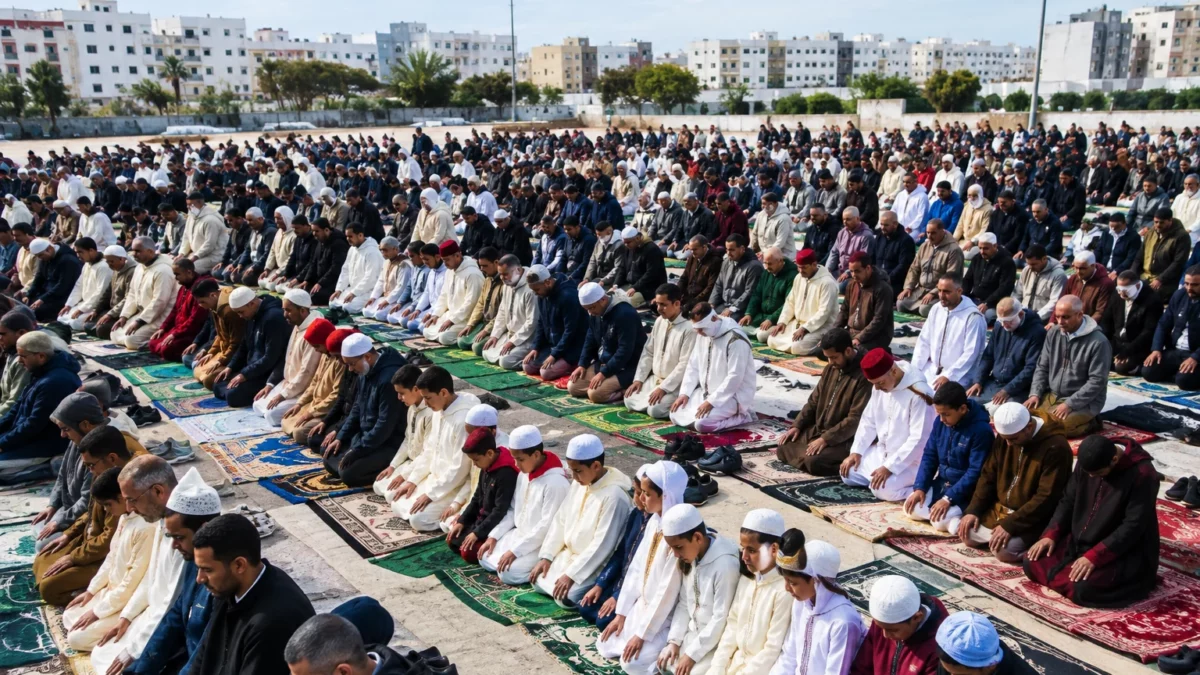
In Morocco, a few weeks of inadequate rainfall can have a serious impact, even when dams hold far more water than in previous years. On 27 November 2026, worshippers gathered in Salé for Salat al-Istisqa, the collective Muslim prayer asking for rain. The rite expresses a spiritual hope. It also serves as a reminder of how water remains an everyday concern, unevenly distributed across regions and seasons.
A collective prayer organised across the kingdom
At the request of King Mohammed VI, prayers for rain were scheduled for Friday 27 November at 10am in prayer grounds and major mosques across the country. The Ministry of Habous and Islamic Affairs presented the decision as a response to declining rainfall. It also linked the ceremony to a Muslim tradition observed when rain is scarce.
In Salé, a city neighbouring Rabat, worshippers took part in the gathering, accompanied in particular by pupils from Quranic schools. After the prayer, an imam delivered a sermon about the practice. Imam Ahmed Elgaidi explained that participants had come together in a spirit of humility and a request for forgiveness. These details describe the local ceremony reported that day; the official announcement, for its part, confirmed that it was being held across the kingdom.
Local reports from the same Friday also noted prayers in Tiflet and Tangier. They show that participation was not limited to Salé, in keeping with the nationwide call. Salat al-Istisqa is a religious rite: it is neither a water-management measure nor a weather forecast.
Rising reserves, but a mixed picture
The context needs to be set out. In mid-January 2026, Morocco’s Minister of Equipment and Water, Nizar Baraka, said that rainfall and snowfall had brought seven years of drought to an end. He reported 108 millimetres of rain between 1 September 2025 and 12 January 2026, and a dam-filling rate of 46%, compared with 28% a year earlier.
In autumn, indicators remained better than in previous seasons, though conditions were not uniformly favourable. A budget document presented to the House of Representatives recorded 43 millimetres of rain as of 10 November 2026. That was 183% more than the previous year, but 36% below the usual average for that date. The same document put reserves in agricultural dams at 9.3 billion cubic metres, a filling rate of 64% as of 2 November.
These figures are not necessarily contradictory: they cover different periods and point to the same reality, that water resources vary over time and between areas. The Moroccan Climate Observatory, which uses, among other sources, ERA5 reanalysis data, estimated that rainfall for the agricultural season was around 101% of normal as of 16 November. It nevertheless noted recent shortfalls in several regions, including Rabat-Salé-Kénitra and Tangier-Tétouan-Al Hoceïma.
Water is not distributed evenly
A national average does not tell the whole story of actual access to water. Dam levels, local rainfall and groundwater conditions vary from one basin to another. Farmers who depend on rain or reservoirs can therefore remain exposed to local shortages, even when national reserves are recovering. In cities, the main concern is continuity of household supplies; in rural areas, it also affects crops, livestock and the income of farming households.
Nor does the recovery in water inflows erase the consequences of several dry years. Reserves need to be replenished, groundwater monitored and competing uses planned for, from drinking water to irrigation. That is why the Moroccan state is continuing to invest in water transfers and desalination, alongside dams. These infrastructure projects can secure supplies for some sectors, but they do not make water unlimited, and their benefits depend on their cost, location and how the resource is distributed.
The ceremony in Salé thus brings together two dimensions that should be distinguished without being set against each other: a religious practice that is important to believers, and a public signal of concern about rainfall. The royal call also draws on Mohammed VI’s religious role as Amir Al-Mouminine, “Commander of the Faithful”. This institutional dimension explains the event’s national reach, without turning prayer into a technical response to water scarcity.
An issue that extends beyond Morocco’s borders
For Morocco, a North African country and member of the African Union, water management forms part of regional discussions on climate adaptation and water security. Conditions in neighbouring countries are not the same: rainfall, rivers, groundwater and infrastructure choices differ. It would therefore be misleading to generalise Morocco’s experience to all of North Africa, just as it would be wrong to infer the water situation across the entire kingdom from a local ceremony.
The next useful assessment will be of rainfall and reserves over the course of the agricultural season, basin by basin. Rising stocks offer measurable respite after several difficult seasons; on their own, they do not guarantee lasting security. In Salé, worshippers asked for rain. For the authorities and residents, the practical challenge also remains ensuring a predictable distribution of water among cities, rural areas and economic sectors.