Algeria
 Egypt
 Libya
 Morocco
 Sudan
 Tunisia
 Benin
 Burkina Faso
 Cabo Verde
 Côte d'Ivoire
 Ghana
 Guinea
 Guinea-Bissau
 Liberia
 Mali
 Niger
 Nigeria
 Senegal
 Sierra Leone
 The Gambia
 Togo
 Cameroon
 Central African Republic
 Chad
 DR Congo
 Equatorial Guinea
 Gabon
 Republic of the Congo
 São Tomé and Príncipe
 Burundi
 Comoros
 Djibouti
 Eritrea
 Ethiopia
 Kenya
 Madagascar
 Malawi
 Mauritius
 Mozambique
 Rwanda
 Seychelles
 Somalia
 South Sudan
 Tanzania
 Uganda
 Angola
 Botswana
 Eswatini
 Lesotho
 Namibia
 South Africa
 Zambia
 Zimbabwe
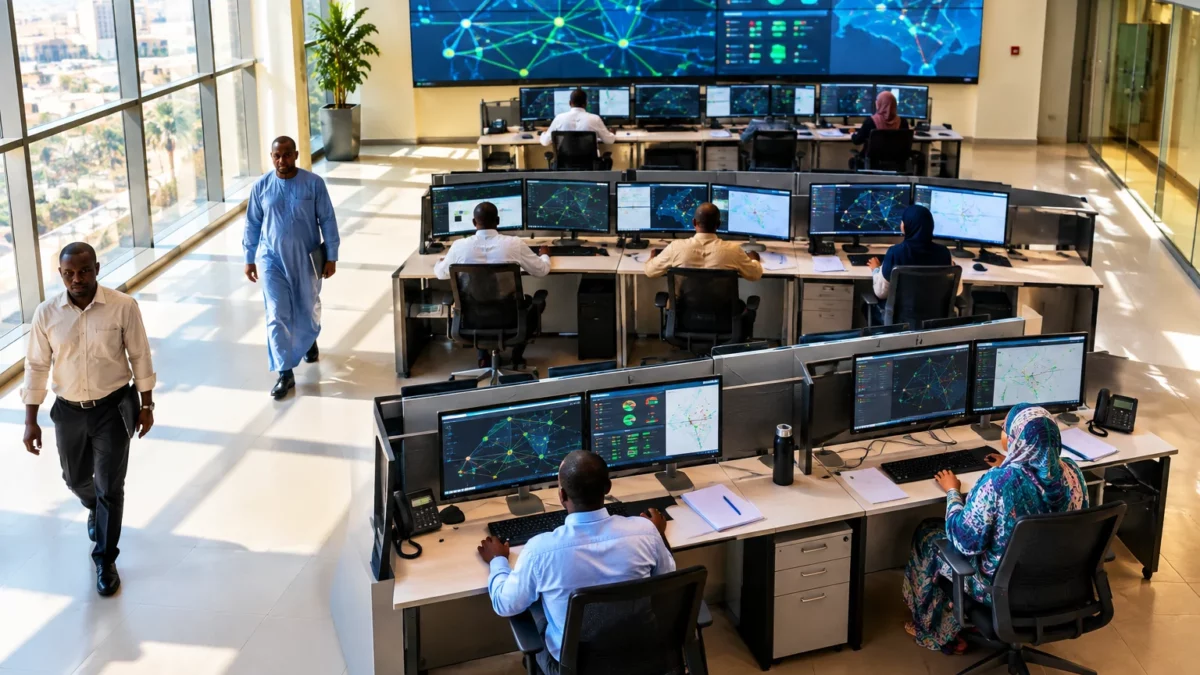
A mobile outage is measured by more than the number of base stations out of service. For Mauritanians, it can complicate a payment, interrupt a business or cut off contact with loved ones. In Nouakchott, the opening of a monitoring centre by Mauritel promises faster interventions. It comes, however, after the regulator imposed sanctions for persistent shortcomings.
A monitoring tool in a sector under pressure
The Minister of Digital Transformation and Modernisation of the Administration, Ahmed Salem Ould Bedda, inaugurated Mauritel’s national supervision and control centre on Thursday 26 November 2026 in Nouakchott. The Mauritanian News Agency and local media outlet Madar reported the opening. The facility, known as a NOC — short for “network operations centre” — is intended to monitor infrastructure continuously and coordinate technical teams. The Mauritanian News Agency’s announcement of Mauritel’s NOC centre is corroborated by Madar’s report from Nouakchott.
Such a centre can identify anomalies, track equipment performance and direct maintenance work. It can therefore reduce the time taken to detect and repair faults. But its opening alone does not prove that coverage or the quality experienced by subscribers will improve everywhere. The outcome will also depend on investment on the ground and the monitoring of performance indicators.
The timing gives the initiative particular significance. On 5 November, the National Regulatory Council imposed financial penalties on the country’s three operators: Mauritel, Mattel and Chinguitel. The announced total is 421,259,757 new ouguiyas (MRU), or about $10.3m, according to Mauritanian reports. Mauritel is liable for the largest share, about MRU 262.1m. The breakdown of the penalties reported by Le Quotidien is consistent with the decision published by Cridem.
Gaps measured in towns and along roads
The proceedings are based on several inspection campaigns. According to information attributed to the regulator, checks carried out between July and August 2025 covered 62 localities and 11 road routes. After a formal notice and a further four-month deadline, a new campaign in February and March 2026 reportedly found persistent shortcomings in coverage and the quality of communications and internet access.
The 2025 inspection report published by the Regulatory Authority already documents significant disparities between locations and routes. On the Akjoujt-Atar route, it recorded a call failure rate of 32.93% in the measurements presented. These results do not describe every subscriber’s experience or the current state of the entire network. They nevertheless show why checks in localities and along roads matter: a national average can mask areas with poorer service. The ARE’s 2025 quality-of-service report provides the readings by location.
For customers in Nouakchott, network density and the volume of users pose different challenges from those faced by residents of rural areas or travellers on major routes. In the latter areas, distance, electricity supply and installation costs can slow repairs or the expansion of coverage. A monitoring centre gives the operator better visibility of its equipment; it cannot replace an additional base station or a reliable power supply.
Quality also depends on infrastructure
The World Bank’s February 2025 assessment of Mauritania’s digital economy describes several constraints on network deployment: taxes on imported equipment and software, supply delays and difficulties accessing electricity outside the main centres. According to estimates cited in the report, a lack of grid connection or unreliable power supply increases the cost of installing a mobile site by 34% to 40%. These factors help explain the difficulties facing operators, without absolving them of their quality obligations or negating the regulator’s findings. The World Bank’s assessment of Mauritania’s digital economy sets out these obstacles in detail.
The resilience of international connectivity is another concern. The ACE submarine cable connects Mauritania to international networks. During the June 2024 incident, the World Bank estimated that more than 90% of the country’s international traffic depended on the cable and noted the lack of active alternative routes. The incident disrupted internet access. A NOC can detect an outage and help co-ordinate Mauritel’s response; on its own, it cannot eliminate dependence on an external link. The World Bank report on the ACE incident details this vulnerability, also reported by the Mauritanian News Agency in June 2024.
A test for the country’s digital ambitions
Mauritania operates in a regional environment where digital infrastructure and cross-border exchanges shape access to services, markets and information. It is a member of the Arab Maghreb Union, while its connectivity challenges also affect its West African neighbours. The World Bank assessment forms part of the “Digital Economy for Africa” initiative, linked to the African Union’s 2020-2030 digital transformation strategy. Network quality is therefore not just a commercial issue: it also determines the ability of public administrations, businesses and users to benefit from digital services.
The next measure of the centre’s effectiveness will not be its inauguration, but verifiable changes in outages, repair times and coverage indicators. The regulator will need to continue inspections across multiple localities, while Mauritel will have to show whether real-time monitoring translates into a more stable service. For subscribers, the practical issue remains the same in the capital and the regions: being able to make calls and connect reliably.