Algeria
 Egypt
 Libya
 Morocco
 Sudan
 Tunisia
 Benin
 Burkina Faso
 Cabo Verde
 Côte d'Ivoire
 Ghana
 Guinea
 Guinea-Bissau
 Liberia
 Mali
 Mauritania
 Niger
 Nigeria
 Senegal
 Sierra Leone
 The Gambia
 Togo
 Central African Republic
 Chad
 DR Congo
 Equatorial Guinea
 Gabon
 Republic of the Congo
 São Tomé and Príncipe
 Burundi
 Comoros
 Djibouti
 Eritrea
 Ethiopia
 Kenya
 Madagascar
 Malawi
 Mauritius
 Mozambique
 Rwanda
 Seychelles
 Somalia
 South Sudan
 Tanzania
 Uganda
 Angola
 Botswana
 Eswatini
 Lesotho
 Namibia
 South Africa
 Zambia
 Zimbabwe
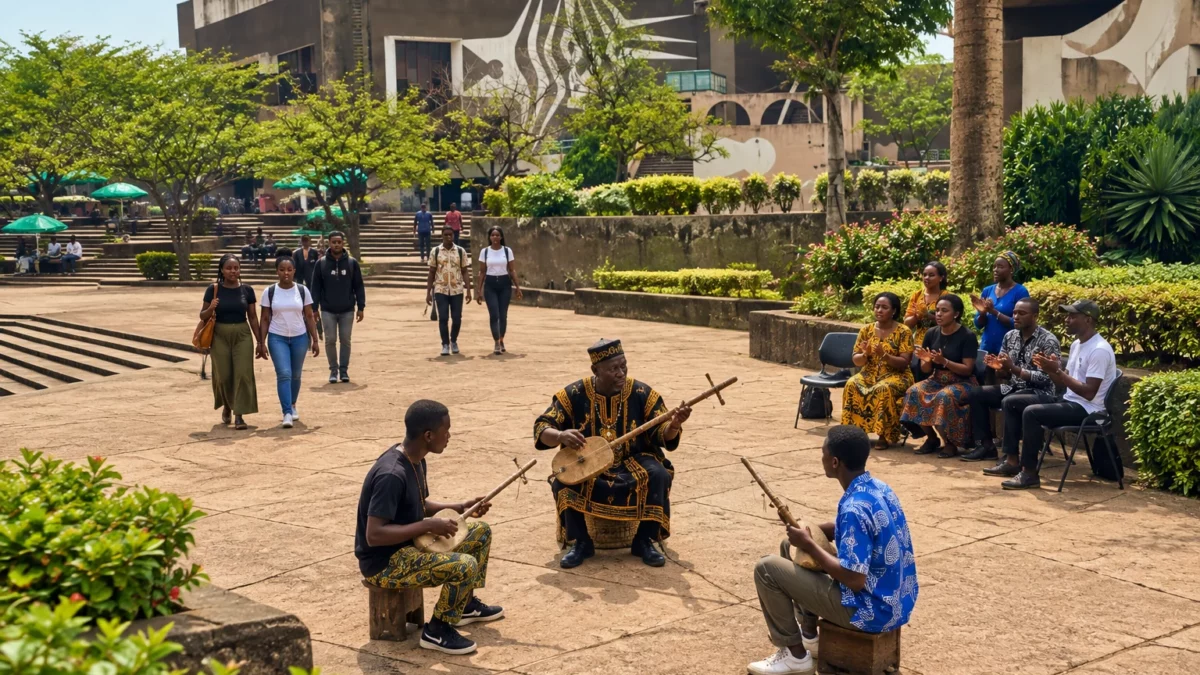
Can an instrument convey a history, a philosophy and know-how without leaving the stage? In Cameroon, the mvet poses this question at every performance. Its recent international recognition opens up a new window of visibility. It does not, however, guarantee that younger generations will learn to play it.
A tradition shared across borders
Mvet Oyeng is associated with the Ekang community, found notably in Cameroon, Gabon, Congo and Equatorial Guinea. It is not merely a stringed instrument. The practice brings together epic narratives, singing, dancing and audience participation. Listeners can accompany the storyteller by striking sticks, singing or clapping.
This collective dimension matters as much as the instrument itself. The mvet is part of an oral culture in which stories convey genealogies, maxims and a worldview. There are several forms of practice. Some are artistic and can be learned; others are part of an initiation and involve knowledge reserved for particular contexts. The learning periods cited by practitioners vary according to the form and are not a universal measure.
The UNESCO nomination was jointly submitted by Cameroon, Gabon and the Republic of the Congo. The Intergovernmental Committee inscribed Mvet Oyeng on the Representative List of the Intangible Cultural Heritage of Humanity on 8 December 2025, at its session in New Delhi. The organisation describes a living musical tradition linked to Ekang practices and know-how. The inscription concerns shared heritage, not the exclusive cultural property of a single state. UNESCO’s official decision on Mvet Oyeng sets out the role of the three countries in the nomination.
From recognition to transmission
In Cameroon, mvet practitioners face a practical challenge: passing on a practice that requires time, places to learn and artists being paid fairly. Master Mvet Scienty Ekoro presents the instrument as an oral memory. The storyteller does not simply recount an old tale. He brings it to life before an audience, which contributes to the performance.
Transmission, therefore, is not simply a matter of keeping an instrument in a museum or recording a few pieces. It requires masters to be able to teach, apprentices to have access to places to practise, and performances to find an audience. It also means respecting the differences between artistic and initiatory forms, without reducing the latter to a show for visitors.
UNESCO’s inscription can help raise the mvet’s profile and strengthen co-operation between the three countries. But it is neither automatic funding nor a cultural policy in itself. Symbolic recognition must translate into learning programmes, archives accessible to the communities concerned, and regular opportunities to perform. Otherwise, international visibility risks remaining detached from practitioners’ everyday lives.
In early November 2026, the “Les Mystères du Mvet” festival scheduled activities in Yaoundé around this tradition. Initiatives of this kind can bring urban audiences closer to an art sometimes seen as old or reserved for specialists. To endure, they will also need to involve practitioners and support transmission beyond one-off events. A school dedicated to the mvet has been discussed as a project in Cameroon; the information available does not yet make it possible to specify its timetable or arrangements.
A living heritage, not a museum piece
The challenge also concerns the place of artists in the cultural economy. Storytellers and musicians must be able to earn a living from their work without losing control of their narratives. Public policies can support training, documentation and distribution. Organisers, media and cultural venues can give the mvet a place in contemporary programmes, in dialogue with other musical forms.
This openness does not mean that every practice must be changed to appeal to a new audience. Artists may choose new arrangements or collaborations, while communities retain an essential role in defining what can be passed on and shown. The challenge is to broaden opportunities to practise without erasing the rules or meanings that practitioners associate with this art.
The cross-border dimension also gives the issue regional significance. Cameroon, Gabon and Congo have built a joint nomination around a heritage that transcends their present-day borders. This cultural co-operation offers a practical basis for dialogue in Central Africa, where communities and practices move across several countries. It could also encourage other joint initiatives, provided responsibilities and visibility are shared among partners.
The mvet’s next chapter will therefore not be decided solely at official ceremonies. It will depend on the continuity of learning, the place accorded to masters and the involvement of young people. It is at this level that international inscription can become genuine transmission, in Cameroon and in the countries linked to this tradition.