Algeria
 Egypt
 Libya
 Morocco
 Sudan
 Tunisia
 Benin
 Burkina Faso
 Cabo Verde
 Côte d'Ivoire
 Ghana
 Guinea
 Liberia
 Mali
 Mauritania
 Niger
 Nigeria
 Senegal
 Sierra Leone
 The Gambia
 Togo
 Cameroon
 Central African Republic
 Chad
 DR Congo
 Equatorial Guinea
 Gabon
 Republic of the Congo
 São Tomé and Príncipe
 Burundi
 Comoros
 Djibouti
 Eritrea
 Ethiopia
 Kenya
 Madagascar
 Malawi
 Mauritius
 Mozambique
 Rwanda
 Seychelles
 Somalia
 South Sudan
 Tanzania
 Uganda
 Angola
 Botswana
 Eswatini
 Lesotho
 Namibia
 South Africa
 Zambia
 Zimbabwe
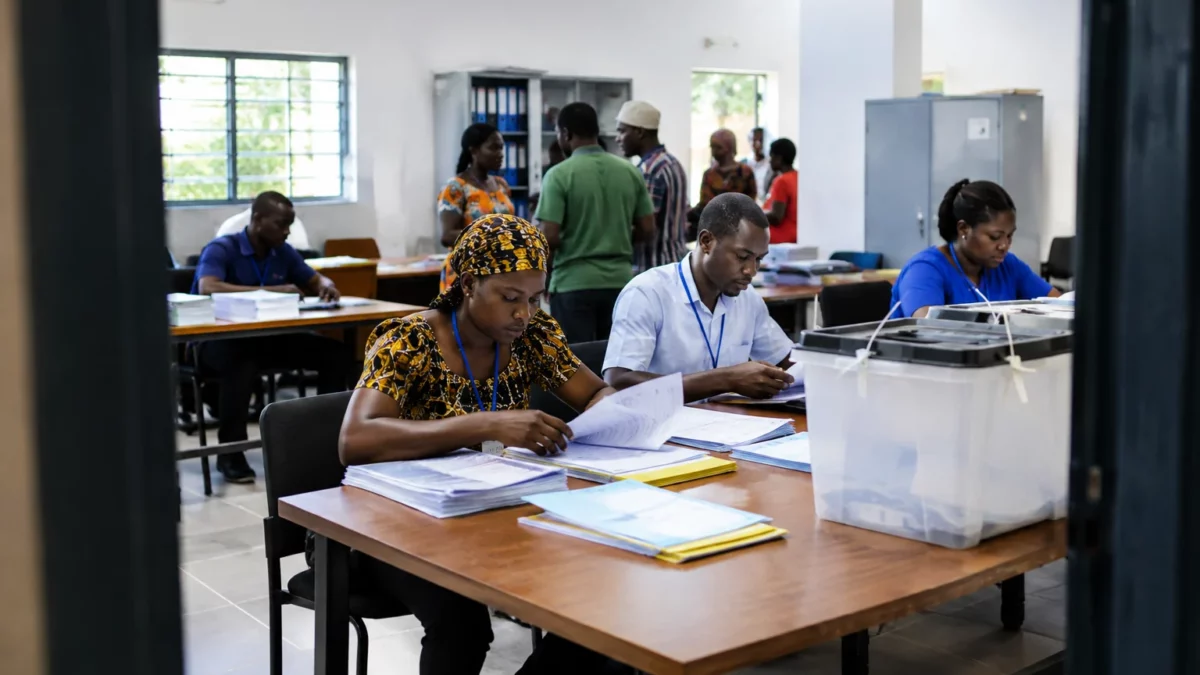
In Bissau, the electoral timetable was meant to pave the way for a return to civilian rule. It has now pushed that prospect back by two years. For the people of Guinea-Bissau, the stakes go beyond the date of the vote: they concern the length of the transition, the conditions for political competition and the ability of institutions to function without military oversight.
Vote postponed, transition extended
Transition president General Horta Inta-a has set 26 November 2028 as the date for presidential and legislative elections. The decree announced on 26 November 2026 replaces the timetable that had scheduled the polls for 6 December 2026. The authorities cite a lack of technical, material and financial resources, as well as the need to ensure a lawful, transparent and inclusive process. These reasons have also been reported by Tunisia’s TAP news agency.
The postponement effectively extends military rule beyond the one-year period announced after the November 2025 coup. The authorities also say they intend to hold municipal elections in 2027, presenting them as a step towards strengthening local powers. Whether this interim vote will take place, and how it will be organised, remain to be clarified.
The electoral timetable had already been undermined before this announcement. In October, Felisberta Moura Vaz, vice-president of the National Electoral Commission, warned that preparations were unlikely to make it possible to meet the 6 December 2026 date. The electoral administration’s limited capacity is therefore a tangible concern. But the decree sets out neither which resources are lacking nor the steps that would make them available by 2028.
The November 2025 precedent weighs on confidence
The current crisis dates back to the presidential and legislative elections of 23 November 2025. Three days later, before provisional results had been published, the army seized power and halted the electoral process. General Horta Inta-a subsequently led the transition. The International Monetary Fund and the United Nations recall this sequence of events and the initial December 2026 timetable.
Guinea-Bissau remains suspended from the decision-making bodies of ECOWAS, the Economic Community of West African States, and from those of the African Union, according to the IMF report published in March 2026. This regional exclusion gives the electoral timetable significance beyond domestic politics: a return to these bodies depends in particular on the restoration of constitutional order.
The institutional context has evolved during the transition. According to information released in the months before the postponement, a constitutional referendum strengthened presidential powers, while political restrictions limited public gatherings. These decisions raise a fundamental question: will the rules for the next election be drawn up with the participation of political parties, civil society and independent institutions, or set mainly by the transition authorities?
Different consequences for different groups
For the military leaders, the postponement means more time to prepare elections according to their timetable and priorities. For parties and candidates, it prolongs uncertainty over campaign rules and access to public spaces. Voters, meanwhile, will have to wait an additional two years before they can choose their representatives at the ballot box, unless the timetable changes or municipal elections are indeed held in 2027.
The postponement could also affect the work of local administrations. Elected municipalities could strengthen representation of the needs specific to each area. But if municipal elections do not take place or lack safeguards, people in the regions and rural areas risk remaining distant from decisions made in Bissau. The announced date alone therefore guarantees neither participation nor balanced representation.
The material difficulties cited by the authorities need to be assessed against verifiable evidence: the election budget, the preparation timetable, the state of voter registers and the autonomy of the electoral commission. Without these details, it is difficult to distinguish operational obstacles from a political decision to extend the transition. This distinction is crucial to restoring confidence after the 2025 vote was halted.
ECOWAS and the African Union face the new timetable
The response of ECOWAS and the African Union will be an important indicator. Both suspended Guinea-Bissau after the military seized power. The announced postponement presents them with a new test: maintaining pressure for a return to civilian rule while assessing whether the proposed steps — notably local elections — can lead to a credible process.
The next milestone to watch is now 2027, when the authorities say they intend to hold municipal elections. Other things to follow include the publication of a detailed electoral timetable, funding for the electoral administration and the conditions offered to parties and observers. Without safeguards and verifiable milestones, 26 November 2028 will remain an announced date, not proof that a return to constitutional order is assured.