Algeria
 Egypt
 Morocco
 Sudan
 Tunisia
 Benin
 Burkina Faso
 Cabo Verde
 Côte d'Ivoire
 Ghana
 Guinea
 Guinea-Bissau
 Liberia
 Mali
 Mauritania
 Niger
 Nigeria
 Senegal
 Sierra Leone
 The Gambia
 Togo
 Cameroon
 Central African Republic
 Chad
 DR Congo
 Equatorial Guinea
 Gabon
 Republic of the Congo
 São Tomé and Príncipe
 Burundi
 Comoros
 Djibouti
 Eritrea
 Ethiopia
 Kenya
 Madagascar
 Malawi
 Mauritius
 Mozambique
 Rwanda
 Seychelles
 Somalia
 South Sudan
 Tanzania
 Uganda
 Angola
 Botswana
 Eswatini
 Lesotho
 Namibia
 South Africa
 Zambia
 Zimbabwe
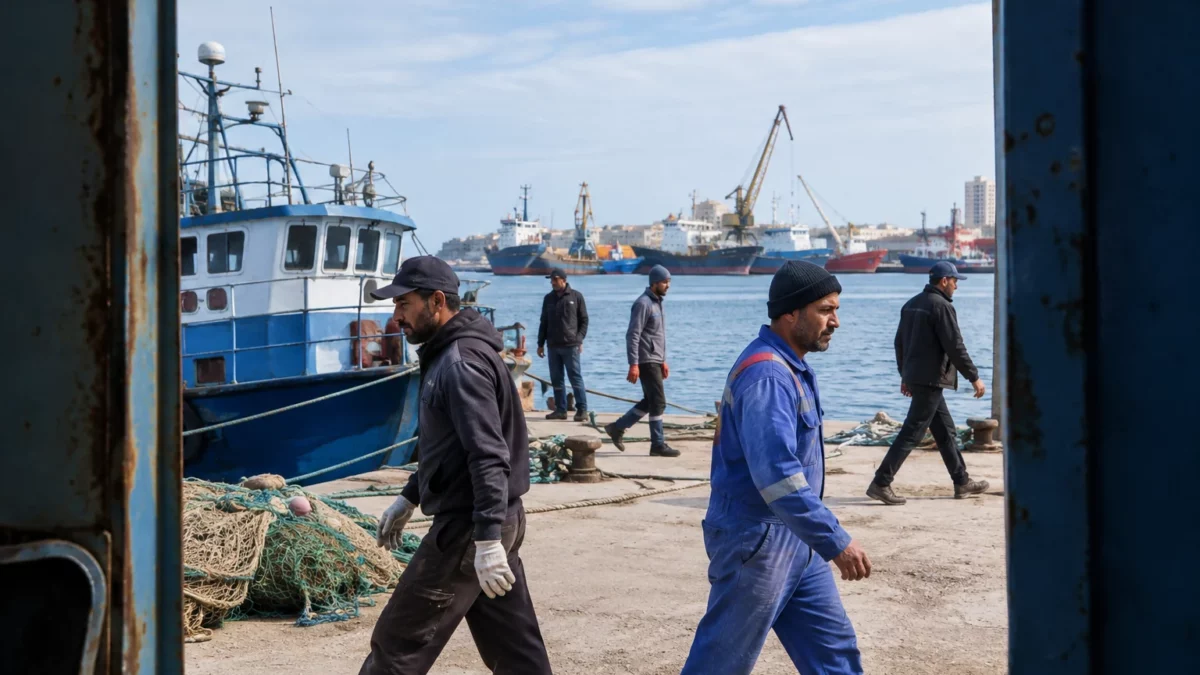
A strike targeting Russian vessels off Benghazi has placed Libya at the intersection of two issues that extend beyond its borders: the war in Ukraine and security in the Mediterranean. For Libyans, the immediate question is also whether the risk of a new foreign confrontation could further destabilise a country whose institutions remain divided.
A strike off Benghazi, with details still unclear
On Sunday 22 November 2026, naval drones targeted two Russian vessels in the Benghazi region of eastern Libya. One was docked at a naval base, the other off the city. The Associated Press reports that Libyan authorities said an attack was suspected. A report by the Turkish news agency Anadolu says Kyiv confirmed it had targeted the two vessels. The precise circumstances and extent of the damage have not been fully established by independent sources.
Two days later, in Brussels, Italian Prime Minister Giorgia Meloni said the war “must not and cannot spread to the Mediterranean”. She reiterated her support for Ukraine, while calling for the warning to be clearly conveyed to Kyiv and Rome’s partners. She made the remarks on the sidelines of an extraordinary European meeting, amid Italian concerns about regional security.
This caution does not mean Rome is withdrawing its support for Kyiv. Meloni distinguished support for Ukraine from the question of operations in the Mediterranean basin. The aim is to limit the risk of the conflict spreading geographically, without presenting as established what remains uncertain about how the strike unfolded.
Libya’s divisions complicate matters
Libya is not merely a backdrop to this confrontation. Since the fall of Muammar Gaddafi in 2011, the country has endured lasting political and security fragmentation. Two rival centres of power are vying for control of institutions, resources and legitimacy. The government based in Tripoli runs the west, while rival authorities are established in the east, where Benghazi is located.
This division makes any national response to a military incident more difficult. Local authorities may not have the same resources or priorities. An operation targeting a Russian vessel could therefore heighten tensions between Libyan actors or prompt conflicting accounts, without the country as a whole having taken part in the decision.
The United Nations Support Mission in Libya (UNSMIL) is seeking to facilitate an inclusive political process and support the implementation of the ceasefire. The Security Council has extended its mandate until 31 October 2027. In its resolution, it calls on the parties to avoid actions that could deepen divisions and stresses that there is no lasting military solution to the Libyan crisis.
The UN mission and Libyan institutions therefore face a practical challenge: preventing an incident involving foreign powers from fuelling internal rivalries. For residents of Benghazi and coastal areas, the immediate focus is on the security of ports, facilities and shipping lanes. The impact on local economic activity will depend, among other things, on how the situation develops and on measures taken locally.
Energy and shipping routes at the heart of Italy’s concerns
Italy is watching the situation closely because of its economic and energy ties with Libya. The Italian group Eni operates hydrocarbon assets there. The Greenstream pipeline links Libyan facilities to Italy and provides a supply route between the two countries. Greater instability could therefore affect Rome’s energy interests and heighten its concerns about movement in the Mediterranean.
The risks are not limited to infrastructure. Increased maritime insecurity could complicate commercial transport and port operations. But it would be premature to conclude that the strike has already disrupted these activities or threatened Italian supplies. The available information does not make it possible to measure a direct economic impact.
A previous incident is nevertheless prompting vigilance. In March 2026, the Russian LNG carrier Arctic Metagaz caught fire in the Mediterranean, between Malta and Libya. Moscow accused Ukraine of using drones launched from Libyan territory. Reuters reported these claims and described the attack as alleged; they do not, in themselves, constitute independent proof of its origin. The incident had already raised questions about maritime security and the possibility of the war affecting vessels far from the Ukrainian front.
Regional implications, with developments to watch
The Mediterranean is shared by countries in Africa, Europe and the Middle East. An escalation around Libya could affect several trade and energy routes, while adding pressure on Libyan actors seeking to preserve a fragile ceasefire. This does not mean the strike automatically heralds a resumption of fighting in the country. The risk will depend on the responses of the authorities, armed groups and states involved.
For the African Union and North African countries, the incident underlines the importance of de-escalation that takes Libyan sovereignty and the safety of the population into account. UNSMIL’s role will also bear watching, particularly its engagement with rival institutions and those responsible for security. At the European level, Rome’s position shows that support for Ukraine goes hand in hand with particular concern about repercussions in the Mediterranean.
The next details to verify concern the identity and status of the vessels, any damage and confirmed responsibility for the operation. It will also be important to see whether the Libyan authorities take measures around Benghazi and whether diplomatic channels can prevent further strikes. At this stage, Meloni’s warning expresses a fear of escalation; it does not prove that the conflict is already spreading.
Sources consulted: report on the suspected strike against a Russian vessel in Benghazi, Giorgia Meloni’s remarks in Brussels, mandate of the United Nations Support Mission in Libya, Security Council resolution on Libya, Reuters report on the Arctic Metagaz, context on Italian concerns.