Algeria
 Egypt
 Libya
 Sudan
 Tunisia
 Benin
 Burkina Faso
 Cabo Verde
 Côte d'Ivoire
 Ghana
 Guinea
 Guinea-Bissau
 Liberia
 Mali
 Mauritania
 Niger
 Nigeria
 Senegal
 Sierra Leone
 The Gambia
 Togo
 Cameroon
 Central African Republic
 Chad
 DR Congo
 Equatorial Guinea
 Gabon
 Republic of the Congo
 São Tomé and Príncipe
 Burundi
 Comoros
 Djibouti
 Eritrea
 Ethiopia
 Kenya
 Madagascar
 Malawi
 Mauritius
 Mozambique
 Rwanda
 Seychelles
 Somalia
 South Sudan
 Tanzania
 Uganda
 Angola
 Botswana
 Eswatini
 Lesotho
 Namibia
 South Africa
 Zambia
 Zimbabwe
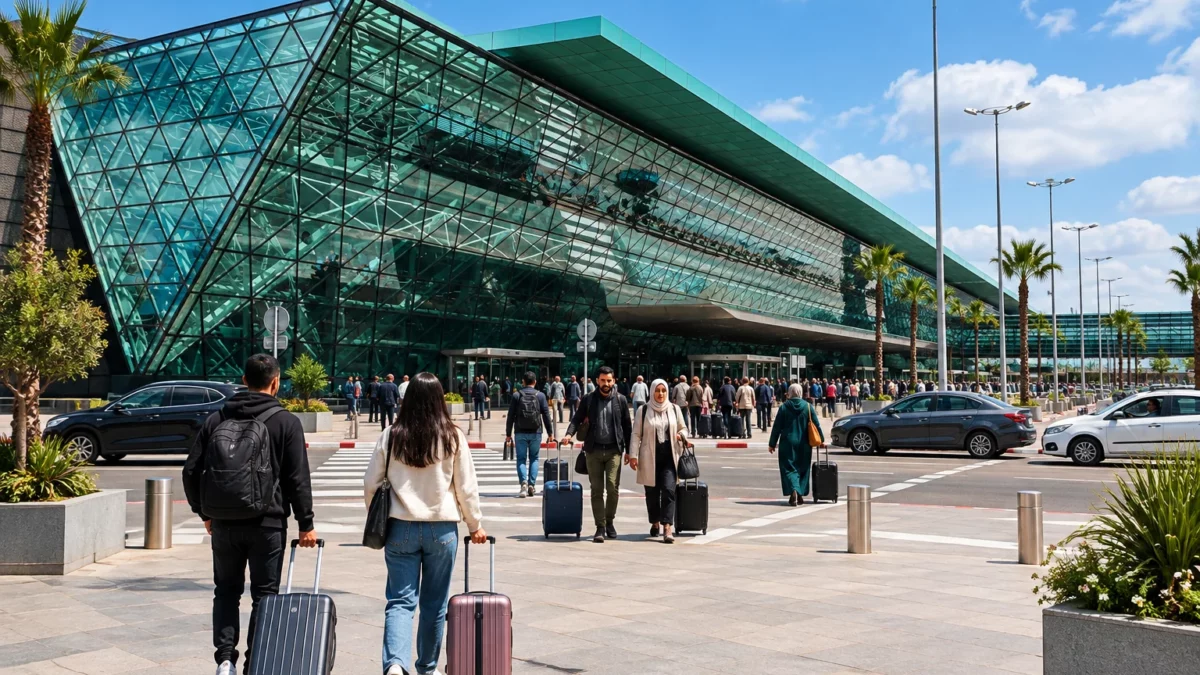
For a passenger connecting in Casablanca, a tourist arriving in Marrakech or a family taking a domestic flight, traffic growth is also measured in queues and time spent in the terminal. Moroccan airports are welcoming ever more passengers. The major projects intended to increase their capacity, however, will be rolled out over several years.
Growth driven by international routes
From January to October 2026, Moroccan airports welcomed nearly 33 million passengers. Traffic rose by 8.96% compared with the first ten months of 2025, according to statistics from Airports of Morocco, the public body responsible for the network. Several Moroccan media outlets reported the figures, including Médias24 and Hespress.
The increase covers both international and domestic travel. International traffic exceeded 29.35 million passengers, up 8.98%. Domestic traffic passed 3.58 million, an increase of 8.81% in a year. In October alone, the network handled about 3.6 million travellers. Air freight and aircraft movements are also rising, a sign of activity that extends beyond tourist trips.
Casablanca Mohammed V remains the main gateway, with more than 10.47 million passengers over ten months. Marrakech-Ménara follows with more than 9.18 million. Agadir, Tangier and Rabat-Salé come next. This distribution shows that pressure is not concentrated solely in the economic capital: airports serving tourism and regional trade are also seeing heavy activity.
Long-term projects meet immediate demand
The gap between growth and construction lies at the heart of the challenge. In 2025, Marrakech airport reportedly welcomed nearly 10 million travellers, while its nominal capacity was estimated at about 8 million. Attributed to data from the airport authority, these figures illustrate pressure on some facilities, but cannot on their own measure waiting times or day-to-day service quality.
Morocco has launched the “Airports 2030” strategy to raise the network’s annual capacity to 80 million passengers. The programme includes expansions and upgrades in several cities. In Casablanca, a new terminal is set to add substantial capacity and strengthen the airport’s role as an international hub, or a point where different routes connect. Information published by the National Airports Office places this transformation within a development programme running to 2030.
The timetable matters as much as the amounts invested. Until the new facilities are operational, airports must absorb growth using existing equipment and operational adjustments. Holiday periods, major events and peak connecting traffic can increase the pressure. Longer queues, delays or a poorer passenger experience are risks to watch, but cannot be presented as already widespread consequences without verified data.
The construction work itself requires careful management. In Casablanca, projects planned over several years must coexist with day-to-day operations. The airport authority’s documentation notes that construction can create operational constraints. For airlines, this means adjusting schedules and ground operations. For passengers, the key issue is the reliability of journeys, particularly when making connections.
An issue extending beyond tourism
Airport capacity affects several parts of the Moroccan economy. Foreign visitors support hotels, restaurants, transport and shops, with benefits that vary by city and season. Air links also serve businesses, high-value goods trade and travel by the diaspora. Increased capacity could therefore widen connectivity, provided that routes and services keep pace.
The benefits and constraints are not distributed evenly. Casablanca handles international connections and a significant share of traffic. Marrakech and Agadir depend more heavily on tourist flows. Regional airports can facilitate domestic travel, but their role depends on flight frequency and accessibility from cities and less well-served areas. A national rise in passenger numbers therefore does not automatically mean an equivalent improvement for every region.
The strategy is also part of Morocco’s preparations for the 2030 World Cup, co-hosted with Spain and Portugal. This deadline gives the projects a clear target, but the value of the investment will also be judged after the event: by the ability to maintain facilities, service quality and the balance between major hubs and regional airports. The stated target of 80 million passengers does not, on its own, guarantee that infrastructure will meet the needs of every type of traveller.
A North African dimension to watch
Regionally, these investments could consolidate Morocco’s position on routes between Africa, Europe and the Americas. The country belongs to the Arab Maghreb Union (AMU), a North African co-operation organisation whose economic integration remains limited. In this context, the development of air links could strengthen exchanges with partners beyond the Maghreb, but it does not replace closer regional co-operation.
The next stage will be tangible: tracking the progress of construction, the opening of new facilities and how airports handle traffic peaks before 2030. For the authorities, the challenge is to expand capacity without allowing current operations to become the weak link. For travellers and businesses, the decisive measure will not simply be the number of available seats, but the ability to travel reliably, across different parts of Morocco and to its international markets.