Algeria
 Egypt
 Libya
 Morocco
 Sudan
 Tunisia
 Benin
 Burkina Faso
 Cabo Verde
 Ghana
 Guinea
 Guinea-Bissau
 Liberia
 Mali
 Mauritania
 Niger
 Nigeria
 Senegal
 Sierra Leone
 The Gambia
 Togo
 Cameroon
 Central African Republic
 Chad
 DR Congo
 Equatorial Guinea
 Gabon
 Republic of the Congo
 São Tomé and Príncipe
 Burundi
 Comoros
 Djibouti
 Eritrea
 Ethiopia
 Kenya
 Madagascar
 Malawi
 Mauritius
 Mozambique
 Rwanda
 Seychelles
 Somalia
 South Sudan
 Tanzania
 Uganda
 Angola
 Botswana
 Eswatini
 Lesotho
 Namibia
 South Africa
 Zambia
 Zimbabwe
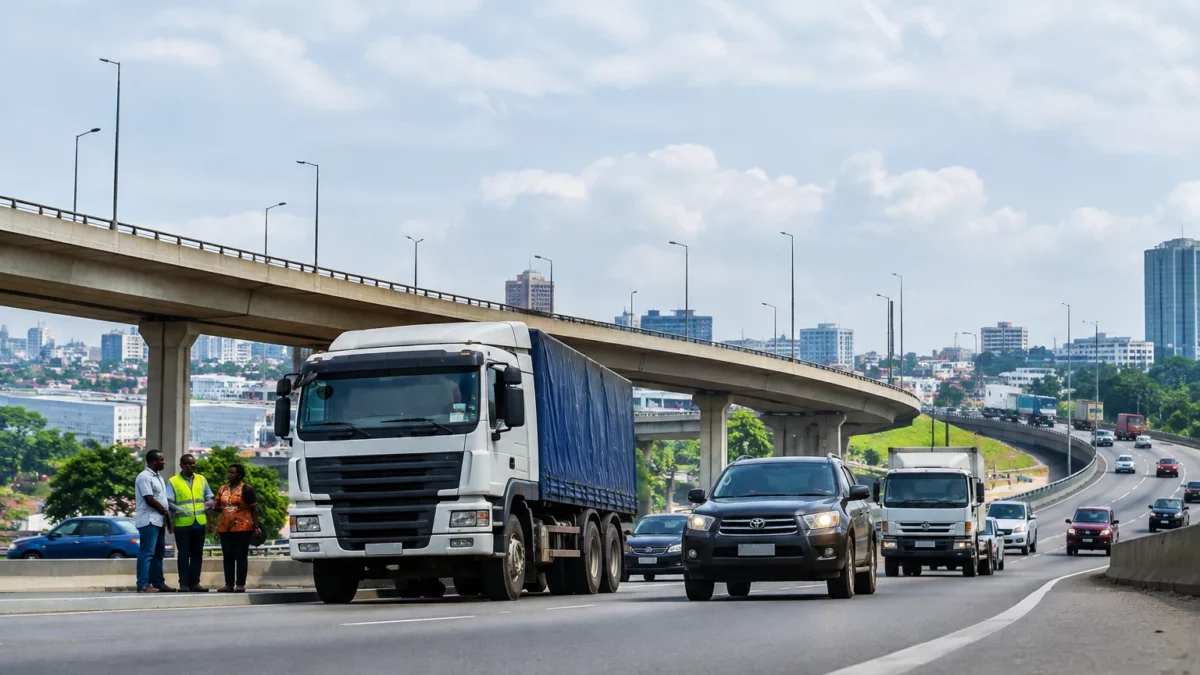
A road, port or railway line is worth more than the kilometres built. For Ivorian businesses, the question will also be who finances and builds this infrastructure, and whether the transport gains benefit economic activity beyond major urban centres.
Côte d’Ivoire wants to make transport a driver of its next stage of development. The National Development Plan (PND) 2026–2030, the government’s five-year roadmap, places strategic infrastructure and regional economic hubs among its priorities. The country is a member of ECOWAS, the organisation that brings together West African states and promotes their economic integration.
Projects along several corridors
On 24 November 2026, in Abidjan-Plateau, Yacouba Hien Sié, the Minister for Infrastructure and Road Maintenance, presented a portfolio of 500 priority projects to the private sector. Their total investment exceeds 13,000 billion CFA francs over the 2026–2030 period, according to the Ivorian government. The meeting was organised with the General Confederation of Enterprises of Côte d’Ivoire (CGECI). The Ivorian Press Agency also reported the minister’s call for local companies to take part in the projects.
The programme covers roads, rail, ports, airports and inland waterway and lagoon transport. The road component provides for paving 3,800 kilometres of roads, upgrading 1,533 kilometres of road surfaces, building 300 kilometres of motorways and developing 928 kilometres of urban roads. Fifteen major structures are also planned. The work could make daily journeys and freight transport easier, but its impact will depend on where projects are located, their timetables and the maintenance of the infrastructure.
Rail links the Ivorian plan directly to regional trade. Three corridors are listed: Abidjan–Ferkessédougou, San Pedro–Odienné–Mali and Abidjan–Ouangolodougou–Kaya. The minister said that more than 2,700 billion CFA francs still had to be raised for these projects. The proposed routes map out connections to the north of the country and neighbouring states, but the information available here does not specify detailed timetables, financing arrangements or implementation stages for each line.
Ports are also included in the programme. In San Pedro, the portfolio lists a mineral terminal, an extension to a container terminal and a 330-hectare economic, industrial and logistics zone. In Abidjan, it provides for a 600-hectare industrial zone in the port area, a 400-hectare free-trade zone on Boulay Island and a grain terminal, among other projects. The aviation component comprises six projects, including an extension to Félix-Houphouët-Boigny International Airport, the rehabilitation of domestic airports and a new airport in Bondoukou. Finally, 17 lagoon stations and two shipyards are planned, at a cost of 361 billion CFA francs.
The private financing bet
These projects form part of a much broader plan. The PND 2026–2030 provides for total investment of 114,838.5 billion CFA francs. The government expects 70.2% to come from the private sector, or 80,614.7 billion, and 29.8% from the public sector, or 34,223.9 billion. The official document sets an average economic growth target of 7.2% over five years. These figures are financing targets: they do not mean that the funds have already been raised or that all the projects are under way.
By urging companies to prioritise domestic capital and promising government support, the minister is seeking to broaden Ivorian participation. This raises a practical question: will local companies be able to access the contracts, financing and partnerships they need, given the scale of the investment? Presenting the projects is a step towards mobilising support. On its own, it does not provide information about procurement terms, the allocation of risk or the guarantees planned for each project.
Mobilising private capital can speed up construction, but it also makes contracts and monitoring rules crucial. For users, the impact will be measured by the reliability of roads, transport costs and journey times, as well as access to secondary cities and production areas. For businesses, ports, rail corridors and logistics zones could reduce barriers to trade. However, the benefits will also depend on connections between this infrastructure and local production and distribution chains.
Regional reach, results to be assessed
The corridors to Mali and Burkina Faso give this portfolio a West African dimension. They could strengthen links between Ivorian ports and markets in the region’s interior. But this ambition requires cross-border co-ordination: compatible infrastructure, efficient transport procedures and networks that connect seamlessly. ECOWAS membership provides a regional framework, but does not in itself guarantee that these conditions will be met.
The PND links infrastructure to other priorities, including agriculture, industrialisation, human capital development and governance. This highlights that new roads and port capacity will not automatically produce balanced economic transformation. The benefits will depend on how well they are aligned with the needs of producers, businesses and communities, as well as access to services and jobs in the regions concerned.
The next step, then, will be less about announcing funding envelopes than turning them into financed, contracted and monitored projects. Timetables, the partnerships selected and the actual role of Ivorian companies will show how far implementation has progressed. At the regional level, delivery of the corridors to landlocked countries will also show whether investment strengthens trade between economies or remains concentrated around Côte d’Ivoire’s main hubs.
Information on the presentation of the portfolio and the plan’s objectives is reported by the Ivorian government, the Ivorian Press Agency and the PND Consultative Group.