Algeria
 Egypt
 Libya
 Morocco
 Sudan
 Tunisia
 Benin
 Burkina Faso
 Cabo Verde
 Côte d'Ivoire
 Ghana
 Guinea
 Guinea-Bissau
 Liberia
 Mali
 Mauritania
 Niger
 Nigeria
 Senegal
 Sierra Leone
 The Gambia
 Togo
 Cameroon
 Central African Republic
 Chad
 DR Congo
 Equatorial Guinea
 Gabon
 Republic of the Congo
 São Tomé and Príncipe
 Burundi
 Comoros
 Djibouti
 Eritrea
 Ethiopia
 Kenya
 Madagascar
 Malawi
 Mauritius
 Mozambique
 Rwanda
 Seychelles
 Somalia
 South Sudan
 Tanzania
 Uganda
 Angola
 Botswana
 Eswatini
 Lesotho
 Namibia
 South Africa
 Zambia
 Zimbabwe
For a family whose loved one has disappeared at sea, an identification cannot restore the life that was lost. It can, however, end years of uncertainty and make previously stalled procedures possible. That is the aim of forensic work undertaken between Brazil and Mauritania after a boat was found adrift in the Atlantic.
Bodies found thousands of kilometres from their point of departure
On 13 April 2024, fishermen spotted a boat stranded in the state of Pará, in north-eastern Brazil. Nine bodies were found: eight in the boat and one nearby. The vessel is believed to have left Nouadhibou, Mauritania, on 23 January 2024, in an attempt to reach the Canary Islands, Spanish territory off the coast of West Africa.
Brazilian investigators examined phones and documents recovered on board. The available reports do not agree on the number of phones: the forensic investigation refers to 28, while an earlier account by Spain’s EFE news agency listed 27. The two identity documents found pointed to Mali and Mauritania. These clues guided the search, but were not enough to establish the identities of the dead.
The crossing is believed to have lasted several weeks. According to information from the investigation, at least 42 men are thought to have boarded, although the total number remains uncertain. The authorities found only nine bodies. The other passengers are missing; the exact circumstances of their disappearance have not been established. An earlier EFE account of the boat and its drift describes the initial difficulties in identifying those on board.
DNA matching gives six victims their names
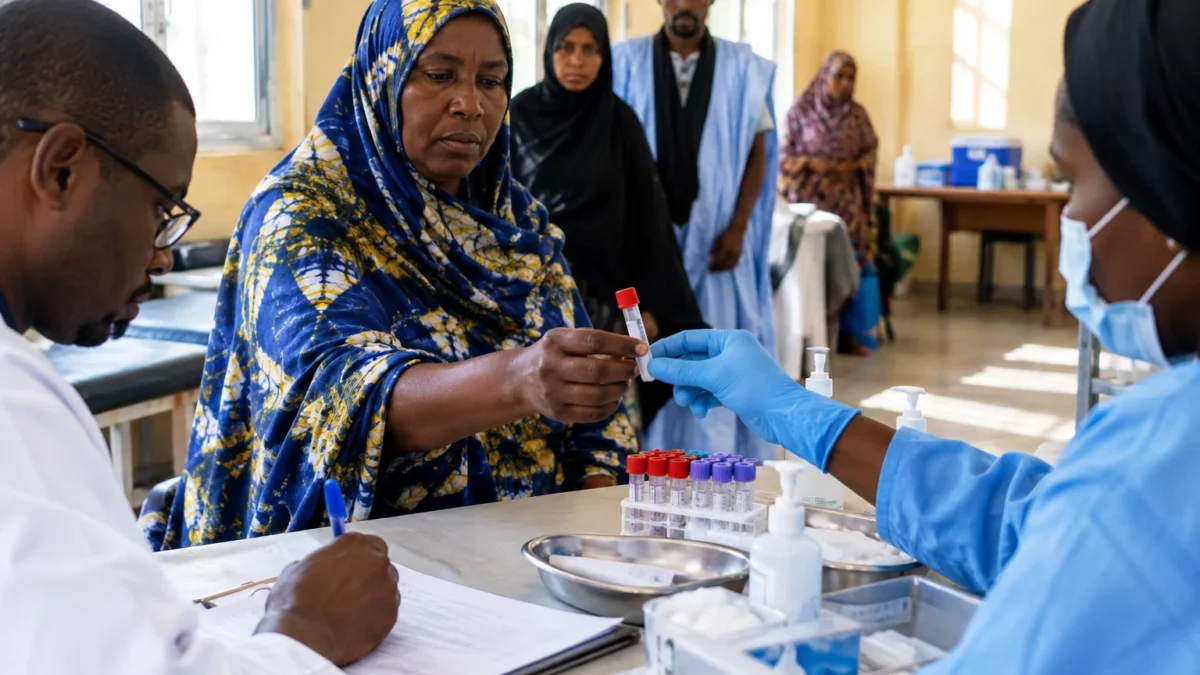
Alexandre Deitos, a forensic investigator with the Brazilian police, sought to identify the victims by finding their families. With support from the International Committee of the Red Cross and co-operation from the Mauritanian authorities, he carried out a 10-day mission in Mauritania. He travelled more than 1,500 kilometres and collected DNA samples from 85 people from 29 families.
Tests identified six of the nine men. They included Souleimane Gassama. His wife, Kadiatou, knew he had boarded the boat and had spoken to him shortly before his departure. The identity document found in the boat had provided a clue; genetic comparison confirmed his death. The findings were reported by several media outlets, including the Associated Press and Africanews.
The work went beyond DNA testing. Information found on phones, accounts from relatives and medical records also helped investigators check leads. In one case, the father of a missing man recognised an X-ray showing an old fracture in his son’s ankle. This lead must, however, be distinguished from the identifications formally confirmed by the Brazilian tests.
A death certificate has practical significance for relatives
Without official confirmation, families often face a double ordeal: grief and the absence of legal proof. A death certificate can help settle an inheritance, access benefits or clarify the administrative status of a spouse and children. The consequences vary according to the country, residency status and rules applying to each family.
For Kadiatou Gassama, who is raising six children in Mauritania, confirmation should make it possible to obtain a death certificate. She hopes the document will make certain procedures easier for her family. Her case is a reminder that the consequences of a disappearance do not end with the traveller: they also affect relatives who remain at home or are living in another country, sometimes without regular access to administrative services.
The mission also highlighted the limitations of approaches relying solely on communication between government departments. Emails had failed to advance the search. Family networks, community organisations and information from phones helped investigators find relatives. This cross-referencing can support an investigation, but requires personal data to be protected and families’ consent to be obtained.
The Atlantic route: documented departures and invisible disappearances
The route to the Canary Islands begins in coastal West African countries, including Mauritania, Senegal and The Gambia. It connects these areas to the Spanish archipelago, but boats can drift a long way when they lose their bearings or means of calling for help. The boat found in Brazil illustrates this transatlantic dimension: a journey intended for Europe ended on the coast of South America.
The International Organization for Migration estimates that more than 6,500 people have died on this route since 2020. This is a tally of documented deaths, not a comprehensive total: shipwrecks without witnesses or recovered bodies often go uncounted. In a more recent tally, the IOM also recorded 168 deaths or disappearances involving 59 boats that did not reach the Canary Islands in the first half of 2026. These figures do not necessarily cover every disappearance along the entire route.
The route exists in a context where people leave their regions for a range of reasons, including the search for income or job opportunities. Accounts gathered in connection with this boat mention relatives who had already left for Europe and the hope of sending money to family. This does not sum up either West African migration journeys or the reasons behind every departure. However, the distance, length of the crossing and fragility of the boats make rescue difficult when contact is lost.
A possible precedent, but not yet a regional system
For Brazil, the investigation shows that co-operation between police, families, humanitarian organisations and community networks can advance identification even when bodies have drifted far from their country of departure. Brazilian authorities had encountered a similar case in 2021, but were unable to identify the victims. Alexandre Deitos hopes this experience will serve as a model, but it is not yet a joint mechanism adopted by the countries concerned.
The next step is to identify the three men whose bodies have not yet been formally attributed, while continuing the search for the other missing passengers. At regional level, the challenge is also to enable reliable exchanges between countries of departure, transit and discovery. As long as such co-operation remains sporadic, many families will continue to await an answer that no national registry can provide on its own.
The IOM’s data on the West African Atlantic route provide an overview of recorded arrivals, shipwrecks and disappearances. They also highlight an essential limitation: counting deaths depends on being able to document events that, by definition, often take place far from view.