Algeria
 Egypt
 Morocco
 Sudan
 Tunisia
 Benin
 Burkina Faso
 Cabo Verde
 Côte d'Ivoire
 Ghana
 Guinea
 Guinea-Bissau
 Liberia
 Mali
 Mauritania
 Niger
 Nigeria
 Senegal
 Sierra Leone
 The Gambia
 Togo
 Cameroon
 Central African Republic
 Chad
 DR Congo
 Equatorial Guinea
 Gabon
 Republic of the Congo
 São Tomé and Príncipe
 Burundi
 Comoros
 Djibouti
 Eritrea
 Ethiopia
 Kenya
 Madagascar
 Malawi
 Mauritius
 Mozambique
 Rwanda
 Seychelles
 Somalia
 South Sudan
 Tanzania
 Uganda
 Angola
 Botswana
 Eswatini
 Lesotho
 Namibia
 South Africa
 Zambia
 Zimbabwe
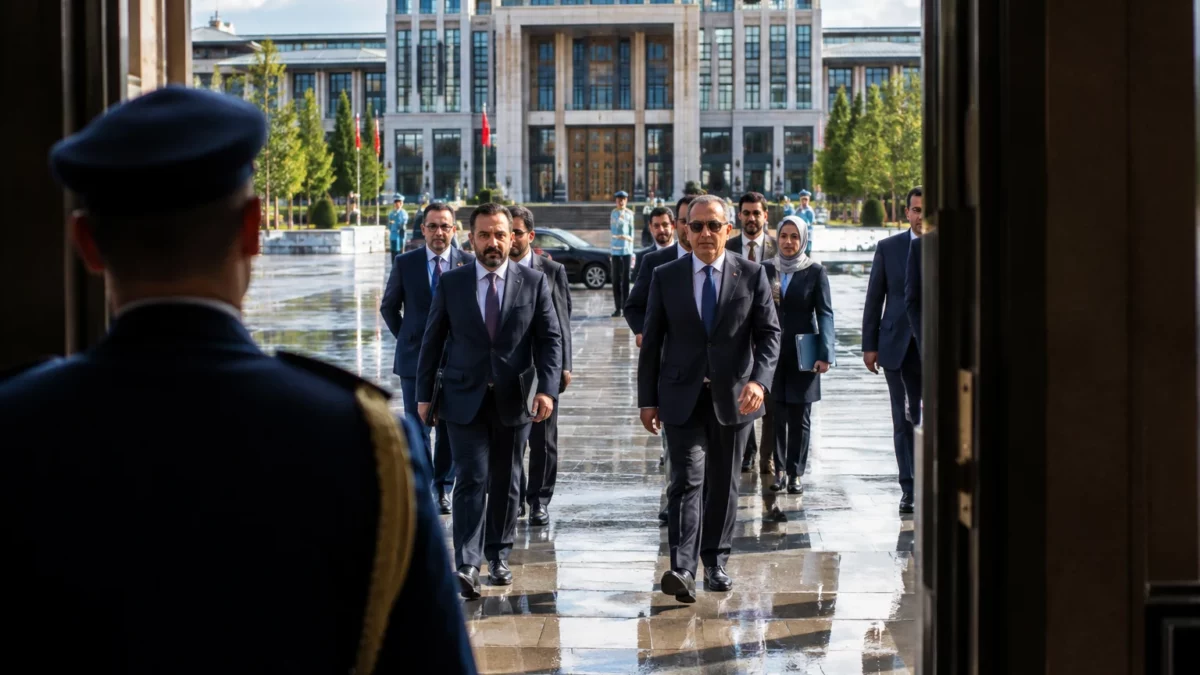
A meeting in Ankara is not enough to reunify a country. But when the Turkish president receives Khalifa Haftar, long opposed to Ankara’s Libyan allies, the gesture could affect the balance of power between eastern and western Libya.
A rapprochement in a country still divided
Since the fall of Muammar Gaddafi in 2011, Libya has remained marked by the fragmentation of its institutions and armed forces. In Tripoli, Abdelhamid Dbeibah’s Government of National Unity is recognised by the UN. In the east, a rival administration is backed by the House of Representatives and the forces led by Haftar. This duality is, in particular, holding up preparations for national elections.
Turkey has long supported the Tripoli camp. In 2019, Haftar’s forces launched an offensive against the capital. Ankara provided military support to the government recognised by the UN, helping to push back the advance. The conflict stabilised after the permanent ceasefire signed in October 2020, without resolving political rivalries or reunifying the army. The International Crisis Group’s analysis of Turkey’s intervention in Libya examines this period.
The issue extends beyond Libya’s borders. Turkey is seeking to consolidate its relations with both centres of power, while other foreign actors also maintain ties with the rival authorities. The region falls within the remit of the Arab Maghreb Union, but divisions between member states limit its role. The UN therefore remains one of the main frameworks for mediation, through its Support Mission in Libya, UNSMIL.
Official visit, with no deal announced
On Wednesday 25 November 2026, Recep Tayyip Erdogan received Haftar at the presidential complex in Ankara. It was the first official visit to Turkey by the military leader of eastern Libya, according to the Turkish presidency and Anadolu Agency. Turkish officials from the foreign affairs, defence and intelligence services, as well as the general staff, also took part in the discussions. Anadolu’s report on the meetings in Ankara details the composition of the delegations.
Haftar’s office said the discussions covered regional and international issues, as well as cooperation between Libya and Turkey. It also said the sides supported international efforts to unify Libya’s institutions. However, no detailed public agreement or implementation timetable was announced. The meeting marks a diplomatic opening; on its own, it does not prove a change of alliance or an understanding on power-sharing.
The contact is part of a series of Turkish initiatives involving both camps. Ankara hosted talks in October between representatives of the eastern administration and the Tripoli government, according to information available on those exchanges. For Turkey, dialogue with Haftar could strengthen its influence across the country and reduce the risk of its interests being tied to a single power. For the eastern authorities, the meeting offers a direct channel to an important external actor.
Issues that go beyond diplomacy
The test will be what follows. Closer ties between Ankara and Haftar could facilitate discussions on security, economic exchanges or infrastructure. But without transparent mechanisms and decisions taken with the Libyan institutions concerned, bilateral arrangements could mainly strengthen leaders and networks already in a position to negotiate.
The effects would not be the same everywhere. In Tripoli, a Turkish-Haftar rapprochement could be seen as a redistribution of foreign support, with no guarantees for residents or local institutions. In the east, political and military officials might see it as increased recognition. For Libyans, from the capital to regions far from decision-making centres, the practical issue remains access to stable public services, a unified administration and common rules for the country’s resources.
A UN political process provides a benchmark for assessing the significance of the visit. On 30 August 2026, Libyan representatives reached an agreement covering, among other things, the electoral commission and the legal framework for elections. The House of Representatives subsequently approved it, and the Security Council welcomed the commitment to presidential and legislative elections within two years. UNSMIL described the agreement as a step, not the culmination of the process. UNSMIL sets out the agreed steps to revive the elections.
The regional significance will be determined over time
If Ankara uses its relations with both camps to support Libyan dialogue, its role could help sustain the political opening. But if contacts remain focused on bilateral interests, they risk bypassing the institutions Libyans are trying to rebuild. The visit also leaves the central question unanswered: who will govern the country, and under what rules, after the next elections?
For the African Union and Libya’s neighbours, the country’s stability affects regional security, cross-border trade and movement across the Mediterranean. The sign to watch, then, is not merely whether visits to Ankara continue. It will be necessary to see whether diplomatic commitments translate into progress on the 30 August agreement, the reunification of institutions and the organisation of elections accepted in both the east and the west.