Algeria
 Egypt
 Libya
 Morocco
 Sudan
 Tunisia
 Benin
 Burkina Faso
 Cabo Verde
 Côte d'Ivoire
 Ghana
 Guinea
 Guinea-Bissau
 Liberia
 Mali
 Mauritania
 Niger
 Nigeria
 Senegal
 Sierra Leone
 The Gambia
 Cameroon
 Central African Republic
 Chad
 DR Congo
 Equatorial Guinea
 Gabon
 Republic of the Congo
 São Tomé and Príncipe
 Burundi
 Comoros
 Djibouti
 Eritrea
 Ethiopia
 Kenya
 Madagascar
 Malawi
 Mauritius
 Mozambique
 Rwanda
 Seychelles
 Somalia
 South Sudan
 Tanzania
 Uganda
 Angola
 Botswana
 Eswatini
 Lesotho
 Namibia
 South Africa
 Zambia
 Zimbabwe
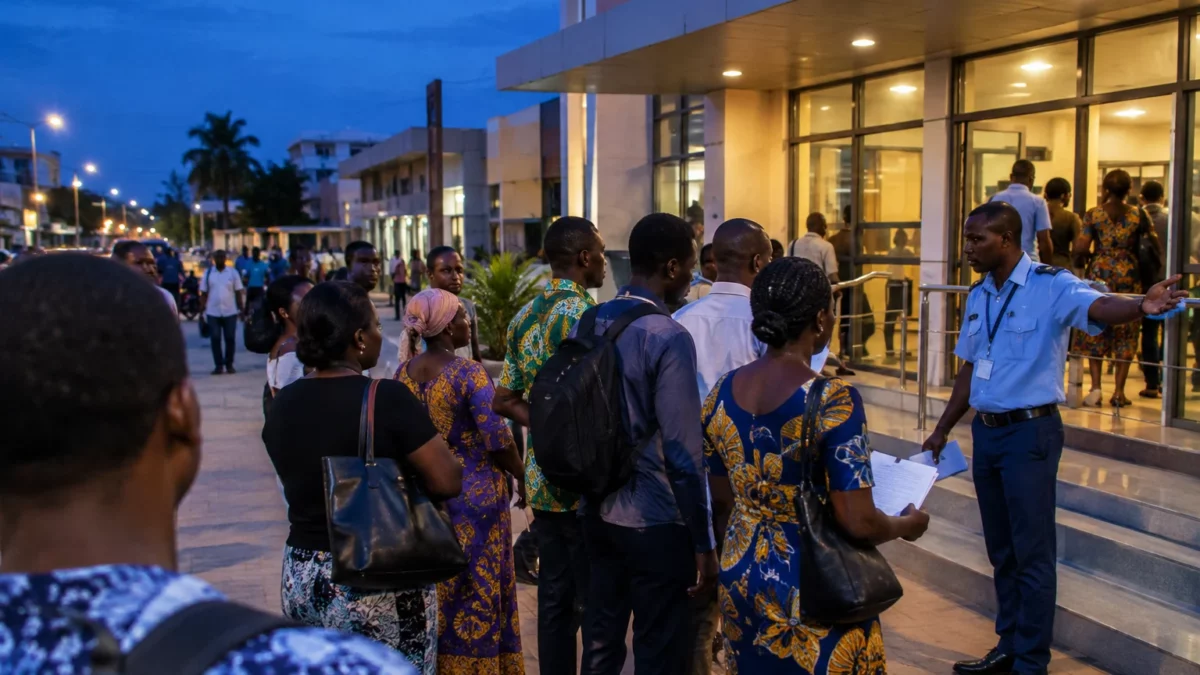
When several ministries operate from separate sites, travel and coordination weigh on the State’s day-to-day functioning. In Lomé, the planned grouping in Lomé II promises to bring public services closer together, but its usefulness will also be measured by how users are able to access them.
A project designed around Lomé II’s administrative hub
Togo is a member of the Economic Community of West African States (ECOWAS), which brings neighbouring countries together through regional cooperation mechanisms. In this context, the organisation of public services remains a tangible national issue: it affects both coordination between administrations and the procedures followed by residents and businesses.
The future ministerial city is part of the transformation of Lomé II’s administrative hub, where public institutions are already based. The site, located in the commune of Golfe 3, is to accommodate some of the State’s services currently spread across the capital. The project was presented before work began as part of the government’s administrative modernisation strategy.
This ambition raises a broader question than that of buildings: how can administrations be made more accessible and better coordinated when public activity is largely concentrated in Lomé? Bringing them together may facilitate exchanges between ministries. It may also shift the burden to users if transport, reception and administrative procedures do not keep pace.
Work begins, with a three-year timetable
On 23 November 2026, the Togolese State handed service orders to the companies involved in the project, formally marking the start of construction. The news was reported by Togo’s Ministry of Finance and Budget, as well as by several media outlets in the country, including Togo First and Togo-Presse.
The programme предусматривает 18 buildings across a site of around 67 hectares: eight towers of between 7 and 12 storeys and ten low-rise buildings. Documents released by the authorities specify 90,000 square metres of built space, more than 3,700 workstations, including those for 12 ministerial offices, and 800 parking spaces. These details have also been reported by the Togolese press.
The announced timetable runs for 36 months, in two phases. This is a projected deadline: meeting it will depend on the progress of the work, its financing and coordination between the parties involved. The State presents the grouping as a way to facilitate collaboration between departments, improve public reception and make better use of available resources.
The project is based on a public-private partnership, an arrangement in which the State entrusts private partners with part of the delivery and operation of a facility. The ministry names SOCOCIM as project owner, PFO Construction Togo for design and construction, and the INROS LACKNER consultancy for technical supervision. These roles were reported at the handover of the service orders.
Financing and benefits: estimates to monitor
The West African Development Bank (BOAD), a regional financial institution, has provided financing of 20 billion CFA francs for the construction and operation of the ministerial city. Its April 2025 bulletin confirms this amount. This is an identified contribution to the financing package, but the public information consulted does not detail the overall costs or the full allocation of risks between partners.
Projections associated with the project cite more than 1,000 jobs and 11.6 billion CFA francs in indirect or induced value added per year. These are estimates, not results already observed. Their impact will depend in particular on the use of local companies, the proportion of jobs actually created in Togo and how long activity continues beyond the construction phase.
Concentrating services could reduce some work-related travel between administrations. For civil servants, the quality of workspaces and equipment will affect the project’s actual benefits. For citizens, the decisive measure will instead be how straightforward procedures are: a modern building alone does not guarantee shorter waiting times or more efficient reception.
The choice of a single site also raises practical questions. Access by public transport, traffic at peak times, parking and visitor wayfinding will need to be addressed when the complex opens. The effects could vary among users: staff working nearby may benefit from better coordination, while residents travelling from distant neighbourhoods may have to cover a greater distance.
Completion must deliver on promises of better public services
The construction project is a test of implementation for the Togolese administration and its partners. The next steps to monitor are progress across the two phases, transparency on financing, adherence to the timetable and the practical arrangements for operation. The ministerial city will achieve its full impact only if the services brought together maintain suitable access for people who cannot travel easily.
Across West Africa, the project illustrates the growing use of public-private partnerships and regional financing for public infrastructure. The issue is not simply to build offices: it is to establish whether this concentration actually improves coordination within the State and the services it provides. For Togolese people, the results will be measured in everyday use, long after construction is complete.
Togo’s Ministry of Finance details the launch and programme for the ministerial city. Togo First reports on the handover of service orders and the project structure. Togo-Presse reports on the formal authorisation to begin work. BOAD’s bulletin confirms its financing of 20 billion CFA francs.