Algeria
 Egypt
 Libya
 Morocco
 Sudan
 Tunisia
 Benin
 Burkina Faso
 Cabo Verde
 Côte d'Ivoire
 Ghana
 Guinea-Bissau
 Liberia
 Mali
 Mauritania
 Niger
 Nigeria
 Senegal
 Sierra Leone
 The Gambia
 Togo
 Cameroon
 Central African Republic
 Chad
 DR Congo
 Equatorial Guinea
 Gabon
 Republic of the Congo
 São Tomé and Príncipe
 Burundi
 Comoros
 Djibouti
 Eritrea
 Ethiopia
 Kenya
 Madagascar
 Malawi
 Mauritius
 Mozambique
 Rwanda
 Seychelles
 Somalia
 South Sudan
 Tanzania
 Uganda
 Angola
 Botswana
 Eswatini
 Lesotho
 Namibia
 South Africa
 Zambia
 Zimbabwe
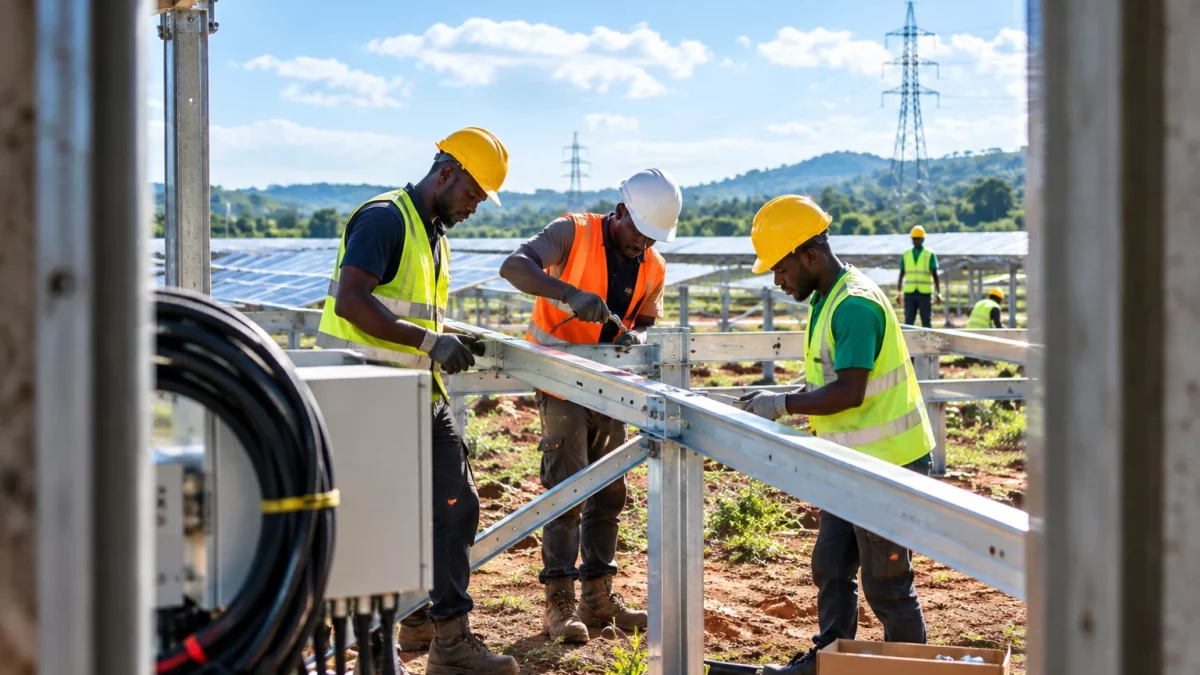
Generating electricity is not enough: it must also be delivered to homes, public services and businesses. In Guinea, a project combining solar power and high-voltage lines focuses on both links in the chain, while its financing highlights the growing role of public guarantees in major energy investments.
A power plant connected to the national grid
At Kamissaya, in Kindia prefecture, a 50-megawatt-peak (MWp) photovoltaic power plant is to be built alongside 350 kilometres of 225-kilovolt transmission lines and two substations. Megawatt-peak measures the maximum theoretical output of solar panels under standardised conditions. Together, the facilities are intended to generate electricity and strengthen its flow through Guinea’s grid.
On 24 November 2026, Bpifrance Assurance Export announced that it would guarantee a €187.1 million buyer credit for the project. A consortium led by Deutsche Bank and Crédit Agricole CIB is providing the financing. VINCI Energies is responsible for designing and building the infrastructure. Bpifrance’s announcement states that the guarantee covers the risk of the lending banks not being repaid.
This financial arrangement is not a subsidy announced for the public, nor a guarantee that bills will fall. It secures the credit provided for the works. The construction contract, announced in April 2026, was valued at about €192 million. The contract and credit amounts relate to different elements of the operation.
The challenge goes beyond generation
Guinea already has hydroelectric capacity, but installed generation alone does not guarantee a reliable supply throughout the country. Lines and substations are essential to transport electricity, connect generation areas to centres of consumption and ease grid bottlenecks. Their practical impact will also depend on commissioning, maintenance and system management.
The Guinean Agency for Rural Electrification said work on the Kamissaya power plant began on 1 August 2026. This step distinguishes the project from a mere financing announcement, but does not mean that electricity is already available. The public information consulted does not give a full commissioning schedule or specify which localities will be directly served.
For residents and small businesses, the key issue is therefore not so much the stated capacity as the quality of access: continuity of service, connections, tariffs and the grid’s ability to absorb the new generation. Infrastructure can support economic activity and services, but building it is not enough to guarantee those benefits. They will also depend on connection choices and the management of the electricity sector.
A guarantee that shares financial risk
The use of a public guarantee addresses a broader challenge in energy financing. In its 2023 report on financing clean energy in Africa, the International Energy Agency estimated that the cost of capital for large renewable energy projects on the continent was at least two to three times higher than in advanced economies and China. High borrowing costs can make projects more expensive, even when the technologies are proven.
Bpifrance’s guarantee reduces some of the risk borne by the banks. It thus facilitates lending while supporting a contract awarded to a French company. The mechanism can make a project financeable, but it does not eliminate execution risks, repayment risks or questions about how benefits are distributed. The detailed terms of the credit and the share of risk remaining with each party have not been disclosed in the public information consulted.
This distinction matters for Guinea’s public finances. A guarantee does not automatically amount to immediate expenditure, but it can expose the state to obligations if repayments are not made, depending on the terms of the contract. Transparency on repayment dates, financial conditions and each party’s responsibilities would make it easier to assess the operation’s real cost and risks.
At regional level, the grid becomes strategic
Guinea is a member of ECOWAS, the Economic Community of West African States. The country is also part of the regional electricity trading system run by the West African Power Pool (WAPP). This organisation aims to integrate national grids and facilitate electricity exchanges between countries.
The 350 kilometres of lines announced are part of Guinea’s grid; nothing in the published information supports the claim that they form a cross-border interconnection. But a more robust national grid can help make regional exchanges more reliable, provided transmission capacity and agreements between operators keep pace. In Conakry and the regions, the test will be the results: infrastructure that is completed, connected and maintained, and a service that genuinely benefits users.
The project comes amid high economic expectations surrounding Simandou, the vast iron ore project whose exports are expected to boost activity and infrastructure needs. The World Bank anticipates a sharp acceleration in Guinea’s growth in 2026 and 2027, driven in particular by mining production coming on stream. This outlook does not, however, guarantee that revenues and investment will automatically translate into better access to electricity.
In the short term, the next steps to watch are progress on construction, connection of the facilities and the publication of information on their operation. In the longer term, Kamissaya will raise a central question for Guinea and its West African partners: can major financed projects strengthen electricity services sustainably, beyond generation intended to support the growth of economic activity?