Algeria
 Egypt
 Libya
 Morocco
 Sudan
 Tunisia
 Benin
 Burkina Faso
 Cabo Verde
 Côte d'Ivoire
 Ghana
 Guinea-Bissau
 Liberia
 Mali
 Mauritania
 Niger
 Nigeria
 Senegal
 Sierra Leone
 The Gambia
 Togo
 Cameroon
 Central African Republic
 Chad
 DR Congo
 Equatorial Guinea
 Gabon
 Republic of the Congo
 São Tomé and Príncipe
 Burundi
 Comoros
 Djibouti
 Eritrea
 Ethiopia
 Kenya
 Madagascar
 Malawi
 Mauritius
 Mozambique
 Rwanda
 Seychelles
 Somalia
 South Sudan
 Tanzania
 Uganda
 Angola
 Botswana
 Eswatini
 Lesotho
 Namibia
 South Africa
 Zambia
 Zimbabwe
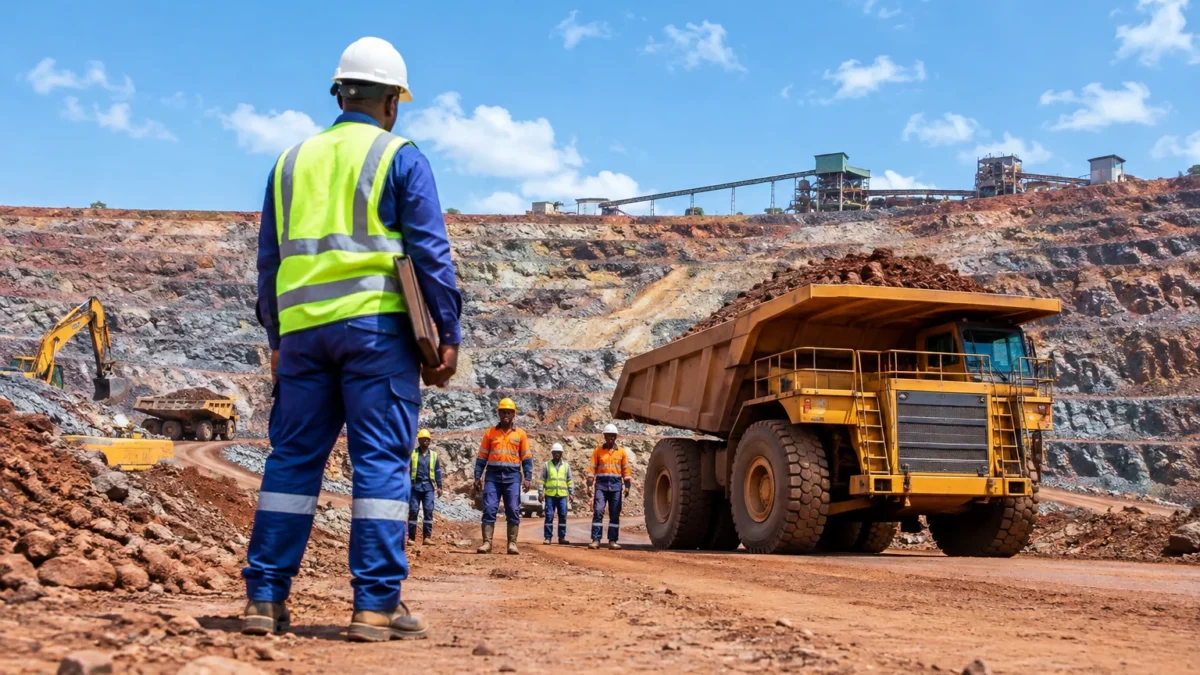
Rising mining revenues can boost state income without, in themselves, guaranteeing more jobs or better public services. In Guinea, a new agreement with the International Monetary Fund (IMF) puts this question at the heart of a $425 million financial programme, approved on 23 November 2026.
A deal accompanying the expansion of mining
Guinea, a West African country and member of the Economic Community of West African States (ECOWAS), is preparing for a period of intensive extractive activity. The Simandou iron ore project and bauxite exports are central to the country’s economic outlook. The national Simandou 2040 programme aims to turn these resources into investment and longer-term development.
This growth is nevertheless exposed to risks. Public finances and external reserves depend in part on mining revenues, while inflation, the cost of energy imports and fluctuations in global markets can put pressure on the budget. Guinea’s budget execution report for the first half of 2026 highlights both the mining sector’s importance to growth prospects and the country’s dependence on natural resources.
The regional context also matters. West African countries must fund their infrastructure and public services in an environment marked by commodity price volatility and tighter financing conditions. For Conakry, the question is therefore not only how to attract capital, but also how to consolidate public revenues and better cushion shocks.
41-month financing tied to reforms
Meeting in Washington on 23 November, the IMF executive board approved an economic and financial programme covering the period 2026-2029. The package amounts to 310.59 million special drawing rights, the Fund’s unit of account, equivalent to around $425 million and 145% of Guinea’s quota. The agreement is backed by the Extended Credit Facility and the Extended Fund Facility.
The timeline merits clarification: before final approval, the IMF announced in August a staff-level agreement on a 41-month Extended Credit Facility. The board’s approval turns this negotiating milestone into an approved programme. The announced package is financing available under the agreement, not proof that all the funds have already been disbursed.
Announced priorities include better revenue mobilisation, particularly from mining, stronger cash and budget management, and the replenishment of external reserves. The programme also provides for reforms concerning central bank governance, gold operations, and integrity and anti-corruption safeguards. The IMF says the aim is to support priority spending while preserving debt sustainability.
For Prime Minister Amadou Oury Bah, the agreement should also facilitate access to other financing and improve economic management. The government sees it as a vote of confidence for investors and financial partners. This is the authorities’ assessment; it does not automatically guarantee new loans or additional private investment.
What it means for households
The challenge will be to turn increased mining activity into public revenues that are actually collected, and then into useful spending. Infrastructure investment can support economic activity and jobs. But its effects will depend on the quality of projects, how they are distributed across the country, and the ability to fund education, health and essential services sustainably.
The stakes differ for each group. The state is seeking to widen its fiscal room for manoeuvre and borrow on more favourable terms. Mining companies and investors will be watching the stability of regulations, infrastructure and the arrangements for sharing revenues. For workers and small businesses, particularly in the informal economy, the impact will be more indirect: it will depend on jobs created, local procurement, and access to markets and public services.
Fiscal reforms will also have to address a practical concern: protecting priority spending when mining revenues fluctuate. Measures to control spending and improve public accounts can strengthen stability, but their implementation will need to be assessed in light of their effects on services and households. Before the programme was approved, the IMF itself noted the need to reconcile fiscal sustainability with development needs.
Proposals under discussion include a framework of rules for managing natural resource revenues, as well as a possible sovereign wealth fund. Such an instrument could help smooth revenues over time; its effectiveness would nevertheless depend on public rules, independent oversight and accessible information about the sums received and spent. As of the programme’s approval, this remains work in progress to be followed, not a guarantee of benefits.
Commitments to be assessed over time
The agreement’s significance extends beyond relations between Conakry and the IMF. For Guinea, the task is to show that the mining boom can support a more diversified economy and public finances less vulnerable to global prices. For the region, Guinea’s experience will inform debates on natural resource management, access to finance and the place of social spending in stabilisation programmes.
The next steps will be concrete: tracking the implementation of reforms, the mobilisation of mining revenues, changes in reserves and the composition of public spending. Guinea’s Ministry of Economy, Finance and Budget says the agreement should improve transparency and the quality of spending. These aims can be judged by published budgets and results, rather than by the announced amount alone.
The programme thus provides financing headroom and a framework for monitoring, but does not predetermine its effects on daily life. The challenge for Guineans in Conakry and across the regions will be to see whether the associated revenues and financing translate into services, infrastructure and job opportunities beyond the mining sector.