Algeria
 Egypt
 Libya
 Morocco
 Sudan
 Tunisia
 Benin
 Burkina Faso
 Cabo Verde
 Côte d'Ivoire
 Ghana
 Guinea
 Guinea-Bissau
 Liberia
 Mali
 Mauritania
 Niger
 Nigeria
 Senegal
 Sierra Leone
 The Gambia
 Togo
 Cameroon
 Central African Republic
 Chad
 Equatorial Guinea
 Gabon
 Republic of the Congo
 São Tomé and Príncipe
 Burundi
 Comoros
 Djibouti
 Eritrea
 Ethiopia
 Kenya
 Madagascar
 Malawi
 Mauritius
 Mozambique
 Rwanda
 Seychelles
 Somalia
 South Sudan
 Tanzania
 Uganda
 Angola
 Botswana
 Eswatini
 Lesotho
 Namibia
 South Africa
 Zambia
 Zimbabwe
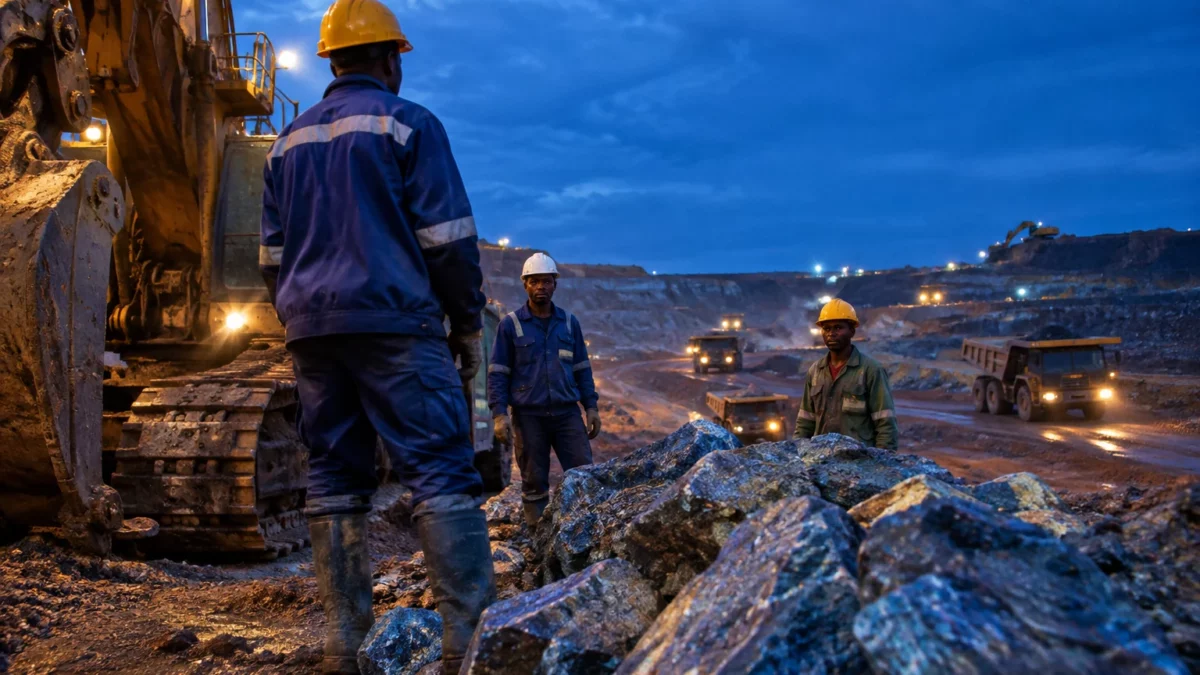
For the Democratic Republic of the Congo, the fall in cobalt prices raises a question that goes beyond prices: how far can the country influence a global market by controlling export volumes without undermining revenues and activity at home? In Kinshasa, this question has taken centre stage at a forum devoted to critical minerals.
A market lever already used
The Authority for the Regulation and Control of Strategic Mineral Substances Markets (ARECOMS) announced on 23 November 2026 a new suspension of Congolese cobalt exports, effective from 30 November until further notice. The measure covers both industrial and artisanal production, according to information published by Congolese mining news outlet Mines.cd and confirmed by economic information service Shanghai Metals Market.
The regulator cites excess supply and a price decline observed since June. Data from the Central Bank of the Congo (BCC) provide a recent reference point: on 5 November, cobalt quoted on the London Metal Exchange stood at $33,930 a tonne, down 29.1% from a year earlier. This benchmark price does not necessarily correspond to the price obtained for every cobalt product exported by the DRC.
The suspension comes during Makutano Mining, an economic forum held in Kinshasa from 23 to 25 November focusing on critical minerals. The simultaneous presence of public policymakers, investors and industry players gives the announcement immediate significance: Congo’s mining strategy is being discussed at the very moment its rules are changing.
From moratorium to quotas, then another pause
This decision extends a sequence that began in 2025. After an initial moratorium on exports, the authorities introduced a quota system from 16 October that year. The Congolese Press Agency (ACP) reported at the time an annual ceiling of 96,600 tonnes for 2026 and 2027. The International Energy Agency also describes the regime as a tool intended to regulate volumes and support prices.
This time, the quota system is suspended for the duration of the halt. According to Mines.cd and Shanghai Metals Market, ARECOMS plans to review the measure after four months and revise the quota allocation mechanism. The decision therefore does not mean, at this stage, that exports will remain blocked without reassessment; it does not, however, specify a resumption date.
In 2025, Kinshasa justified the first halt by the need to correct what it considered excessive supply. The resumption under quotas subsequently allowed capped exports to restart. That precedent is shaping expectations today, but does not guarantee the same outcome: prices also depend on demand, stocks and decisions made by buyers and processors.
The price of cobalt does not tell the whole story of the mining economy
The DRC occupies a central place in global cobalt supply. Restricting shipments can therefore put pressure on available supply and strengthen the authorities’ bargaining power. But the effect on prices is neither automatic nor entirely under Kinshasa’s control. Industrial users can draw on stocks, adjust their purchases or seek other sources, while a slowdown in consumption can limit the expected rise.
The consequences are not evenly distributed. For the state, higher prices could increase the value of sales and associated revenues, but suspended exports also delay trade flows. For large mining companies, the halt complicates sales and transport schedules. For workers and subcontractors, uncertainty will depend on the duration of the measure and its effects on production, which the export decision alone is not enough to determine.
Artisanal miners are also affected, since the suspension covers their cobalt. A closure of sales channels could reduce the incomes of miners and intermediaries if local purchasing slows. Conversely, simply keeping the ore in the country does not automatically create processing jobs. Facilities, energy, financing and predictable rules are needed to turn a trade restriction into local industrial activity.
This is one of the aims set out at Makutano: to move beyond exports of raw resources and develop more value added on the continent. For the DRC, this means reconciling volume regulation, continuity of revenues and investment in processing. The authorities have yet to detail the economic arrangements that will accompany this new suspension.
A national decision with regional repercussions
Congolese cobalt is part of supply chains linking mines, ports, refineries and battery manufacturers across borders. The measure will therefore be watched by neighbouring countries, regional companies and trading partners. It is also a reminder that producer states are seeking to use their mining clout to secure a larger share of the value created, rather than relying solely on prices set on external markets.
The next concrete step will be the assessment announced by ARECOMS after four months. It should clarify the duration of the halt, the fate of the quotas and any conditions for a possible resumption. Until then, indicators to watch will include price movements, available stocks, refinery purchases and the suspension’s impact on the incomes of different players in the DRC.
Kinshasa’s bet is clear: limit volumes in an attempt to rebalance an unfavourable market. Its success, however, will be measured on two levels. The focus will be not only on international prices, but also on the country’s ability to preserve economic activity and advance local processing.