Algeria
 Egypt
 Libya
 Morocco
 Sudan
 Tunisia
 Benin
 Burkina Faso
 Cabo Verde
 Côte d'Ivoire
 Ghana
 Guinea
 Guinea-Bissau
 Liberia
 Mali
 Mauritania
 Niger
 Nigeria
 Senegal
 Sierra Leone
 The Gambia
 Togo
 Cameroon
 Central African Republic
 Chad
 Equatorial Guinea
 Gabon
 Republic of the Congo
 São Tomé and Príncipe
 Burundi
 Comoros
 Djibouti
 Eritrea
 Ethiopia
 Kenya
 Madagascar
 Malawi
 Mauritius
 Mozambique
 Rwanda
 Seychelles
 Somalia
 South Sudan
 Tanzania
 Uganda
 Angola
 Botswana
 Eswatini
 Lesotho
 Namibia
 South Africa
 Zambia
 Zimbabwe
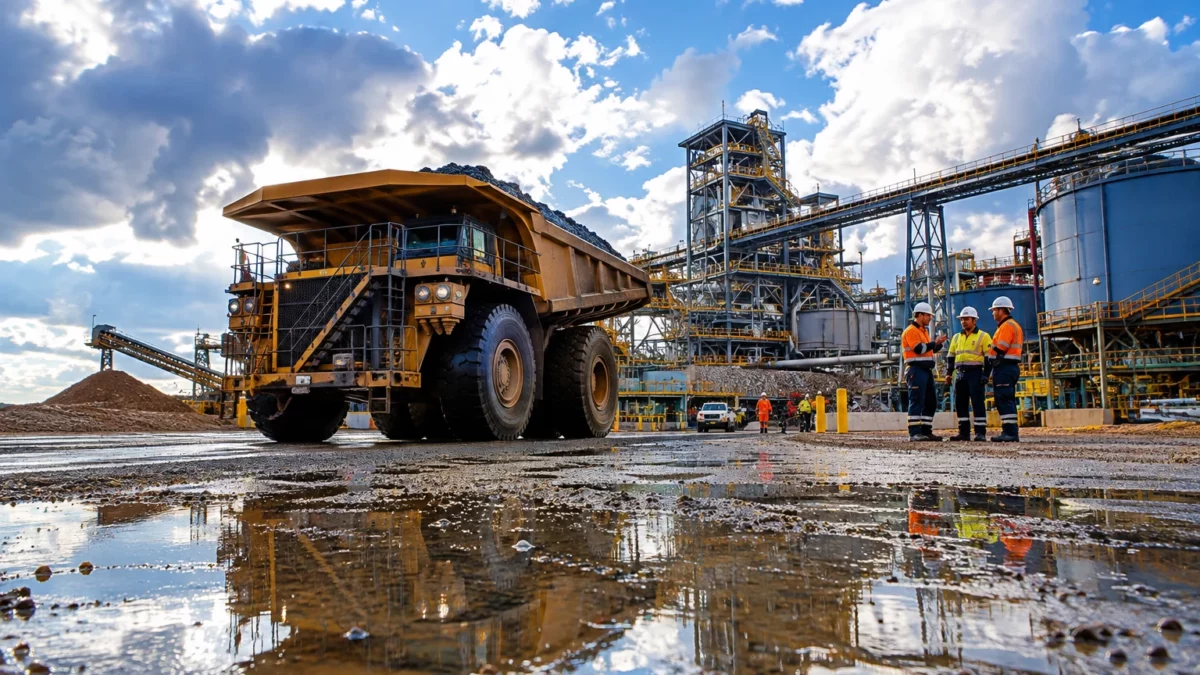
The Democratic Republic of the Congo is one of the main drivers of global copper growth. Yet BHP’s new development plan in Australia does not rely on Congolese permits. The contrast raises a practical question: what persuades a major mining group to explore one country rather than another?
Congolese copper already carries weight in the global market
The DRC, whose capital is Kinshasa, has become the world’s second-largest copper producer, behind Chile. In 2024, it accounted for about 14% of global mine production, according to data cited by the OECD and the International Copper Study Group. The ranking confirms the country’s importance in a sector essential to electricity grids, infrastructure and energy technologies. OECD data on African copper production also places it in a mining belt that extends into Zambia.
Deposits in the south of the DRC are concentrated mainly in the provinces of Lualaba and Haut-Katanga. Their development, however, depends on factors beyond geological wealth: access to electricity, transport, regulatory stability, financing and relations with neighbouring communities. These constraints are not unique to the DRC, but they influence long-term investment decisions.
Regionally, the potential extends into Zambia, another major copper producer. The two countries share a mining belt and are seeking to attract more exploration and processing. Transport corridors, including the Lobito Corridor, can also play a role in moving minerals to international markets.
BHP backs its Australian assets
On 23 November 2026, BHP presented a growth programme for its copper operations in South Australia. The group plans to spend up to US$17.4bn and is targeting annual production of about 650,000 tonnes by 2040. The division’s current output is close to 320,000 tonnes a year. These targets remain development ambitions, not production already secured. The plan announced for BHP’s South Australian operations sets out several stages and will still need to pass investment decisions.
The programme is built around assets already controlled by the group: Olympic Dam, Carrapateena and Prominent Hill. BHP acquired the latter two mines with OZ Minerals in 2023. The company wants to expand mining and processing capacity while reducing costs. The final scale of spending will depend on the progress of the projects and the corresponding investment decisions.
The strategy therefore prioritises expanding an existing mining complex. It differs from exploring new territories, which is more uncertain and generally takes longer to reach production. The group is also developing other options in South America, notably the Vicuña project on the border between Argentina and Chile, which it owns equally with Lundin Mining.
African projects, but no announcement in the DRC
The absence of an announced project in the DRC does not mean BHP is ignoring the continent. In March 2025, Australian company Cobre signed an exploration agreement with the group in Botswana. BHP could fund up to A$25mn of work on the Kitlanya East and Kitlanya West projects, with the option to acquire up to a 75% stake. This is exploration: the agreement does not amount to bringing a mine into production. The terms announced for exploration in Botswana set out the funding and proposed stake.
In April 2026, a BHP delegation also visited Zambia to discuss exploration opportunities with mining authorities. Zambia’s public broadcaster reported that the discussions included deep or underexplored copper deposits. Here too, exploration interest is not an announcement of a mine or a production commitment. Zambia’s account of BHP’s visit describes the initiative as a search for opportunities.
For the DRC, the publicly available information remains different in nature. In October 2021, Bloomberg reported preliminary discussions between BHP and Ivanhoe Mines about Western Foreland, a large exploration area next to the Kamoa-Kakula complex. In February 2024, Reuters also reported informal talks about a possible partnership. Neither those reports nor the discussions they describe demonstrate that an agreement was reached. The preliminary discussions reported in 2021 and the informal talks mentioned in 2024 were not followed by a public announcement of investment by BHP in the DRC.
Trade-offs also affect local communities
For a mining group, choosing a site involves more than comparing reserves. It must also assess infrastructure costs, permitting timelines, operational risks and its capacity to work with governments and communities. In the case of the DRC, reports in 2024 referred to boardroom reservations over risks and governance requirements. These reported factors shed light on a possible trade-off, but BHP has not publicly confirmed that they alone explain the absence of investment.
For Congolese people, the stakes go beyond the volume extracted. Mining generates public revenue, jobs and contracts for local businesses, but its benefits are unevenly distributed. The mining centres of Lualaba and Haut-Katanga face different realities from Kinshasa or provinces less affected by copper. Access to services, tax revenues, local employment and environmental impacts directly affect people living near mining sites.
The comparison with South Australia also serves as a reminder that developing a deposit requires processing facilities and networks capable of handling increased output. For the DRC and Zambia, improvements to power, rail and local processing could help retain more value in the region. This, however, depends on public policy choices, financing and lasting trade agreements.
The signal to watch for the region
BHP’s Australian plan shows that the group is currently favouring growth based on existing assets, while its documented initiatives in Africa remain at the exploration stage. The DRC remains central to global copper supply, but its position as a producer does not automatically guarantee that every investor will enter the market.
What happens next will depend on verifiable announcements: permits, agreements with partners, feasibility studies or final investment decisions. For Central and Southern Africa, the challenge is also to turn global interest in copper into infrastructure, skills and local benefits, without reducing the debate to export volumes alone.