Algeria
 Egypt
 Libya
 Morocco
 Sudan
 Tunisia
 Benin
 Burkina Faso
 Cabo Verde
 Côte d'Ivoire
 Ghana
 Guinea
 Guinea-Bissau
 Liberia
 Mali
 Mauritania
 Niger
 Nigeria
 Sierra Leone
 The Gambia
 Togo
 Cameroon
 Central African Republic
 Chad
 DR Congo
 Equatorial Guinea
 Gabon
 Republic of the Congo
 São Tomé and Príncipe
 Burundi
 Comoros
 Djibouti
 Eritrea
 Ethiopia
 Kenya
 Madagascar
 Malawi
 Mauritius
 Mozambique
 Rwanda
 Seychelles
 Somalia
 South Sudan
 Tanzania
 Uganda
 Angola
 Botswana
 Eswatini
 Lesotho
 Namibia
 South Africa
 Zambia
 Zimbabwe
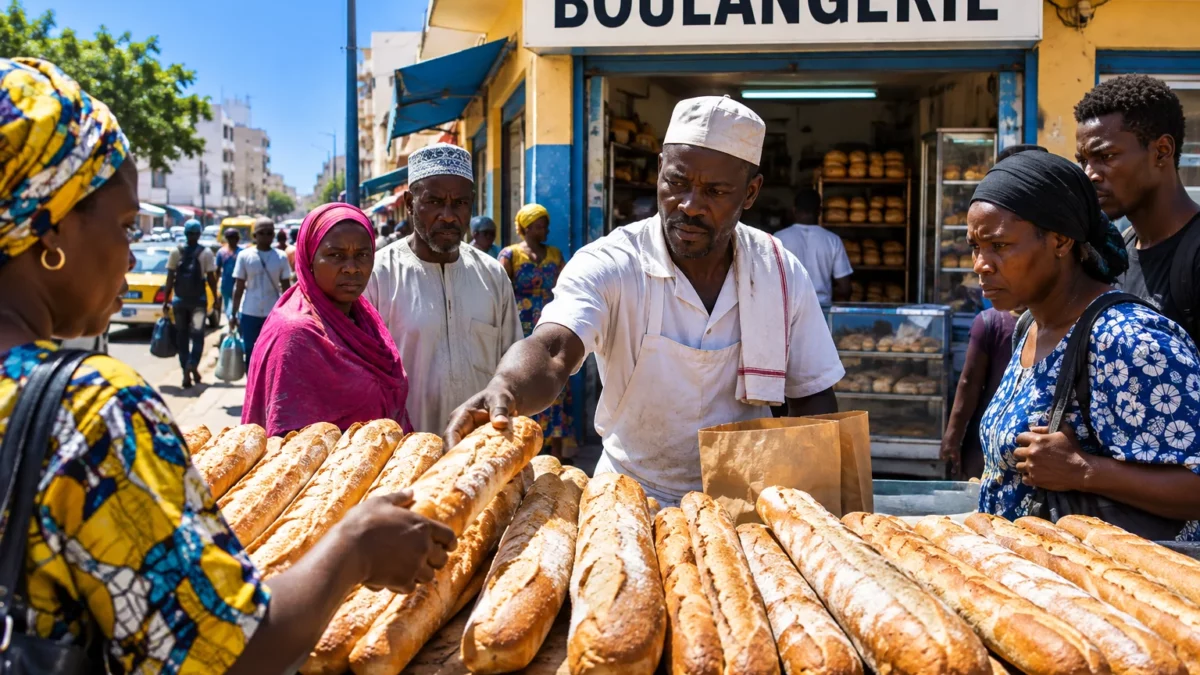
Bread remains available in several Dakar neighbourhoods as some bakers call for production to be suspended. The contrast between the union’s call and the situation observed at points of sale reveals a divided sector, at the heart of a delicate balancing act: protecting professionals’ incomes without increasing households’ daily expenses.
Regulated prices, disputed costs
In Senegal, the reference price of a 190-gram baguette is set at 150 CFA francs. Bakers’ organisations are calling for an increase to 200 or 210 CFA francs, or for a reduction in the cost of flour. They also cite the price of electricity, yeast, salt and fuel, all of which weigh on production and delivery costs.
The disagreement therefore goes beyond the price displayed. Bakers want the price of their product to cover their costs more adequately. The authorities, meanwhile, fear that an increase would be passed directly on to consumers, as bread is a regular purchase. The Minister of Industry and Trade favours a response addressing production costs rather than an immediate revision of the price, according to the Senegalese Press Agency.
The price level is not a new issue. In 2024, the government revised the prices of consumer goods, including bread. The regulated price has since served as a point of balance between affordability for households and the viability of businesses. But this compromise is regularly challenged when professionals believe their costs are rising faster than the authorised price.
Disputed scale of the mobilisation
The Inter-Union of the Bakery Sector called for production to stop on 23, 24 and 25 November 2026. It has threatened to extend the action if it does not receive a response it considers satisfactory. However, the call does not bring together all professional organisations: the National Federation of Bakers of Senegal (FNBS) said it had not approved it and distanced itself from the action, according to a statement carried by Sunugox.
On the ground, the impact was uneven on Monday 23 November. In Dakar, shops and bakeries visited by PressAfrik were still selling bread at the usual price. Traders said they were sourcing supplies from establishments that remained open. These local observations do not make it possible to assess the situation across the country, but they show that the announced stoppage did not immediately lead to shortages everywhere.
The ministry, for its part, says supplies will be maintained and that it remains open to dialogue, reports Senegalese outlet Média 28. The available information does not, however, detail the specific arrangements planned to ensure deliveries. The announced guarantee must therefore be distinguished from the availability actually observed, which varies between neighbourhoods and supply channels.
Figures for bakery closures cited by unions should also be attributed to their sources. In a sector where organisations do not all share the same call to action, a national rate cannot be regarded as established without an independent and representative survey. The situation in the capital is likewise insufficient to describe conditions in the regions.
The cost of the trade-off for households and small businesses
For families, an increase from 150 to 210 CFA francs would mean an extra 60 francs per baguette, or 40% more. The impact would depend on the number of loaves bought and how often they are purchased. For bakers, keeping the current price, their representatives say, may squeeze margins and put establishments with high costs under strain.
The consequences are not distributed evenly. Consumers in Dakar can sometimes turn to another shop if production continues nearby. In areas with fewer points of sale, a local interruption could limit choice. Small bakeries, meanwhile, do not necessarily have the same room for manoeuvre as better-equipped networks or those able to redistribute their production.
The debate is therefore about how the cost is shared. An increase would place a larger share of the adjustment on buyers. A reduction in the price of flour or other costs would shift it to suppliers or public revenues, depending on the mechanism chosen. Each option requires precise data on actual costs, margins, production volumes and any support provided.
The authorities present their approach as structural: to act on production conditions rather than change the final price immediately. For this path to address the reported difficulties, it will need to result in identifiable measures discussed with the different organisations in the sector. Otherwise, disagreement over the price risks resurfacing, even if supplies are maintained during the strike days.
A test of social dialogue in Senegal
The issue forms part of national expectations around the cost of living and pledges to lower prices. It also tests the authorities’ ability to reconcile the protection of purchasing power with the continuity of an economic activity that depends on many small operators. Negotiations will have to contend with fragmented professional representation: the lack of union unity makes it harder to reach a compromise accepted across the sector.
Across West Africa, the issue is tangible, though not uniform. Bread and input prices are determined nationally, while supply chains and raw material costs can cross borders. Senegal, a member of ECOWAS — the regional organisation for economic and political cooperation in West Africa — cannot therefore address the issue sustainably without monitoring the markets that supply its mills and bakeries.
The next step will be to establish whether discussions produce a specific response after the three announced days, and whether it involves both organisations supporting the action and those that have distanced themselves from it. Until then, two indicators matter: the actual continuity of deliveries outside Dakar and the parties’ ability to agree on a measure that does not shift the entire adjustment onto households or small businesses.