Algeria
 Egypt
 Libya
 Morocco
 Sudan
 Tunisia
 Benin
 Burkina Faso
 Cabo Verde
 Côte d'Ivoire
 Ghana
 Guinea
 Guinea-Bissau
 Liberia
 Mali
 Mauritania
 Niger
 Nigeria
 Senegal
 Sierra Leone
 The Gambia
 Togo
 Cameroon
 Central African Republic
 Chad
 Equatorial Guinea
 Gabon
 Republic of the Congo
 São Tomé and Príncipe
 Burundi
 Comoros
 Djibouti
 Eritrea
 Ethiopia
 Kenya
 Madagascar
 Malawi
 Mauritius
 Mozambique
 Rwanda
 Seychelles
 Somalia
 South Sudan
 Tanzania
 Uganda
 Angola
 Botswana
 Eswatini
 Lesotho
 Namibia
 South Africa
 Zambia
 Zimbabwe
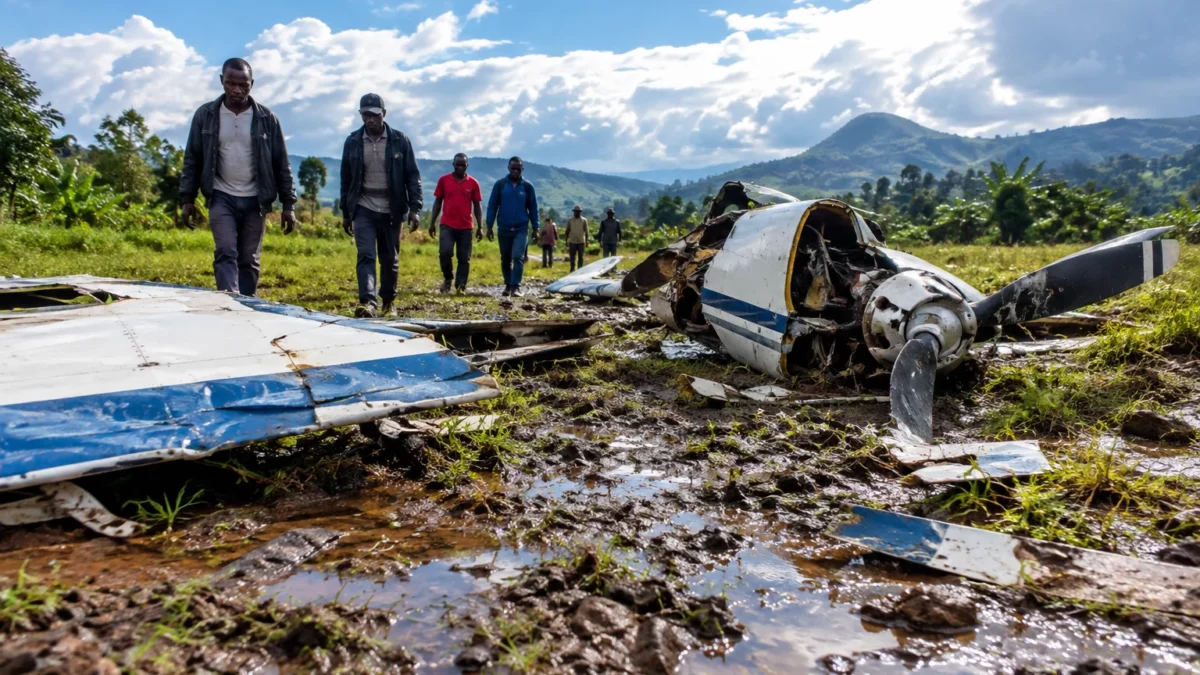
When images of wreckage circulate before the army has located a plane, one question arises: what do they really show, and what can they not yet establish? In the Democratic Republic of the Congo, the distinction matters both to the families concerned and to understanding competing accounts of the fighting in the east of the country.
A light aircraft, not a fighter jet
Images shared on social media show debris presented as that of a Congolese military aircraft. Visual identification, according to the information available, points to a Cessna 208 Caravan. This single-engine propeller aircraft is a light plane that can be used for transport, surveillance or, in some configurations, armed missions. It is not a fighter jet.
This distinction is more than a matter of terminology. A surveillance or light-support aircraft does not have the role or characteristics of a fighter. However, identifying a model from fragments is not, on its own, enough to establish its exact version, equipment or the circumstances of its crash.
The first images described show incomplete wreckage. Several important components, including the engine and some wing or sensor parts, are not visible. Their absence from photos does not show whether they were destroyed, moved or simply left out of frame. The traces presented as blood and videos showing an injured man also do not establish his identity, status or connection to the aircraft.
Accounts that do not yet align
On 23 November 2026, Congolese media reported that the general staff of the Armed Forces of the Democratic Republic of the Congo (FARDC) had announced the loss of contact with a Cessna 208 cargo plane. According to the military statement relayed, the aircraft was flying between Beni, in North Kivu, and Kalemie, in Tanganyika province. The army cited poor weather conditions and said the search was continuing. FNTV reports the version communicated by the general staff, while Chrono News confirms the announcement that the plane was missing.
At the same time, accounts linked to the Front for the Refoundation of the Nation (FRN) claimed that their fighters had shot down a FARDC aircraft. A Congolese publication reports the claim, but it does not constitute independent confirmation of the cause of the incident. RDC Nouvelles reports an account of a crash near Kalonge, but the available information does not allow this account to be reconciled with the initial announcement that an aircraft had not been located.
A death toll of two among four occupants also appears in secondary aviation databases. At this stage, it is not corroborated by a consistent official statement or a sufficiently robust second independent source. It should therefore be treated as unconfirmed information. Likewise, the images prove neither that gunfire caused the crash nor that bad weather was responsible.
In the east, information becomes part of the conflict
The announced route connects two distant provinces in a country where distances, infrastructure and insecurity make travel difficult. Beni is in North Kivu; Kalemie is the capital of Tanganyika. The eastern region remains marked by clashes and the presence of armed groups. In this context, the disappearance of a military aircraft can quickly fuel claims of victory or responsibility before any investigation has taken place.
The FARDC are the national army. The FRN, described in the publications consulted as a politico-military movement associated with former president Joseph Kabila, has made a claim that must be attributed to its authors. Reporting it as an established fact would mean confusing a party’s communications with independent verification. Conversely, the army’s weather explanation is also an official account, not a publicly released investigative conclusion.
For people living in the areas concerned, the uncertainty has tangible consequences. It makes it harder to understand the risks and can fuel rumours about victims, foreign fighters or military operations. For the authorities, locating the aircraft and establishing the crew’s fate are necessary steps before clarifying the toll and cause of the incident.
What further checks are expected
What happens next will depend first on locating the wreckage and gaining access to the site. Physical evidence, testimony from the crew or people present, and flight data could help determine whether the aircraft suffered a mechanical failure, encountered difficult weather conditions or was hit. A technical investigation and verifiable information about the occupants would be needed to confirm details circulating online.
At regional level, the episode is a reminder that images of conflict quickly cross borders and can influence perceptions of the fighting in the Great Lakes region. For now, the strongest conclusion remains limited: the images point to a Cessna Caravan, not a fighter jet. The aircraft’s full identity, the human toll and the cause of its loss remain to be confirmed.