Algeria
 Egypt
 Libya
 Morocco
 Sudan
 Tunisia
 Benin
 Burkina Faso
 Cabo Verde
 Côte d'Ivoire
 Ghana
 Guinea
 Guinea-Bissau
 Liberia
 Mali
 Mauritania
 Niger
 Nigeria
 Senegal
 Sierra Leone
 The Gambia
 Togo
 Cameroon
 Central African Republic
 Chad
 Equatorial Guinea
 Gabon
 Republic of the Congo
 São Tomé and Príncipe
 Burundi
 Comoros
 Djibouti
 Eritrea
 Ethiopia
 Kenya
 Madagascar
 Malawi
 Mauritius
 Mozambique
 Rwanda
 Seychelles
 Somalia
 South Sudan
 Tanzania
 Uganda
 Angola
 Botswana
 Eswatini
 Lesotho
 Namibia
 South Africa
 Zambia
 Zimbabwe
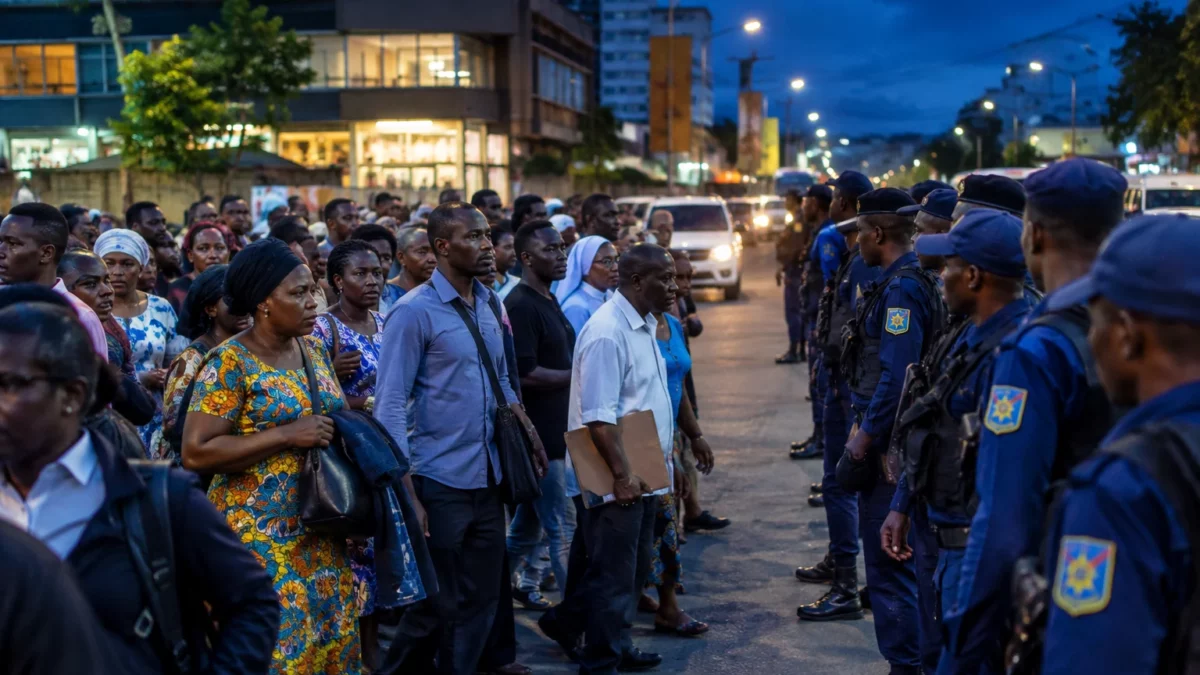
In Kinshasa, a religious service was cancelled. In Lubumbashi, worshippers were prevented from marching to defend a disputed plot of land. In the space of two days, relations between the Catholic Church and the Congolese authorities have become strained over separate issues: access to public space and the enforcement of a court ruling.
Two mobilisations, two sources of friction
On Sunday 22 November 2026, a mass that Cardinal Fridolin Ambongo was due to celebrate at Tata-Raphaël Stadium in Kinshasa did not take place. It was scheduled for the Solemnity of Christ the King and the Diocesan Youth Day. The Fides News Agency reports that the authorities cancelled the service. The National Episcopal Conference of Congo (CENCO), which brings together the country’s Catholic bishops, also denounced the obstruction. However, the information available does not establish precisely what administrative reasons were given or how discussions with the organisers unfolded.
The following day, Monday 23 November, the Archdiocese of Lubumbashi wanted to organise a peaceful march to the town hall. The mobilisation was intended to demand the enforcement of a court ruling concerning the land of the Saint Paul Interdiocesan Major Seminary in the Tshamalale neighbourhood. The Church says buildings encroach on the property and is calling for the implementation of the ruling ordering their demolition. The town hall had banned the march, citing a measure suspending gatherings on public roads. Police dispersed participants and used tear gas, according to CENCO and Radio Moto, a Congolese media outlet based in the region.
These accounts concur on the dispersal and the ban, but responsibility and justifications remain disputed. The provincial police commissioner, quoted by Radio Moto, described the deployment as a measure to enforce the municipal decision and maintain public order. CENCO, for its part, describes it as an obstruction of a peaceful mobilisation. It is important to distinguish these accounts from the established facts: the demonstration was banned and then dispersed, while the land dispute and implementation of the ruling remain at the heart of the disagreement.
National dialogue awaited, but contested
The events come as Kinshasa seeks to launch a national dialogue on peace and cohesion. President Félix Tshisekedi announced the plan on 27 August. According to a report by the United Nations Secretary-General, the proposal envisages consultations in all 26 provinces, followed by a national forum in Kinshasa bringing together political, religious and traditional leaders, civil society and the diaspora. A preliminary committee was established by decree on 13 September to prepare the process.
But the announcement does not resolve the question of representation. Opposition groups, including the Sauvons la RDC platform and the C64 coalition, have criticised the process for lacking inclusivity, the UN report notes. Expectations surrounding the forthcoming appointments and the dialogue’s practical arrangements are therefore fuelling questions: who will choose the participants, what guarantees will be offered to critical voices, and how will any commitments be followed up? The participation of religious denominations matters because they have networks in the provinces and are regularly called upon in public debates.
In this context, the incidents in Kinshasa and Lubumbashi do not, on their own, prove a general campaign against the Church. They nevertheless raise a concrete question about the space afforded to religious organisations when they engage in public life. In Lubumbashi, the issue goes beyond the freedom to demonstrate: the alleged failure to enforce a court ruling affects trust in institutions and equality before the law. For residents of the Tshamalale neighbourhood, the case also concerns the use of a plot of land and the authorities’ ability to settle a dispute without worsening tensions.
Minerals, another test of economic sovereignty
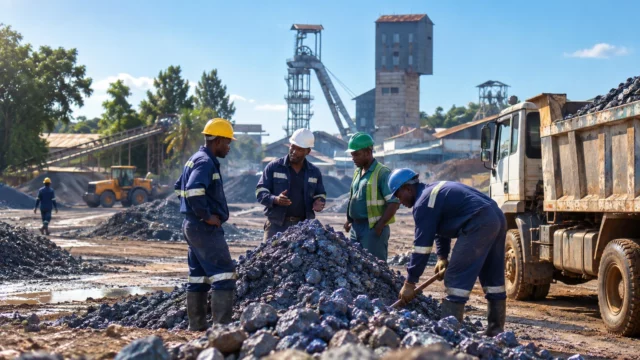
In Kinshasa, another event is bringing the state’s choices into focus: the Makutano Mining forum, which opened on 23 November and is due to run until the 25th. The programme announces discussions between public decision-makers, investors and industry players on local processing, infrastructure and the governance of critical minerals. Félix Tshisekedi is among the announced speakers. The forum comes as the government seeks to capture more value in the Democratic Republic of Congo, beyond the extraction and export of raw materials.
Official figures underscore the importance of this debate. The Congolese budget document published in preparation for the 2027 budget estimates copper production at about 3.4 million tonnes in 2025. This volume puts the country at the centre of global supply chains, but does not in itself show what proportion of revenues translates into jobs, public income or local industrial activity. Processing locally requires, among other things, energy, infrastructure, skills and predictable rules. The benefits may differ for large companies, formal-sector workers, subcontractors and communities near mining sites.
The two issues converge on the question of trust, though they are not equivalent. The mining forum concerns the distribution of economic value; tensions with the Church concern civil liberties, justice and dialogue. In both cases, announcements will be judged by what follows: investment and effective processing for minerals, equitable access to dialogue and the enforcement of decisions for institutions.
A regional dimension to watch
The Democratic Republic of Congo is a member of the Southern African Development Community (SADC), a regional cooperation framework that also includes Zambia, which neighbours Haut-Katanga. Cross-border mineral trade and supply chains give the question of local processing a significance that extends beyond Kinshasa. At the same time, the credibility of Congolese institutions matters to regional partners as the country seeks to address persistent political and security crises.
The next steps will therefore be decisive: the publication of appointments linked to the national dialogue, clarification of the conditions for participation, and follow-up on the Lubumbashi land dispute. For the Makutano forum, the key indicator will be whether discussions translate into projects and verifiable local benefits. In Kinshasa and Haut-Katanga alike, trust will depend less on statements than on how decisions are implemented.
Sources consulted: Fides News Agency on events in Kinshasa and Lubumbashi ; CENCO news website ; Radio Moto on the Lubumbashi march ; UN Secretary-General’s report on the DRC ; official programme for Makutano Mining 2026 ; mining data in the Congolese budget document.