Algeria
 Egypt
 Libya
 Morocco
 Sudan
 Tunisia
 Benin
 Burkina Faso
 Cabo Verde
 Côte d'Ivoire
 Ghana
 Guinea
 Guinea-Bissau
 Liberia
 Mali
 Mauritania
 Niger
 Nigeria
 Sierra Leone
 The Gambia
 Togo
 Cameroon
 Central African Republic
 Chad
 DR Congo
 Equatorial Guinea
 Gabon
 Republic of the Congo
 São Tomé and Príncipe
 Burundi
 Comoros
 Djibouti
 Eritrea
 Ethiopia
 Kenya
 Madagascar
 Malawi
 Mauritius
 Mozambique
 Rwanda
 Seychelles
 Somalia
 South Sudan
 Tanzania
 Uganda
 Angola
 Botswana
 Eswatini
 Lesotho
 Namibia
 South Africa
 Zambia
 Zimbabwe
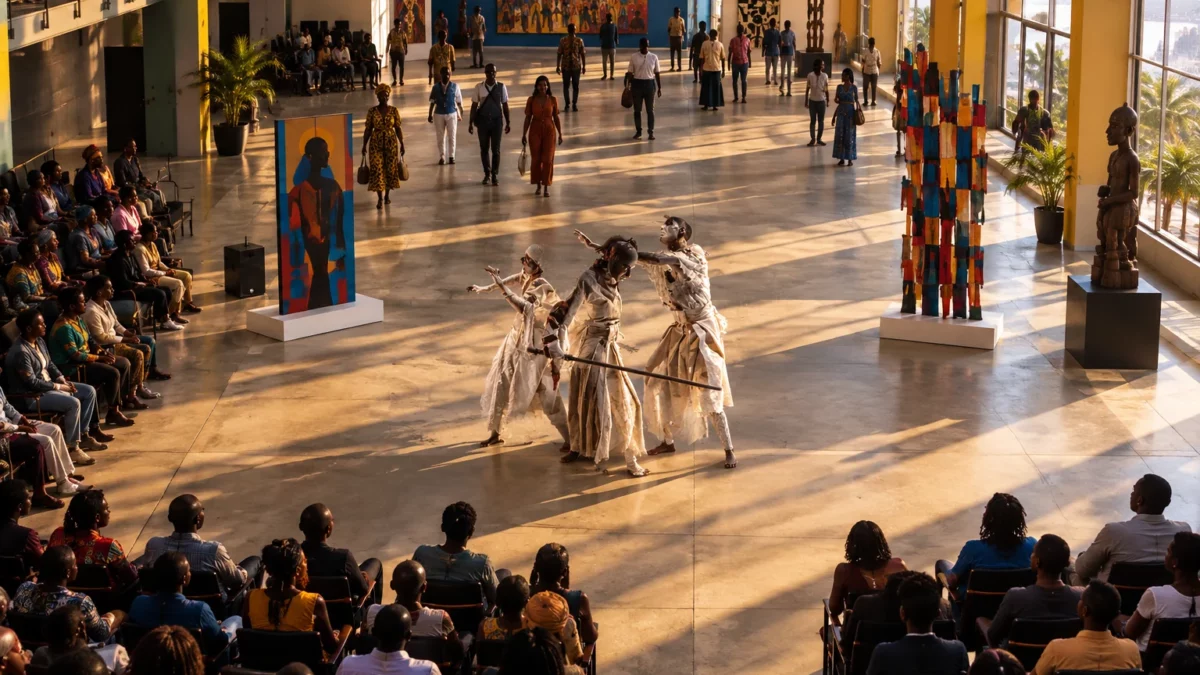
In Dakar, the question was not only who could admire African art. It was also necessary to decide who had the power to name it, exhibit it and give it a place in world history. In 1966, the first World Festival of Negro Arts brought this debate to the heart of the Senegalese capital.
Dakar, a stage for cultural affirmation
The festival ran from 1st to 24 April 1966, six years after Senegal’s independence. President Léopold Sédar Senghor was one of its main initiators, alongside Alioune Diop, founder of the journal Présence Africaine. The event brought together visual arts, music, dance, literature and debate. It asserted that African creations were not curiosities to be kept at a distance, but contemporary works to be discussed and passed on.
The gathering took place at a time when newly independent African states were building their institutions and national narratives. Senghor championed a cultural policy that combined the reclaiming of heritage with dialogue with the world. This ambition also prompted debate: négritude, a central concept for Senghor, neither sums up the continent’s cultures nor represents the views of all African intellectuals.
André Malraux, then France’s minister of cultural affairs, took part in the inaugural colloquium in Dakar on 30 March 1966. The text of his speech, held by the French National Assembly and in archives devoted to the writer, confirms the date and the reported remarks. He praised Senghor’s initiative, saying that “a head of state takes into his perishable hands the spiritual destiny of a continent”. The phrase is eloquent, but it should not obscure the role of the Senegalese and African organisers who conceived and brought the festival to life.
An intellectual in French decolonisation
Malraux’s presence in Dakar was also political. A close associate of General de Gaulle and a leading figure in the French government, he accompanied the period of African independence. Congolese literary critic Boniface Mongo-Mboussa distinguishes between a political role and an artistic one in Malraux’s career. He describes Malraux as an intellectual associated with the cultural dimension of decolonisation.
This interpretation nevertheless needs to be put into perspective. The end of the French empire was not limited to speeches or decisions made in Paris. It resulted from mobilisation, negotiations and power struggles in which African movements played a decisive role. Moreover, political independence did not put an end to every form of French influence. Economic, military and diplomatic ties continued to fuel debate about sovereignty and colonial legacies.
Malraux represented a cultural voice of Gaullism, while Jacques Foccart was associated with managing relations with the new African states. Setting them up as two simple figures — the idealistic intellectual on one side, the defender of French interests on the other — would risk obscuring the complexity of the policies pursued. A writer’s prestige could support cultural rapprochement without resolving disagreements over power, resources or the autonomy of newly independent countries.
Brazzaville’s past gives this period particular resonance. In 1940, the city, then the capital of French Equatorial Africa, became a centre of Free France. When the Republic of the Congo declared independence in August 1960, Malraux recalled this history. This was Brazzaville, capital of the Republic of the Congo, not Kinshasa, capital of the Democratic Republic of the Congo. The reminder underlined Africa’s contribution to French history, but was also part of a French state narrative about this shared memory.
Taking African art beyond the “primitive” gaze
The Dakar speech was also an important moment in the way Malraux spoke about African arts. He rejected confining them to the label “primitive” and stressed their symbolic power and ability to evoke aesthetic emotion. He presented them as a contribution to art history, rather than as mere ethnographic objects.
This recognition mattered at a time when many African works were held or exhibited outside the continent, often without their history, uses or the circumstances of their departure being fully explained. But Malraux’s admiration was not enough to decolonise the gaze: the works could still be reduced to a single vision of Africa, conceived as a homogeneous whole. The Dakar festival, by contrast, opened up a space for debate among artists, researchers and audiences from diverse societies.
Malraux’s words carried weight because they came from a renowned writer and a French minister. Yet he was not alone in bringing about a change in perspective. Senghor, Alioune Diop and the African participants created the conditions for an international gathering where the continent’s arts could be presented in line with their own ambitions. The aim was as much to claim a place in a shared heritage as to challenge categories imposed by outside institutions.
A legacy that reaches beyond Senegal’s borders
The festival gave Dakar a role as a cultural and diplomatic crossroads. It showed that an African state could mobilise institutions, artists and international networks around a project led from the continent. This pan-African dimension does not erase national, linguistic and artistic differences; it brings them into relation.
For Senegal, the event recalls a period in which culture helped define the country’s place in the world after independence. For West Africa and beyond, it raises a question that remains current: who selects works, writes their history and decides the terms of their circulation? These issues concern museums, artists, communities of origin and states, as well as audiences discovering these creations.
More than half a century after the 1966 gathering, Malraux’s speech remains a useful archive, to be read alongside the Senegalese and African voices that built the event. Its significance lies less in the idea that a French gaze had revealed African art than in the moment when Dakar placed these creations at the centre of a global conversation. The festival thus reminds us that cultural recognition also depends on African societies’ ability to organise their own platforms and shape the debate.
Category: Culture