Algeria
 Egypt
 Libya
 Morocco
 Sudan
 Tunisia
 Benin
 Burkina Faso
 Cabo Verde
 Côte d'Ivoire
 Ghana
 Guinea
 Guinea-Bissau
 Liberia
 Mali
 Mauritania
 Niger
 Nigeria
 Senegal
 Sierra Leone
 The Gambia
 Togo
 Cameroon
 Central African Republic
 Chad
 Equatorial Guinea
 Gabon
 Republic of the Congo
 São Tomé and Príncipe
 Burundi
 Comoros
 Djibouti
 Eritrea
 Ethiopia
 Kenya
 Madagascar
 Malawi
 Mauritius
 Mozambique
 Rwanda
 Seychelles
 Somalia
 South Sudan
 Tanzania
 Uganda
 Angola
 Botswana
 Eswatini
 Lesotho
 Namibia
 South Africa
 Zambia
 Zimbabwe
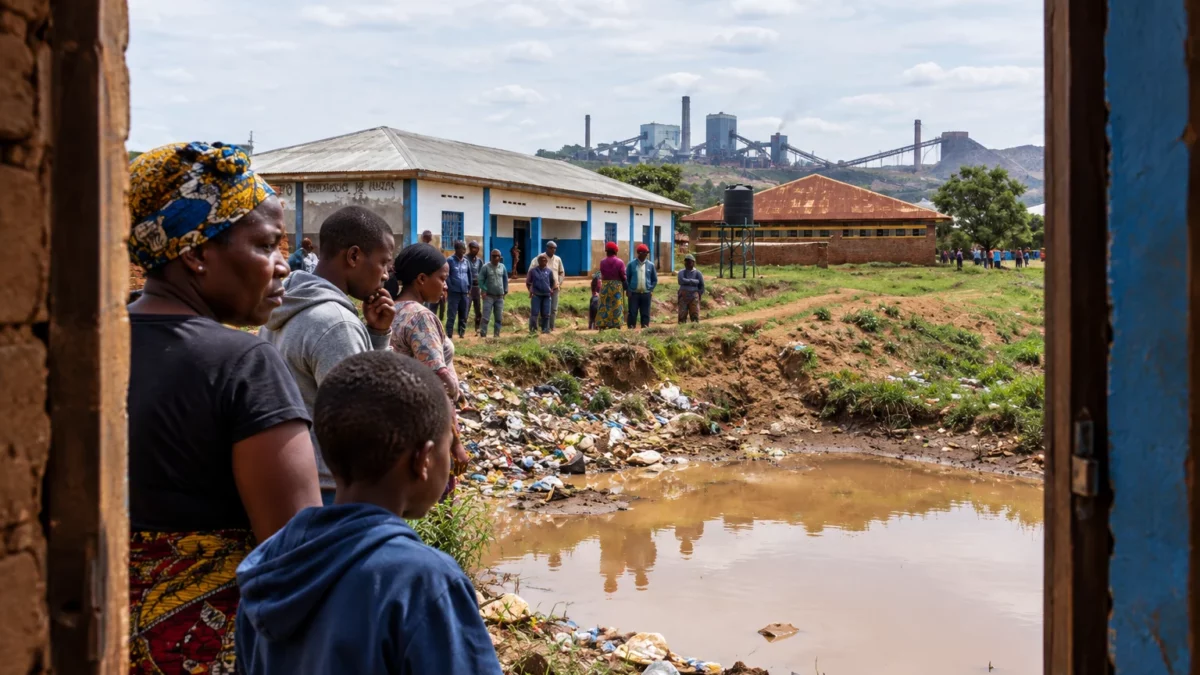
In Kasapa, Kamatete and Kamisepe, the issue is no longer limited to property damaged by industrial wastewater. A year after the spill in Lubumbashi, residents are still waiting to learn which losses have been recognised, what long-term medical care will be provided and how collective compensation will be funded.
In Haut-Katanga, the incident has left several issues unresolved
Lubumbashi lies at the heart of Haut-Katanga, in the south-east of the Democratic Republic of the Congo. The province plays a major role in copper and cobalt extraction and processing. This activity supports public revenue and employment, but also exposes neighbouring communities to risks associated with industrial facilities and effluent management.
On 4 November 2025, a retention pond belonging to Congo Dongfang Mining (CDM), a subsidiary of Chinese group Zhejiang Huayou Cobalt, gave way. Acidic industrial wastewater flooded plots of land, roads and market areas in Kasapa, then reached the neighbouring districts of Kamatete and Kamisepe. Radio Okapi reported the following day that residents were concerned about vegetable gardens and waterways used for everyday tasks. The city authorities had urged the public to avoid all contact with potentially contaminated water.
The Ministry of Mines temporarily suspended operations at the site after the incident. An interministerial commission was subsequently tasked with investigating its causes and consequences. However, the detailed findings of the inquiry remain central to demands made by local human rights organisations.
Medical care and compensation: figures that do not settle everything
Accounts gathered in Kasapa describe material losses and continuing anxiety as the rains approach. Lyly Mbuyi, who lives near the plant, says the current swept away items left outside. She says she fears another flood. These fears do not in themselves constitute a technical assessment of the pond’s safety; they nevertheless underline the importance of public information about the work and inspections carried out.
A mother in the neighbourhood says that her baby, one of her twins, fell ill after drinking the discharged water and then died because the family could not afford treatment. This account, reported by the media, does not independently establish the medical cause of death. It highlights a practical problem: eligibility criteria for medical care and the lists of people registered can leave families without answers, even when the authorities announce that healthcare will be provided.
The available figures do not fully tally. In December 2025, the Congolese Press Agency reported that 612 people had received care and that 424 cases had been approved for individual compensation totalling $529,183. In a statement reported in November 2026, the Ministry of Mines refers to 612 people treated and 423 people compensated. These discrepancies, although limited, make it necessary to publish an anonymised, verifiable list of recipients, together with the criteria applied and the avenues of appeal.
These individual payments are separate from the $6m in collective compensation announced, or $2m per district. According to the IRDH and its partners, the money has not yet been paid to the communities. In its November 2026 communication, the ministry acknowledges that the collective process is delayed. It says the company’s terms of reference need to be revised to formally include Kamisepe, which was omitted when they were initially drawn up.
Collective compensation still needs to be translated into projects
Collective compensation is not simply a transfer of money. It requires residents to help determine priorities and monitoring arrangements, including access to water, sanitation infrastructure, restoration of shared property or environmental monitoring. Civil society organisations are calling in particular for the official damage assessment report and long-term medical care. They say the measures under consideration include medical monitoring, wells for drinking water and groundwater testing.
The ministry, for its part, says that clean-up operations and corrective measures have been launched. It also says that the $6.6m penalty imposed on CDM goes to the public treasury. This sum should therefore not be confused with the collective compensation fund intended for the three districts. The two schemes serve different purposes, and payment of one does not prove that the other has been carried out.
The contrast between the official account and the associations’ demands now centres on transparency and implementation. The IRDH and its partners say they are waiting for the commission’s report and question the resumption of mining operations when, they say, all the corrective commitments have not been publicly documented. The ministry maintains that CDM’s obligations remain in force, even if the company is facing cash-flow difficulties or suspending its operations.
A test for mining governance in the DRC
At local level, the consequences are not the same for everyone. A contaminated farm plot or well may be a direct source of livelihood for a family, while a trader depends on a market stall and an employee on the continuity of industrial activity. Individual compensation may address certain identified losses, but it cannot replace the securing of facilities or monitoring of water quality and health.
For the Democratic Republic of the Congo, the stakes extend beyond Lubumbashi. The country is seeking to add more value to its mineral resources and play a greater role in global copper and cobalt supply chains. The credibility of this ambition also depends on institutions’ ability to prevent accidents, publish their investigations and enforce compensation. The Southern African Development Community (SADC), a regional organisation of which the DRC is a member, provides a framework for cooperation between neighbouring states, but oversight of this site and compliance with commitments are primarily the responsibility of the Congolese authorities and the company.
The next steps are therefore clear: publication of the inquiry report, clarification of the sums actually paid, revision of the terms of reference and a verifiable timetable for collective projects. Until these points are resolved or disputed no longer, residents of Kasapa, Kamatete and Kamisepe will be unable to assess what has been repaired — or verify whether the risk of another incident has genuinely diminished.
Background sources: initial findings in Lubumbashi after the pond breach, ACP report on individual compensation, demands by the IRDH and its partners a year later and the Ministry of Mines’ position on compensation.