Algeria
 Egypt
 Libya
 Morocco
 Sudan
 Tunisia
 Benin
 Burkina Faso
 Cabo Verde
 Côte d'Ivoire
 Ghana
 Guinea
 Guinea-Bissau
 Liberia
 Mali
 Mauritania
 Niger
 Nigeria
 Senegal
 Sierra Leone
 The Gambia
 Togo
 Cameroon
 Central African Republic
 Chad
 DR Congo
 Equatorial Guinea
 Gabon
 Republic of the Congo
 São Tomé and Príncipe
 Burundi
 Comoros
 Djibouti
 Eritrea
 Ethiopia
 Kenya
 Madagascar
 Malawi
 Mauritius
 Mozambique
 Rwanda
 Seychelles
 Somalia
 South Sudan
 Tanzania
 Uganda
 Botswana
 Eswatini
 Lesotho
 Namibia
 South Africa
 Zambia
 Zimbabwe
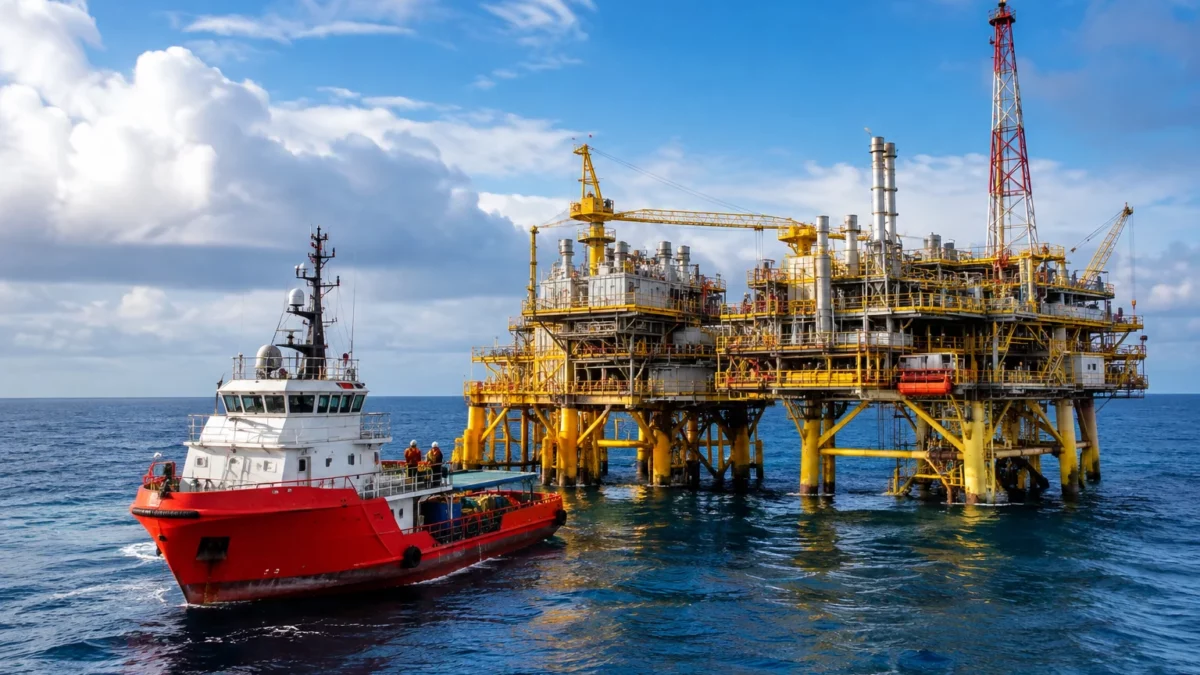
Can an oil field remain useful long after its first years of production? In Angola, the answer now lies in reusing infrastructure and seeking resources still accessible beneath the seabed. The stakes include public revenue and the future of a sector that carries considerable weight in the national economy.
An ageing asset at the heart of Angola’s oil strategy
Block 15 lies off Angola’s northern coast, about 145 kilometres from shore. In operation for more than two decades, it comprises several fields, including Kizomba A, B and C. They came on stream between 2004 and 2008. The challenge now is to extend operations without starting from scratch.
On 19 November 2026, ExxonMobil and its partners approved an investment of about $4bn to redevelop Kizomba A and B. The National Agency for Petroleum, Gas and Biofuels (ANPG), the sector’s regulator and national concessionaire, announced the decision the following day. It follows approval in 2025 for the redevelopment of Kizomba C.
The programme is to use existing facilities at the Kizomba Hub to recover additional resources. It also includes Likembe, a subsea field intended to be tied into equipment already in place. This method, known as a subsea tie-back, avoids building a new platform for each development.
In April 2026, Subsea Integration Alliance, a partnership between Subsea7 and SLB OneSubsea, announced an engineering, construction and installation contract for the Likembe project. The contract, separate from the overall investment approved in November, indicates that preparatory work was already under way. The operator and its partners can therefore rely on shared infrastructure while limiting the need for new heavy equipment.
Extension approved through to 2037
The investment decision comes within a contractual framework that has already been adjusted. In 2025, the Angolan authorities extended the production period for the Kizomba unified development area through to 31 December 2037. The area includes Kizomba A, Kizomba B, Saxi-Batuque and Mondo.
The block operates under a production-sharing contract. This arrangement sets out the rights and obligations of the state and companies, as well as the allocation of extracted hydrocarbons. ExxonMobil is the operator. The other partners include Azule Energy, Equinor and Sonangol, Angola’s state oil company.
For the authorities, the extension gives companies a longer period in which to recoup their spending. For the partners, it reduces uncertainty about the length of operations. But extending a concession does not, by itself, guarantee future production volumes: these will depend on the work undertaken, technical results and reservoir performance.
This distinction matters. A final investment decision means the partners are committing to fund the project. It does not mean that the new volumes are already being produced, or that their rate is known. The expected benefits will therefore need to be assessed as operations progress.
Maintaining output without confusing potential with results
Angola is seeking to slow the decline of mature offshore fields. The country remains one of sub-Saharan Africa’s major oil producers, but national output is around 1 million barrels a day. In September 2026, the ANPG recorded an average of 1.045 million barrels a day, above its monthly forecast of 1.017 million.
This monthly figure is not enough to establish a lasting trend. For the first nine months of 2026, ANPG data cited by the Angolan business newspaper Expansão showed an average of about 1.029 million barrels a day, almost unchanged from the same period a year earlier. The gap between a one-off performance and annual production highlights the difficulty of offsetting the natural decline of mature fields.
Oil contributes to public revenue and exports. It also supports jobs and services, particularly in the capital, Luanda, and in areas linked to oil operations. However, the benefits are not automatically distributed throughout the country. The concentration of investment in offshore activity also makes economic diversification a central issue, so that oil revenues are not the sole driver of public finances and national economic activity.
The discovery announced at the Tchihumba West-01ST1 well adds another element to the picture. According to the ANPG, the well encountered 65.4 metres of hydrocarbon-bearing sandstone, about 350 kilometres north-west of Luanda and in 1,400 metres of water. The agency describes it as the block’s 21st discovery and the second announced in 2026.
A discovery, however, is not yet a producing field. Assessments must establish the extent of the resources and whether they can be exploited commercially. In the short term, the Kizomba redevelopment and Likembe tie-back are based on resources that have already been identified. They therefore offer a more direct route than exploration, but do not guarantee an immediate rise in national output.
A closely watched signal in the region
For Southern Africa, the Angolan case illustrates a question shared by producer economies: how can existing assets be kept in operation while preparing for the post-oil era? Angola is a member of the Southern African Development Community (SADC), which brings countries in the region together for economic and political co-operation. The Block 15 project remains a national one, but its effects on investment, services and energy supply form part of a wider regional market.
The authorities’ priority is to maintain sufficient output to support revenue, while companies seek to make a return on facilities that were already costly. The next steps to watch are the execution of the work, the results of geological assessments and the actual contribution of Kizomba A, B and Likembe to production. The timeline to 2037 provides a long horizon; it does not remove the need to measure, year by year, what these investments deliver for Angola.