
 Algeria
 Egypt
 Libya
 Morocco
 Sudan
 Tunisia
 Benin
 Burkina Faso
 Cabo Verde
 Ghana
 Guinea
 Guinea-Bissau
 Liberia
 Mali
 Mauritania
 Niger
 Nigeria
 Senegal
 Sierra Leone
 The Gambia
 Togo
 Cameroon
 Central African Republic
 Chad
 DR Congo
 Equatorial Guinea
 Gabon
 Republic of the Congo
 São Tomé and Príncipe
 Burundi
 Comoros
 Djibouti
 Eritrea
 Ethiopia
 Kenya
 Madagascar
 Malawi
 Mauritius
 Mozambique
 Rwanda
 Seychelles
 Somalia
 South Sudan
 Tanzania
 Uganda
 Angola
 Botswana
 Eswatini
 Lesotho
 Namibia
 South Africa
 Zambia
 Zimbabwe
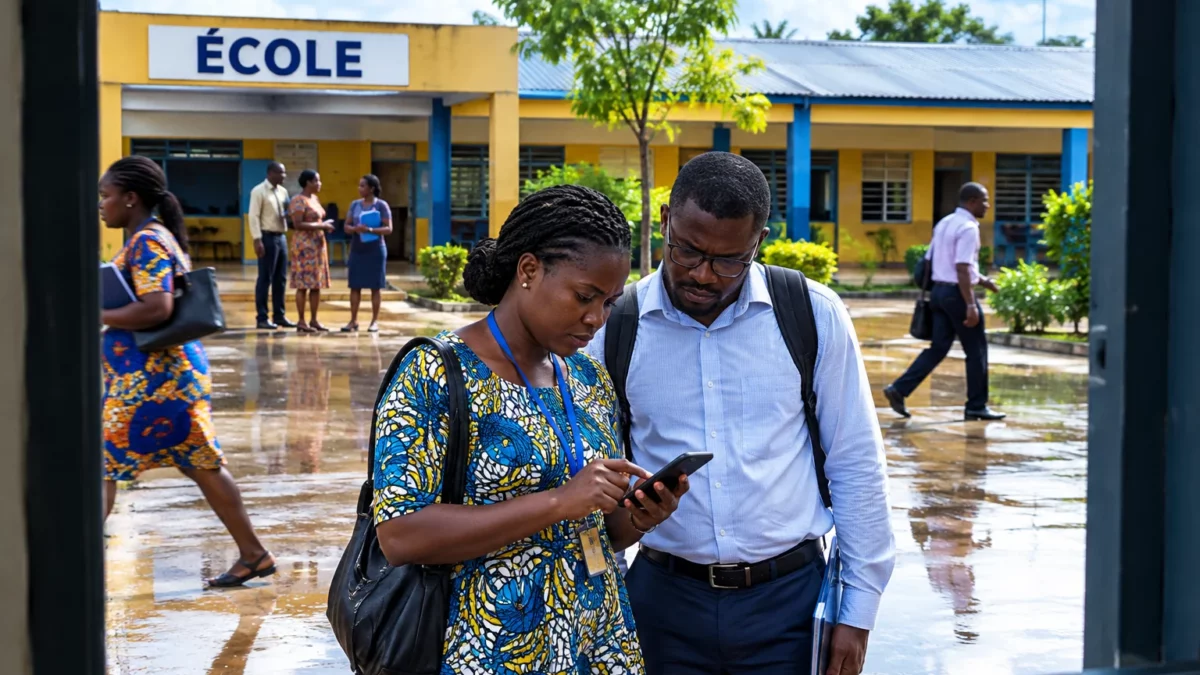
A college can bring pupils closer to school without bringing their teachers closer to teaching resources. In Côte d’Ivoire, hybrid training for science teachers aims to narrow this gap: it combines digital content, face-to-face sessions and regional support, including for staff working far from training centres.
Training without relying on a permanent connection
The programme is for dual-subject teachers, who teach two disciplines, in local colleges. These schools are often located in rural areas to reduce the distance between home and school. The subjects covered include mathematics and information and communication technologies for education, as well as physics and chemistry and life and Earth sciences.
The Directorate of Pedagogy and Continuing Education (DPFC) opened a workshop on regional monitoring of the programme in Yamoussoukro on 16 November 2026. Held in two rounds between 15 and 20 November, the sessions bring together 92 participants, including 41 regional directors, the Ivorian Press Agency reports. Their task is to prepare a roadmap for mobilising teachers and monitoring their training across the various regions.
The digital programme comprises 27 modules. Teachers can download resources from a location with internet coverage, then consult them offline on an Android phone. The platform offers subject-specific content, exercises and activities on lesson preparation, experimentation and assessment. Some tasks and the submission of work nevertheless require a connection. The modules are supplemented by face-to-face sessions, tutoring and support for classroom practice. The official platform provides details of the DHFC-EBiS programme and its modules.
A response to the expansion of the school network
Distance training addresses a practical constraint: schools are multiplying, but teaching centres and supervisors cannot be present everywhere at the same pace. In the 2024-2025 school year, 68 of the 79 new colleges announced were local colleges, according to the Ivorian government. This figure reflects a planning priority: bringing schools closer to families while extending support needs to sometimes remote areas.
The expansion is accompanied by recruitment efforts. At the start of the 2026-2027 school year, the ministry reported that 4,900 secondary teachers had been recruited and deployed, including nearly 2,000 mathematics and physics and chemistry teachers. The government also reported capacity-building initiatives for 1,973 dual-subject science teachers. These figures come from the ministry’s review, also reported by Informateur; on their own, they do not measure the impact on learning.
The hybrid programme is co-ordinated by the ministry, with support from the Agence universitaire de la Francophonie (AUF) and funding from the French Development Agency (AFD) in the form of a sovereign loan. The AUF says the multi-year project also aims to strengthen the capacity of the DPFC, its regional offices and teaching supervisors. This structure therefore puts regional officials at the heart of monitoring, rather than relying on a platform alone to deliver training.
Quality will depend on support in the field
For a teacher based far from an urban centre, offline downloads can reduce travel and allow them to study at their own pace. But access to files alone does not guarantee regular support. The availability of tutors, the quality of face-to-face exchanges and the ability to synchronise work remain decisive, especially in areas with an unstable network.
The pupils are also at stake. Effective training must translate into classroom practice: more accessible explanations, science experiments that can be carried out with the equipment available, and assessments that identify difficulties. The ministry has also said that 1,973 dual-subject teachers had taken part in capacity-building initiatives and that teaching kits were being distributed. Training teachers to use them and ensuring they are available in schools are two distinct but complementary conditions.
The benefits may vary from one area to another. In a remote locality, the programme can spare a teacher from waiting for a session organised in a major city. In regional centres, however, it increases the need to co-ordinate and monitor cohorts. Pupils will benefit from the investment only if continuity in teaching can withstand constraints involving connectivity, travel and equipment availability.
A test for continuing education in West Africa
The Ivorian model combines a national platform with regional support networks and in-person training sessions. The AUF describes a programme intended for more than 2,000 dual-subject teachers and teaching supervisors. In time, its experience could inform other continuing education programmes in the region, without assuming that a solution designed for Ivorian colleges can be replicated everywhere in exactly the same way.
The next step will depend less on the number of modules than on the consistency of follow-up: teachers’ actual participation, the quality of tutoring and observable changes in science lessons. For Côte d’Ivoire, the challenge is to match the expansion of local colleges with teams receiving sustained support. Only then can wider access to school also lead to stronger learning outcomes.



