Algeria
 Egypt
 Libya
 Morocco
 Sudan
 Tunisia
 Benin
 Burkina Faso
 Cabo Verde
 Ghana
 Guinea
 Guinea-Bissau
 Liberia
 Mali
 Mauritania
 Niger
 Nigeria
 Senegal
 Sierra Leone
 The Gambia
 Togo
 Cameroon
 Central African Republic
 Chad
 DR Congo
 Equatorial Guinea
 Gabon
 Republic of the Congo
 São Tomé and Príncipe
 Burundi
 Comoros
 Djibouti
 Eritrea
 Ethiopia
 Kenya
 Madagascar
 Malawi
 Mauritius
 Mozambique
 Rwanda
 Seychelles
 Somalia
 South Sudan
 Tanzania
 Uganda
 Angola
 Botswana
 Eswatini
 Lesotho
 Namibia
 South Africa
 Zambia
 Zimbabwe
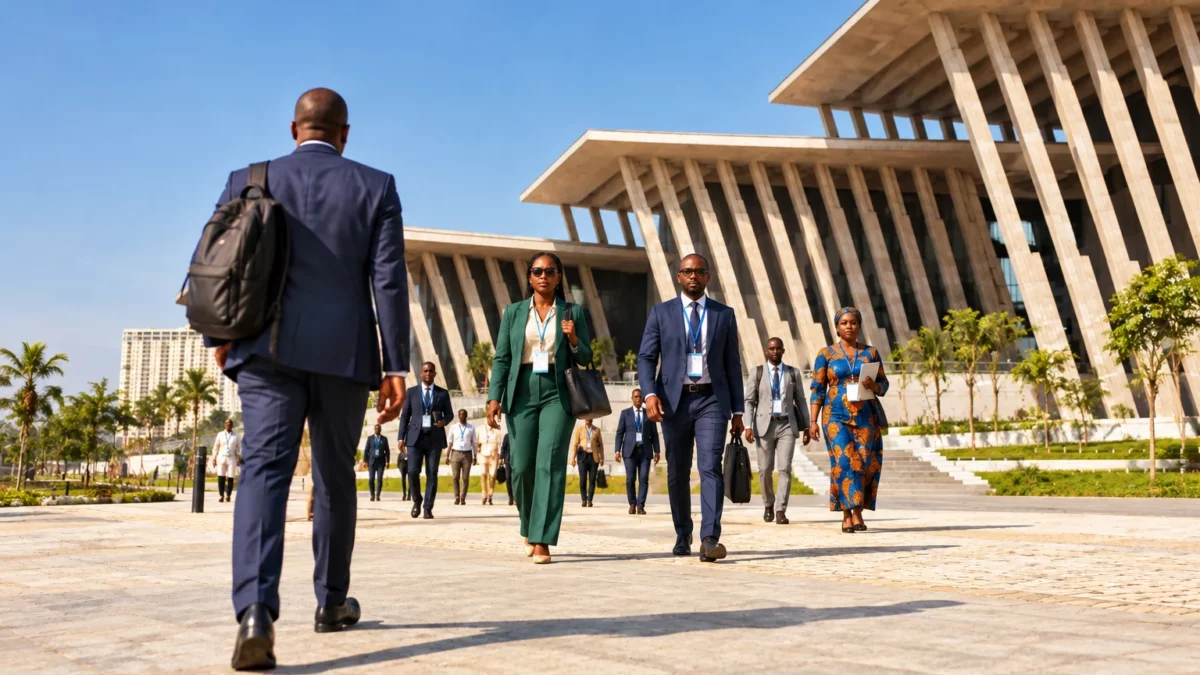
A mine can produce minerals, a deposit can yield oil or gas. But without roads, power lines, storage capacity and processing plants, much of the value escapes local economies. This gap between abundant resources and industrial returns was at the heart of discussions among officials gathered at SIREXE.
Infrastructure beyond borders
The International Exhibition of Extractive and Energy Resources (SIREXE) opened on 18 November 2026 at the Abidjan Exhibition Centre. The second edition, scheduled to run until 22 November, welcomed Botswana’s President, Duma Gideon Boko, whose country was the guest of honour. The ceremony was chaired by Ivorian Vice-President Tiémoko Meyliet Koné, on behalf of the head of state, Alassane Ouattara.
The issue extends beyond Côte d’Ivoire’s borders. In West Africa, resource development also depends on networks capable of transporting electricity, minerals and processed products between countries. The Economic Community of West African States (ECOWAS), in particular, has the West African Power Pool, which is tasked with supporting the integration of power grids and a regional electricity market.
This cooperation has already passed technical milestones. In November 2025, ECOWAS announced a synchronisation test linking West African electricity grids for four hours. The challenge now is to turn this possibility into regular exchanges, with funded interconnections, common rules and sufficient generating capacity. ECOWAS described the test as a step towards an integrated regional grid.
Funding the entire value chain, not just extraction
At the opening of the exhibition, Tiémoko Meyliet Koné called for African investment to be mobilised collectively. His argument covers the entire value chain: exploration and extraction, as well as transport, storage, refining, processing and energy distribution. Without this infrastructure, local companies often remain confined to the initial stages, while higher-value products are made elsewhere.
Botswana’s president advocated a similar ambition: making natural resources the foundation for industrialisation rather than simply a source of exports. He also praised relations between Botswana and Côte d’Ivoire. According to Ivorian authorities, this cooperation is based on an agreement concluded in July 2026 in the mining and energy sectors. The two leaders’ statements set out a political direction; on their own, they do not prove that the announced investments or projects are already funded.
The Abidjan gathering comes as Côte d’Ivoire seeks to diversify its economy and increase the contribution of the extractive and energy sectors. The Integrated Mineral Resources and Energy Policy, adopted by the Council of Ministers on 3 December 2025, sets out a long-term framework. The government estimates its total cost at 38,000bn CFA francs over 15 years. This figure represents a funding ambition, not money already raised or spent.
The 2026-2030 National Development Plan also lists strategic infrastructure and private investment among its priorities. SIREXE aims to connect these objectives with project sponsors and investors. Announced initiatives include SIREXE INVEST. The Ivorian government said 54 business meetings had been organised around Ivorian and Botswanan projects. These meetings are an initial indicator of activity, but their significance will depend on the agreements reached, the capital committed and whether the projects are actually carried out.
Local impact will be the measure
For states, the challenge is to capture more value, public revenue and skills. For domestic companies, a space dedicated to local content could open up markets in subcontracting, services and processing. But access to these contracts will also depend on whether small and medium-sized enterprises can meet the technical and financial requirements of major projects.
The effects will not be the same for everyone. Facilities are often concentrated in industrial corridors or near major urban centres, while rural areas may bear the land and environmental consequences without immediately benefiting from skilled jobs. The communities concerned, workers and local businesses therefore have an interest in being involved in decisions and monitoring mechanisms. The promise of environmentally responsible extraction will need to be translated into enforceable rules and public results.
For Côte d’Ivoire, whose political capital is Yamoussoukro, Abidjan is serving here as an economic showcase and meeting platform. It remains to be seen whether the announced partnerships will lead to infrastructure that is useful beyond extraction sites, and whether Ivorian companies will genuinely gain access to value chains.
A regional test for economic cooperation
SIREXE’s significance is not limited to closer ties between Abidjan and Gaborone. If countries pool some funding and co-ordinate their networks, projects can serve several markets rather than just one. Each state, however, will have to negotiate how costs, jobs, revenues and risks are shared. Regional cooperation therefore does not eliminate power imbalances; it makes them more visible and demands shared rules.
What happens next will depend on investment decisions, implementation of Côte d’Ivoire’s resources policy and progress on West African electricity interconnections. SIREXE has set out a continental ambition. Its credibility will be measured by the capital actually committed, the infrastructure built and the share of value that remains in African economies.